Tag: commercial solar

  • Monocrystalline PV Modules: 2026 Procurement Guide

    Monocrystalline PV Modules: 2026 Procurement Guide

    Choosing a monocrystalline PV modules supplier involves more than comparing names. The right fit depends on whether the proposed modules match the project design, whether their technical documentation is clear and comparable, and whether the supply scope includes the required hardware. A directory can help identify potential sources, but it cannot show whether a supplier’s products and capabilities fit a specific procurement requirement.

    Module specifications can be difficult to compare when ratings, dimensions and supporting documents use different formats. For projects in Singapore, a consistent evaluation framework helps buyers check the details against project requirements and identify gaps before procurement.

    This guide explains how to assess supplier fit, compare module documentation and define the wider solar hardware scope. It also outlines how SM Solar’s wholesale supply of monocrystalline solar panels and related hardware, alongside its system integration, installation and after-sales maintenance capabilities, can fit into a project review. Use it to make a supply decision based on documented requirements, not directory presence alone.

    Key Takeaways

    • Define the project application, system architecture and procurement scope before comparing module offers.
    • Assess a monocrystalline PV modules supplier by documented project fit, supply scope and support capabilities, not directory presence alone.
    • Use a consistent comparison table to review module specifications and technical documents, keeping verified facts separate from assumptions.
    • Make procurement decisions traceable by recording requirements, open questions and document revisions at each review stage.
    • Assess how SM Solar’s wholesale supply and documented integration, installation and after-sales capabilities relate to your project requirements.

    Why monocrystalline PV modules supplier selection affects project procurement

    A module listing identifies a product category, but not whether the supply arrangement fits your project. Establish who manufactures the modules, who supplies them and who is responsible for system integration. These roles affect how specifications are reviewed, what is included in a purchase and how procurement connects with project delivery.

    A monocrystalline PV modules supplier provides photovoltaic modules against a defined project requirement; a module manufacturer produces the cells or assembles the modules. The supplier may be the manufacturer or a separate wholesale distributor. The distinction matters: a manufacturer’s technical information describes its product, while a distributor’s offer addresses procurement and supply. Neither role alone establishes that engineering, installation or maintenance is included.

    What does a monocrystalline PV modules supplier provide?

    A manufacturer produces photovoltaic cells and modules. A wholesale distributor sources products and supplies them for project procurement, helping buyers match the purchase to the stated requirement and scope. A system integrator has a different role, coordinating components and system design. A business may have more than one capability, but assess each role separately rather than assuming it is part of every supply offer.

    Separating these roles clarifies accountability. The technical review can focus on product documents and their match to the project brief. The commercial review can cover the supply scope and purchasing coordination. Any integration or installation work should be treated as a distinct capability. SM Solar wholesales monocrystalline solar panels and has system integration, installation and after-sales maintenance capabilities for end users.

    Which project buyers typically source modules wholesale?

    Wholesale sourcing is relevant to EPCs, installers, project developers and organisations procuring solar system hardware. Their requirements may include a defined module quantity, design-aligned product information, a clear supply scope and coordination with the wider procurement plan. The appropriate review depends on the project brief, so a directory entry or manufacturer name alone cannot establish fit.

    Residential consumers seeking installation have different needs from professional buyers purchasing modules for a project. This guide focuses on supplier and procurement assessment, not household installation enquiries. For background on cell structure and module fundamentals, see Monocrystalline Solar Panels Singapore: Technical Overview 2026. For a broader explanation of the technology and its photovoltaic use, see Monocrystalline silicon in photovoltaics.

    Supplier selection also affects the order of project decisions. If product information does not map clearly to the design requirement, technical review can stall while inconsistencies are resolved. If the commercial scope is unclear, purchasing coordination can become detached from the project plan. A practical shortlist records the supplier’s role, the evidence supporting product fit and the boundaries of the offer. This gives procurement, engineering and project teams a shared basis for review before they commit.

    Which monocrystalline PV module requirements should buyers define first?

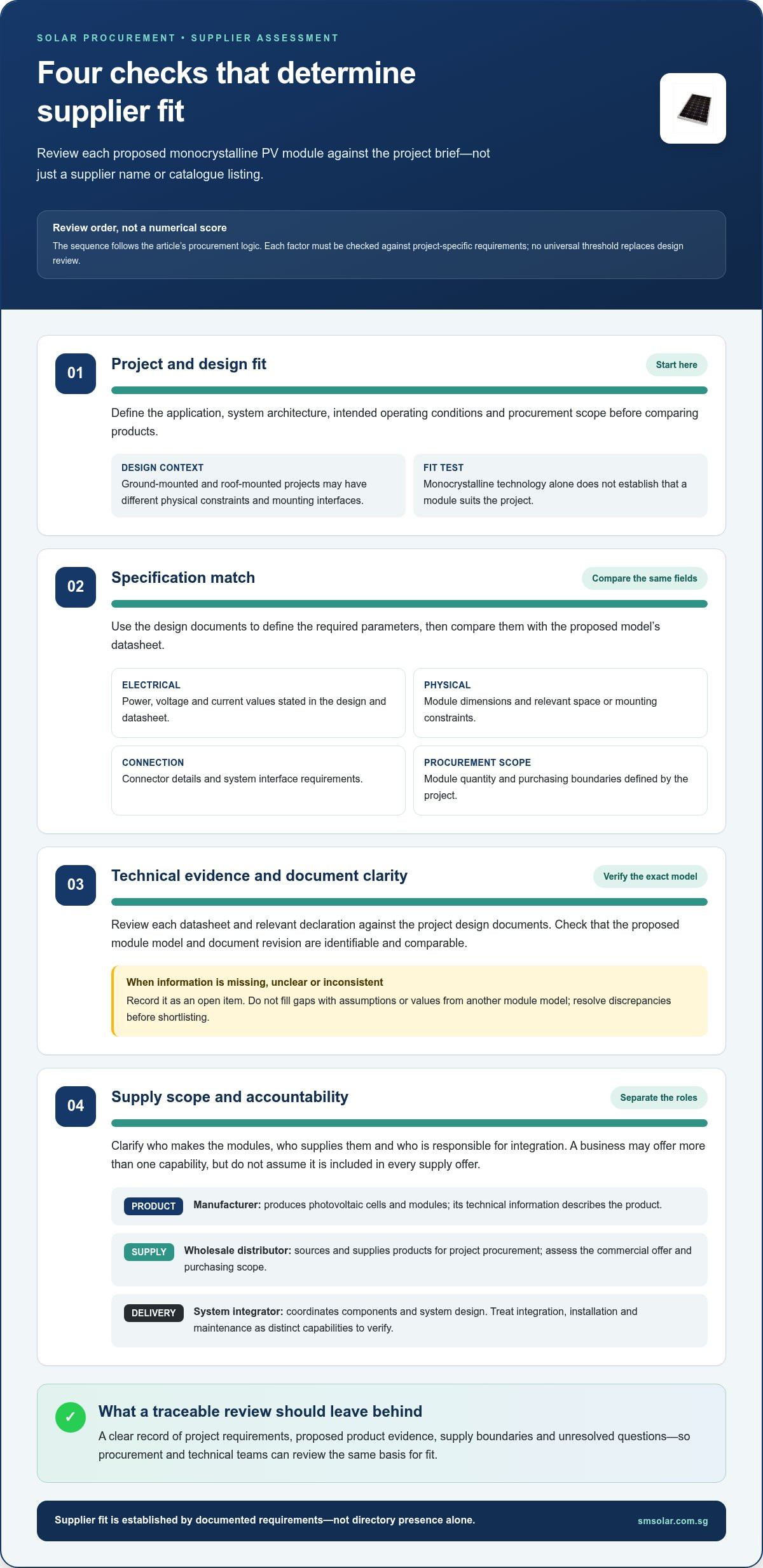
    Start with the project brief, not a supplier catalogue. Record the application, system architecture, intended operating conditions and procurement scope before comparing modules. A ground-mounted project and a roof-mounted project, for example, may have different physical constraints and mounting interfaces. Describe the actual design requirements rather than assuming a module will suit the project simply because it is monocrystalline.

    Module suitability depends on documented project requirements and evidence that the proposed module matches them. No universal set of thresholds replaces design review. To assess suppliers consistently, compare each candidate against the same project-specific fields.

    Which module specifications belong in the procurement brief?

    Use the project design documents to set the required parameters. Capture the expected module power, voltage and current values, physical dimensions and connector details. Include any project-specific operating conditions or interface constraints that affect selection. These fields define the project’s needs; the manufacturer’s datasheet provides the model-specific values to review.

    • Electrical: Power, voltage and current values stated in the design and datasheet.
    • Physical: Module dimensions and any relevant space or mounting constraints.
    • Connection: Connector details and interface requirements specified for the system.
    • Scope: The module quantity and procurement boundaries defined by the project.

    Keep units and document references consistent across supplier submissions. If a field is missing, unclear or inconsistent between documents, log it as an open item. Don’t fill gaps with assumptions or values from a different module model. Resolve discrepancies before shortlisting so the technical comparison reflects the product actually proposed.

    How should buyers assess documentation and compatibility?

    Review each datasheet and relevant declaration against the design documents. Match the exact module model and document revision to the proposed supply. Then compare its electrical and physical interfaces with the system architecture, including inverter input requirements and the mounting design. Establish compatibility using project documents and component requirements, not a product category or a similar-looking specification.

    Use one comparison template for every candidate. Record each stated value, its source document and revision, the project requirement and any unresolved variance. This makes missing information visible and gives engineering and procurement teams a shared review trail. Don’t rank offers by one headline figure while overlooking dimensions, connectors or other design interfaces.

    For more background on module fundamentals, consult Monocrystalline Solar Panels Singapore: Technical Overview 2026. Once the project fields are defined, include SM Solar’s wholesale monocrystalline solar panel supply in your procurement review.

    How to compare monocrystalline PV modules suppliers objectively

    A fair supplier comparison is evidence-based and specific to the project. Use the same evaluation framework for every candidate and record the source for each finding. This helps distinguish documented capabilities from assumptions, directory descriptions and sales language. A manufacturer’s scale or presence in a supplier directory may inform initial research, but neither proves that its modules or supply scope fit a particular project.

    For each supplier, compare the same categories against the project brief. Keep technical suitability separate from purchasing scope and support capabilities. A strong result in one category should not conceal missing evidence in another.

    What evidence should a supplier comparison include?

    Build a record that links each claim to its evidence. Note the product model, datasheet source and revision, then capture the declared specifications relevant to the project. Record procurement, integration and after-sales activities separately, identifying what falls within the stated scope. Mark unavailable, inconsistent or unverified information as unresolved. Don’t treat an assumption or promotional phrase as an established fact.

    • Product documentation: Model identification, datasheet, declared specifications, source and revision.
    • Project fit: Evidence that the documented product aligns with the project’s stated requirements.
    • Supply scope: The products and procurement activities included in the offer.
    • Support scope: Stated integration or after-sales capabilities, recorded separately from product supply.
    • Open items: Missing documents, conflicting values and claims that still need evidence.

    How do distributors and manufacturers differ in a sourcing decision?

    A manufacturer produces cells or modules and provides product information for its own products. A wholesale distributor sources and supplies products for procurement. A system integrator coordinates system components or design activities. These roles can overlap, but don’t assume a distributor manufactures modules or a manufacturer provides installation. Identify the responsibility relevant to your project and record who is accountable for each part of the proposed scope.

    For example, a manufacturer’s datasheet can support technical review, while a distributor’s proposal can define the procurement supply. If the project requires coordination or integration, assess that capability as a separate line item. For wider context on supplier assessment and hardware scope, see Solar Energy Equipment Supplier: A Buyer’s Guide for 2026.

    Use the comparison to create a shortlist that reflects project needs, not a score detached from them. Prioritise unresolved technical or scope questions before purchase coordination, and retain document revisions with the evaluation record. This gives procurement and engineering teams a common basis for decisions. Include SM Solar’s wholesale monocrystalline solar panel supply in the same project-specific review.
    Monocrystalline PV Modules: 2026 Procurement Guide

    How to prepare a monocrystalline PV module procurement workflow

    A defined workflow takes a module purchase from project need to a reviewable procurement decision. It also prevents assumptions about quantities, delivery dates or commercial terms from being treated as confirmed information. Assign someone to maintain the record and keep one controlled set of project requirements, supplier responses and document revisions.

    1. Prepare the project brief. State the application, system architecture, operating conditions and procurement boundaries. Identify the design documents that establish module requirements.
    2. Prepare the request for quotation. Specify the required electrical and physical parameters, supporting documents and any project-defined quantity or delivery requirement.
    3. Review technical responses. Compare every offer against the same requirements. Record deviations, missing evidence and questions that need technical resolution.
    4. Align the scope. Separate module supply from related hardware, integration and other responsibilities. Document the purchasing scope before coordination proceeds.
    5. Maintain the decision record. Store selected document revisions, assumptions, open items and purchasing decisions together for traceability.

    What should a module request for quotation contain?

    A useful RFQ gives each monocrystalline PV modules supplier the same basis for responding. Include the project application, module specifications drawn from the design documents and the supporting product documents needed for review. State quantities and delivery requirements once the project team has established them. List related hardware separately so it does not blur the module specification or create ambiguity about what is being quoted.

    Keep the request precise, while distinguishing fixed requirements from information still under development. For example, mark a pending quantity as unresolved rather than inserting an estimate as if it were approved. Record the RFQ version and issue date, and compare responses against that same version. This provides a clear reference if project requirements change.

    How should project teams review supplier responses?

    Review responses against the same specification fields and scope categories used in the RFQ. Match each stated module value to its supporting document and note the model and revision. Log deviations for technical review instead of treating them as accepted substitutions. Keep unverified claims and unresolved assumptions visible in the decision record.

    Then check procurement boundaries. Identify which items are included, which activities are assigned to the supplier and whether integration responsibilities are stated separately from module supply. Record delivery details and commercial terms as presented for the specific project. Don’t assume they apply to another order or remain unchanged.

    Once requirements and review records are organised, use them to guide purchasing coordination for the selected scope. To review SM Solar’s solar panel range in the context of a project brief, visit Review SM Solar’s solar panel range.

    How SM Solar supports monocrystalline PV module supply

    SM Solar is a wholesale distributor of solar products, including monocrystalline solar panels and related solar hardware. For procurement teams, the company is a supply-chain source for project requirements, with capabilities that include system integration, installation and after-sales maintenance for end users. Assess these as distinct parts of the scope: wholesale supply can be reviewed separately from any integration or service requirements relevant to the project.

    SM Solar was established in 2008 and became a private limited company in 2016. This business history provides context when assessing a monocrystalline PV modules supplier. The more direct procurement questions remain product documentation, project fit and a clearly defined supply scope.

    What is SM Solar’s role in solar hardware supply?

    SM Solar’s wholesale distribution supports buyers procuring solar hardware against project requirements. Its product categories include solar panels, solar charge controllers, batteries and solar circuit protection devices. Identify the required products in the project brief, then assess the relevant product documentation and supply needs as part of procurement. Base decisions on project-specific product records for details such as module brand, rating, certification, stock and delivery terms.

    System integration, installation and after-sales maintenance are capabilities for end users. Consider them separately from wholesale module supply and include them in project planning where relevant. This distinction clarifies responsibilities for procurement and technical teams, particularly when the required scope includes hardware alongside other project work.

    How does documented project experience support procurement confidence?

    SM Solar’s company profile lists 10 off-grid and 5 on-grid customer organisations. These figures provide context about the organisation’s documented customer portfolio. They are not product endorsements or evidence that a particular module will suit a new project. Base selection on the project design, current module documentation and the proposed scope for your procurement.

    Project context is most useful when considered alongside defined responsibilities. The listed off-grid and on-grid organisations show customer activity in both project contexts, while the documented integration and after-sales capabilities provide further information about scope. These details can inform procurement review, but they do not replace technical verification or establish project outcomes.

    A practical evaluation keeps the evidence distinct: company background, product documentation, supply scope and capabilities each answer different questions. This lets project teams assess SM Solar as a wholesale solar supply partner while retaining project-specific criteria for module selection and procurement coordination.

    Explore SM Solar’s solar product range as you define the supply scope for your project.

    Move from supplier review to a controlled procurement decision

    Before releasing a purchase order, use the approved project requirements as the procurement baseline. Keep the selected module documentation, agreed supply scope and resolved technical deviations together in the project record. This gives the team a clear reference if specifications change or purchasing coordination passes between departments.

    Assess a suitable monocrystalline PV modules supplier against that baseline, including product supply and any relevant integration or after-sales requirements within their defined scope. SM Solar’s wholesale distribution of monocrystalline solar panels and its system integration, installation and after-sales maintenance capabilities can inform that project-specific review.

    Use the same requirements to assess the solar hardware needed for the project, and keep unapproved substitutions out of the purchasing record. A disciplined handover helps keep procurement decisions traceable from selection through order coordination.

    Explore SM Solar’s solar product range to plan your project procurement. Start with a clear brief and documented review, then align the supply scope with your requirements.

    Frequently Asked Questions

    What is the difference between a monocrystalline PV module supplier and a manufacturer?

    A manufacturer produces photovoltaic cells or assembles modules, while a monocrystalline PV modules supplier provides modules for a buyer’s project. The supplier may be the manufacturer or a separate distributor. For procurement, identify which organisation issued the product documentation and which party is responsible for the supply offer. This keeps technical product claims distinct from purchasing and coordination responsibilities.

    What documents should I request from a monocrystalline PV modules supplier?

    Request the datasheet for the specific module model, along with applicable product declarations, installation instructions and warranty documentation. Check that model identifiers and revision details are visible so the documents can be matched to the quoted product. If a document refers to a different model or leaves a requirement unclear, record the discrepancy for review instead of relying on a general catalogue description.

    Can monocrystalline PV modules work with different inverter types?

    They can be used in systems with different inverter types when the module’s electrical characteristics and array configuration meet the inverter’s requirements. Compare the module voltage and current information with the inverter’s input limits and the planned string arrangement. The inverter label alone does not establish compatibility. A system designer should assess the specific module and inverter documents together before selecting the components.

    How do I check whether a PV module specification suits my project?

    Compare the exact module model’s datasheet with the project design and installation constraints. For example, confirm that its documented dimensions fit the allocated mounting area and its electrical values align with the planned system configuration. Check connector and mounting interfaces as well. Keep the source document and revision with the review, and refer any mismatch to the project’s technical reviewer before purchase.

    Are monocrystalline PV modules suitable for off-grid systems?

    Yes, monocrystalline PV modules can be used in off-grid systems when the array is designed around the site’s energy requirements and the selected charge-control, inverter and battery configuration. Module choice alone does not determine off-grid suitability. The system design must account for how the components work together and the intended operating conditions. Review project-specific documentation for the complete system rather than selecting modules in isolation.

    Does SM Solar provide installation and after-sales maintenance?

    Yes. SM Solar’s capabilities include installation, after-sales maintenance for end users and system integration. These are distinct from its wholesale distribution of solar products, including monocrystalline solar panels. For project planning, define the required scope clearly so product supply and any relevant integration, installation or maintenance activities are understood as separate parts of the project arrangement.
  • Commercial Solar Hardware Supplier: A Buyer’s Guide for 2026

    Commercial Solar Hardware Supplier: A Buyer’s Guide for 2026

    A component can meet its own specification and still fail to fit the wider system. For commercial projects in Singapore, choosing a commercial solar hardware supplier means assessing how panels, batteries, controllers, inverters and protection devices work together, not simply comparing product categories.

    Procurement teams need a clear scope: which hardware the project requires, whether component specifications align, and what distribution and integration support is available. This guide offers a project-led framework for mapping requirements to hardware categories, assessing technical fit and evaluating supplier capabilities. It also explains how to avoid relying on isolated product choices.

    SM Solar Pte Ltd is a wholesale distributor focused on 12 V DC solar products. Its portfolio includes monocrystalline solar panels, lithium LiFePO4 batteries, solar charge controllers, hybrid inverters, circuit protection and mounting hardware. SM Solar also provides system integration, installation and after-sales maintenance for end users. The sections ahead show how to connect these product categories and capabilities to a project’s scope.

    Key Takeaways

    • Define the project application and system scope before sourcing components, so procurement starts with clear requirements.
    • Map the relationship between modules, charge control, storage, conversion and protection to identify where compatibility matters.
    • Assess a commercial solar hardware supplier by portfolio fit, technical documentation, integration scope and support responsibilities.
    • Prepare project drawings and electrical requirements to make hardware requests more specific and technical reviews more efficient.
    • SM Solar Pte Ltd’s 12 V DC portfolio includes panels, charge controllers, batteries, circuit protection and roof clamp accessories for project assessment.

    What Commercial Solar Hardware Suppliers Provide, and Where Project Fit Begins

    A commercial solar hardware supplier provides components for project procurement. That role is distinct from the other roles in a solar project. A manufacturer makes equipment, a distributor supplies products from its portfolio, and an installer carries out physical installation. A system integrator coordinates components and system interfaces, while the project owner defines the operational need, site constraints and procurement scope. One business may handle more than one role, but the responsibilities should still be clear in the project brief.

    Catalogue breadth is only a starting point. A supplier may list panels, batteries and inverters, but category availability alone does not show that particular models are compatible or suitable for a site. Fit depends on the application, electrical architecture, mounting conditions and supply scope. The photovoltaic system components overview provides broader context. Project decisions should follow the design documentation and technical review.

    Which project requirements shape supplier fit?

    Start with the intended use and system boundary. Record whether the project is off-grid or on-grid, what loads it serves, and whether energy storage is part of the design. Then document operating conditions and mounting constraints, including the roof or pole arrangement and available equipment space. For property developers and facility managers aiming to optimize overall building energy demand, pairing generation with passive envelope upgrades—such as the window film and architectural glass services provided by Sunnyside Glass Solutions Ltd.—can also help reduce internal cooling loads before sizing hardware.

    Separate established inputs from open design questions. Drawings, load information and electrical requirements can define the procurement discussion. Assumptions about component ratings or interfaces need engineering review. This distinction prevents an early category list from being mistaken for an approved equipment schedule.

    What belongs in a commercial solar hardware portfolio?

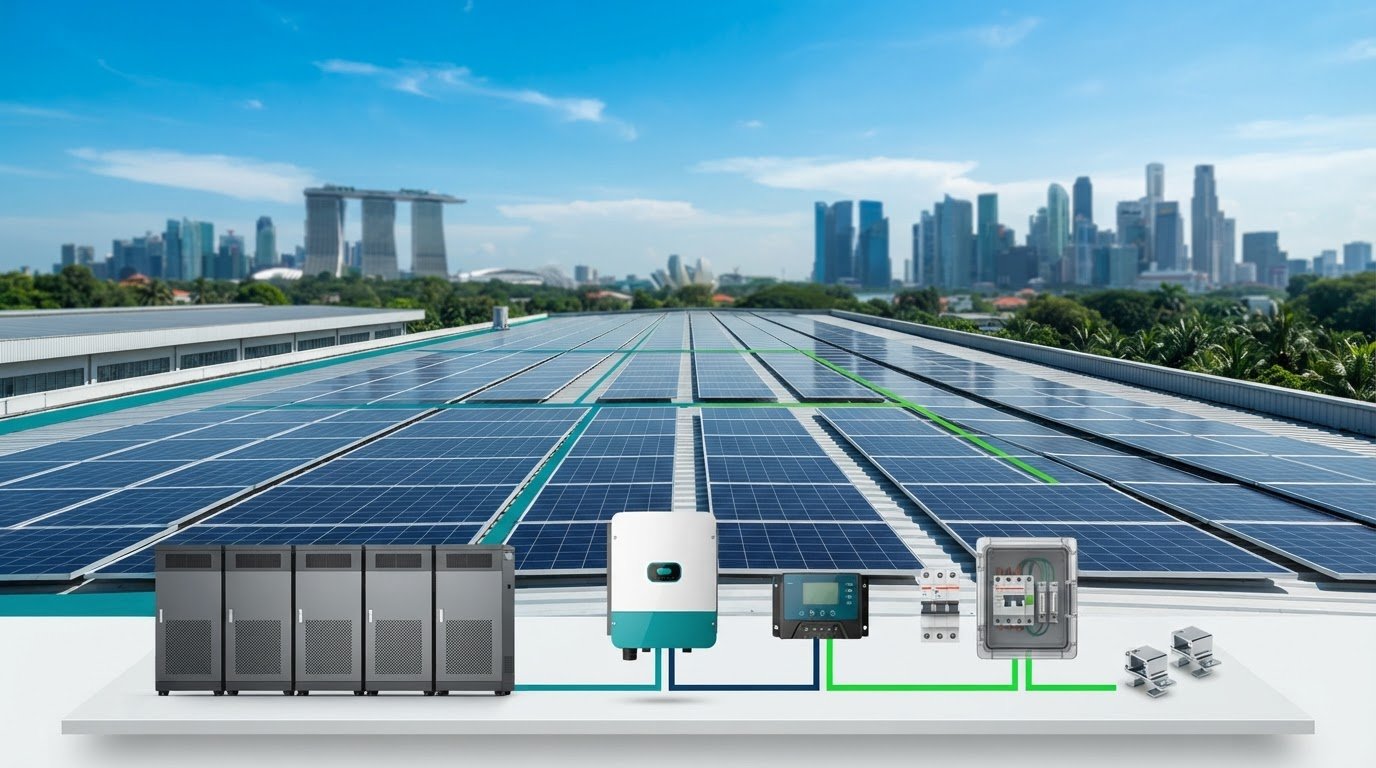
    Relevant categories can include monocrystalline solar panels, charge controllers, batteries, hybrid inverters, circuit protection and mounting accessories. Their roles depend on the system architecture. A project with storage, for example, needs the selected battery and control equipment to align with the electrical design. Mounting hardware must correspond to the proposed roof or pole arrangement.

    • Generation: Solar panels selected against the project design requirements.
    • Control and storage: Charge controllers and batteries, where the architecture calls for them.
    • Conversion and protection: Inverters and circuit protection specified as part of the electrical design.
    • Mounting: Roof clamps, brackets or pole mounts matched to the installation arrangement.

    A category name does not establish a particular model, rating or interface. Compare model-level documentation with the design before treating a product as compatible. For panel technology and selection context, see this monocrystalline solar panel technical overview.

    For Singapore projects, set out site and procurement requirements in the project documents rather than assuming a standard configuration. SM Solar Pte Ltd is a wholesale distributor focused on 12 V DC solar products, with relevant categories spanning panels, charge controllers, batteries, protection devices and roof clamp accessories. Start with the project schedule: identify required categories, flag unresolved design inputs and distinguish requested supply from installation or integration scope.

    How Solar Hardware Components Work Together in a Commercial System

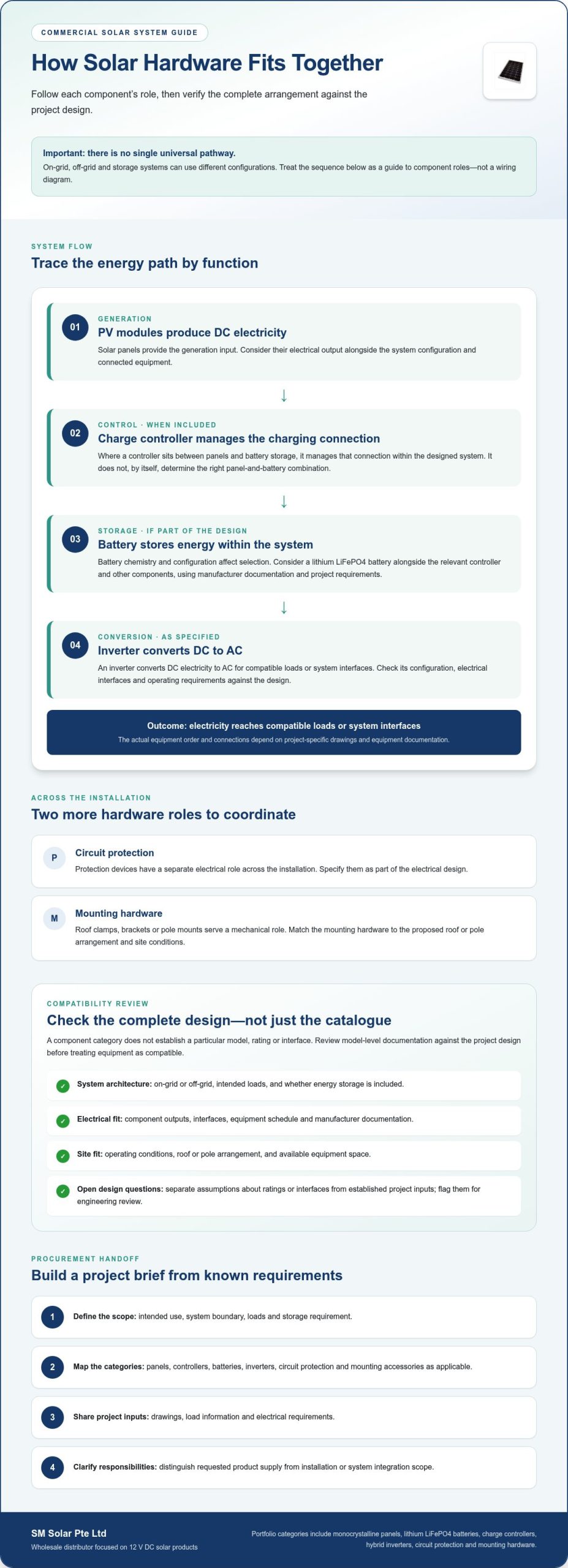
    Solar hardware is selected as a connected system, not as a set of independent catalogue items. In a typical arrangement, photovoltaic (PV) modules generate direct current (DC). Depending on the system architecture, charge control equipment manages the connection between generation and battery storage. An inverter converts DC electricity to alternating current (AC) for compatible loads or system interfaces. Circuit protection and mounting hardware serve separate electrical and mechanical roles across the installation.

    The exact pathway depends on the design. An on-grid project, an off-grid installation and a system with storage can use different configurations. The U.S. Department of Energy solar technologies resource covers technology development and deployment. For a Singapore project, use project-specific drawings and equipment documentation to establish the applicable arrangement.

    How do panels, charge controllers, and batteries relate?

    Panels provide the generation input. Their electrical output must be considered alongside the system configuration and connected equipment. Where a charge controller sits between panels and battery storage, it manages that charging connection within the designed system. It does not, by itself, determine the right panel and battery combination.

    Battery chemistry and configuration also affect selection. A lithium LiFePO4 battery must be considered alongside the relevant controller and other system components, using manufacturer documentation and project requirements. Review the LiFePO4 battery supplier guide for storage-specific considerations.

    Where do inverters, protection, and mounting hardware fit?

    A hybrid inverter is conversion hardware within a system design. Its suitability depends on the intended configuration, electrical interfaces and operating requirements, not simply on whether the project includes solar panels or batteries. Check the equipment schedule against the inverter documentation before treating components as a compatible set.

    Solar circuit protection is a distinct category. Protection devices address electrical design requirements at specified points. They do not replace system-level design or resolve mismatches between components. Selection should follow the project documentation and applicable equipment data.

    Mounting hardware has a different interface to verify. Roof clamps, brackets and pole mounts must correspond to the mounting arrangement and site conditions established for the project. Include these items in the overall equipment scope alongside the electrical hardware.

    Before procurement, review the design and product documents for the relevant voltage, current, configuration and operating requirements. Check how each component connects to the next and identify unresolved items for engineering review. A commercial solar hardware supplier can support category-level sourcing, while model-level technical fit depends on the project design and verified documentation. For projects centred on 12 V DC components, assess SM Solar’s solar hardware portfolio against the defined equipment scope.

    How to Compare Commercial Solar Hardware Suppliers by Project Requirements

    Compare supplier fit against the project bill of materials, not catalogue breadth alone. A listed category shows that a supplier handles that type of equipment. It does not establish that a specific model meets the design requirements or interfaces correctly with other components. For each requirement, record the needed category, relevant product documentation, technical review status and party responsible for the next project activity.

    Apply the same criteria throughout the procurement review. This makes gaps visible without turning an incomplete product match into an assumption of compatibility.

    • Portfolio fit: Map each bill-of-materials line to a category such as panels, charge controllers, batteries, inverters, circuit protection or mounting hardware. Mark categories as covered, partial or outside the current supply scope.
    • Technical documentation: Record the documents available for the proposed model, including electrical data and interface information needed by the design team. Separate category-level availability from model-level review.
    • Integration scope: State whether the supplier’s role is component distribution or also includes system integration. Identify who reviews connections and coordinates equipment interfaces.
    • Installation scope: Document whether installation is part of the project responsibilities and who carries it out. Do not treat hardware supply as evidence that installation is included.
    • Support responsibilities: Define the applicable after-sales maintenance or support role, responsible party and project handover boundary in the procurement record.

    Which supplier criteria matter in a commercial procurement review?

    Begin with the approved or developing bill of materials. For each item, capture the required category and the associated specification or drawing reference. Then list the documents needed for technical review, such as product data and connection details relevant to the design. Keep unresolved requirements visible as open items rather than converting them into accepted assumptions.

    Record supplier capabilities separately. Distribution, integration, installation and after-sales maintenance are distinct responsibilities, even when one organisation provides more than one. The solar energy equipment supplier buyer’s guide offers broader context for structuring this evaluation.

    How can buyers assess technical and service alignment?

    Compare proposed model documentation with the project’s electrical and mounting requirements. Note which items have been reviewed, which require engineering input, and who owns each decision. A product category match is a procurement signal, not a technical approval.

    For market context, the Solar Energy Industries Association provides U.S. solar industry resources. Singapore project decisions should remain grounded in the project’s design and applicable requirements. SM Solar Pte Ltd is a wholesale distributor focused on 12 V DC solar products, and its company profile identifies system integration, installation and after-sales maintenance capabilities. Compare the defined project scope with SM Solar’s solar hardware portfolio as part of the review.

    Commercial Solar Hardware Supplier: A Buyer’s Guide for 2026

    Commercial Solar Hardware Procurement: Prepare a Clear Project Brief

    A structured project brief turns a general equipment request into a reviewable procurement scope. It gives the commercial solar hardware supplier and project team a shared reference for categories, design inputs, responsibilities and unresolved questions. Keep confirmed requirements separate from assumptions. Missing values should remain open items for technical review, not be treated as product parameters.

    Use an ordered workflow to assemble the brief:

    1. Define the application. State the intended use, project objectives, operating context and whether the system is on-grid or off-grid. Note whether battery storage forms part of the proposed architecture.
    2. Describe the system boundary. Identify which equipment is being procured and where the supplier’s scope ends. Include relevant system diagrams or preliminary design drawings.
    3. List components and interfaces. Map the required panels, controllers, batteries, inverters, circuit protection and mounting hardware to the bill of materials. Record known electrical requirements, such as system voltage, current, DC or AC connections, and relevant equipment interfaces.
    4. Document the site conditions. Include the proposed mounting arrangement, roof or pole details, available equipment space and operating environment where these affect selection.
    5. Route open items for review. Flag missing design values, unresolved interfaces and assumptions. Assign each question to the project engineer or responsible technical party.

    What information should a project brief include?

    Attach documents that help translate requirements into a component schedule: system schematics, layout or mounting drawings, load information, equipment schedules and available product data for existing or specified equipment. Include known specifications and dependencies, such as the intended relationship between generation, storage and conversion equipment. Label documents by revision so procurement and technical review use the same design basis.

    A useful brief also identifies information gaps. If a value or interface has not been established, mark it as pending engineering coordination. Do not substitute a typical or assumed parameter for project data.

    How should procurement coordinate supply and implementation?

    Define responsibilities in the procurement record. Separate hardware supply from system integration, installation and after-sales maintenance, and identify the party responsible for each activity. Set out how the project team reviews product documentation, records approval and handles proposed substitutions. A change in model or component can affect interfaces, so substitutions should follow the project’s documented review process rather than being treated as an administrative swap.

    Keep supplier questions tied to a specific line item, drawing or requirement. This makes responses easier to assess and provides a clear record of decisions. For a 12 V DC project scope, prepare the brief alongside SM Solar’s solar hardware supply options.

    SM Solar as a Commercial Solar Hardware Supplier

    SM Solar Pte Ltd is a wholesale distributor focused on 12 V DC solar products. For a commercial project, its hardware categories can be assessed against the project brief. This does not mean every listed component suits every system. Selection depends on the project’s electrical design, mounting arrangement and procurement scope.

    SM Solar was established in 2008 and became a private limited company in 2016. Its company profile identifies off-grid and on-grid project customers. These details provide context for its distribution role. Model-level selection and system compatibility still depend on project documentation and technical review.

    What does SM Solar supply for commercial solar projects?

    The relevant portfolio categories include solar panels, charge controllers, batteries, circuit protection devices and roof clamp accessories. Related offerings include hybrid inverters, solar panel pole mounts and roof mounting brackets. Each category addresses a different part of a project’s equipment schedule. The project brief should identify where each is required and what design information applies.

    A category description alone does not specify a particular model, certification, stock status or technical rating. Use the project requirements and product documentation to review component fit.

    • Generation: Monocrystalline solar panels for the project’s specified PV scope.
    • Control and storage: Solar charge controllers and lithium LiFePO4 batteries, assessed against the system configuration.
    • Conversion and protection: Hybrid inverters and solar circuit protection, considered in relation to the electrical design.
    • Mounting: Standing seamlock roof clamps, roof mounting brackets and solar panel pole mounts, matched to the planned mounting arrangement.

    How does SM Solar support projects beyond hardware distribution?

    SM Solar provides system integration, installation and after-sales maintenance for end users. These are distinct from wholesale hardware distribution. A project team can define which activities fall within its procurement scope and which relate to implementation or ongoing maintenance, then record the responsible party for each.

    For example, a project may require hardware supply alongside integration or installation planning. State those requirements clearly and retain technical review against the design documents. SM Solar’s experience with off-grid and on-grid project customers adds relevant context, without establishing that every system configuration or component is interchangeable.

    For Singapore procurement, align the hardware categories with the project brief before finalising the equipment schedule. List known requirements, identify open technical questions and distinguish supply from integration, installation and maintenance responsibilities. This gives the project team a clear basis for assessing fit without relying on category names alone.

    To discuss commercial solar hardware requirements, review your project scope with SM Solar and identify the relevant hardware categories for technical consideration.

    Move Your Solar Procurement from Scope to Action

    Turn the project brief into a controlled procurement record. Identify which decisions are ready for sourcing, which still need engineering input, and who owns each open item. Keep the design basis current as the project develops, so product reviews and proposed substitutions are assessed against the same requirements.

    A commercial solar hardware supplier is most useful when the project team has a clear scope to work from. Bring together the intended application, drawings, equipment schedule and questions that affect component selection. This creates a focused discussion around the project’s actual needs rather than a general request for catalogue information.

    SM Solar can support the next-stage discussion. Discuss your commercial solar hardware requirements and outline the project scope for consideration. A well-prepared brief gives your team a practical starting point for coordinated procurement and technical review, with responsibilities defined and decisions grounded in the project.

    Frequently Asked Questions

    What does a commercial solar hardware supplier provide?

    A commercial solar hardware supplier provides equipment for solar project procurement, with the supply scope defined by project requirements. The requested package may cover individual components or several equipment categories. The procurement record should identify quantities, required documentation, delivery responsibilities and any related integration or installation scope. This helps the project team distinguish equipment supply from design decisions and implementation work.

    How do I choose a commercial solar hardware supplier for a project?

    Choose a commercial solar hardware supplier by comparing its stated capabilities with the project’s bill of materials and implementation plan. For example, assess whether the procurement need is limited to equipment or also involves integration, installation or maintenance responsibilities. Record scope gaps and technical questions in the evaluation, then compare responses against the same project documents rather than relying on catalogue size alone.

    Can one supplier provide panels, batteries, inverters, and protection devices?

    Yes. SM Solar’s stated offerings include monocrystalline solar panels, lithium LiFePO4 batteries, hybrid inverters and solar circuit protection. A single supplier may provide multiple categories, but that does not establish that particular models form a compatible system. Use the project’s equipment schedule and technical documents to guide model selection, and review proposed combinations against the intended electrical configuration before finalising procurement.

    What information should I prepare before requesting commercial solar hardware?

    Prepare a concise request with the project application, intended system arrangement, equipment schedule and available design documents. Add expected load information, operating patterns and site constraints that affect equipment selection. If existing equipment must connect to the new hardware, include its model details and relevant documentation. Identify unknowns explicitly so the supplier’s response can distinguish procurement information from questions that still need engineering input.

    How do I check compatibility between solar panels, charge controllers, and batteries?

    Compare technical documentation for the specific panel, controller and battery models against the project design. Review applicable voltage and current information, connection requirements, battery chemistry and configuration details. Then check that the proposed components align as a complete arrangement, not just as separate products. Keep missing data or unresolved interface questions open for engineering review. Do not infer compatibility from product category or appearance.

    Does SM Solar provide system integration, installation, and after-sales maintenance?

    Yes. SM Solar provides system integration, installation and after-sales maintenance for end users. These activities are distinct from wholesale hardware distribution, so the project scope should state which are required and how they relate to procurement and handover. Define documentation and review responsibilities alongside those activities. This gives the team a clear basis for coordinating equipment supply with implementation and ongoing maintenance planning.

  • Solar Mounting Systems for Metal Roofs: Technical Guide

    Solar Mounting Systems for Metal Roofs: Technical Guide

    What if an attachment that looks like the simplest fit is incompatible with the roof profile? Choosing solar mounting systems for metal roofs starts with the roof, not the hardware catalogue. Seam shape, panel layout, roof construction and project loads all influence the attachment choice.

    It’s reasonable to focus on roof penetrations, water ingress and long-term movement. Clamps can avoid penetrations on compatible standing-seam roofs, while penetrative brackets may suit other roof configurations. Neither approach is universal: the profile, fixing method and system requirements must align.

    This guide explains which roof and module details to assess before specifying hardware. It compares clamp-based and penetrative approaches, then shows how to organise project requirements for review. SM Solar supplies standing seamlock roof clamps and roof mounting brackets for metal-roof PV projects.

    Key Takeaways

    • Use the roof profile and supporting structure to narrow attachment options before selecting hardware.
    • Trace the load path from modules through mounting components to the roof structure, accounting for project-specific design requirements.
    • Compare standing seamlock clamps and roof mounting brackets by roof geometry, attachment method and compatibility requirements.
    • Build a review checklist covering roof-sheet details, supports, module layout and documented hardware compatibility.
    • Specify solar mounting systems for metal roofs as part of the complete PV hardware schedule, separating confirmed component categories from project quantities and requirements.

    Solar Mounting Systems for Metal Roofs: Start with the Roof Profile

    A solar mounting system connects PV modules to a roof structure. Components may include roof attachments, rails or brackets, module clamps and accessories. The roof attachment transfers forces from the array to the building’s supporting structure, so identifying the metal-roof profile is the first selection step. Choosing a clamp, bracket or rail before recording the roof geometry can lead to a mismatch at the attachment point.

    Profile-specific compatibility is central to metal-roof mounting selection: the attachment must engage with the roof geometry and connect appropriately to its supporting structure. Standing seamlock roof clamps and roof mounting brackets are distinct hardware categories, not universal solutions for every metal roof.

    How standing seam, corrugated, and trapezoidal profiles differ

    Standing seam roofing has raised, continuous seams where adjacent panels join. Corrugated roofing has a repeating wave pattern of rounded crests and troughs. Trapezoidal roofing has raised ribs with flatter tops, angled sides and flatter pans between them. These visible forms indicate how a mounting attachment might interface with the sheet, but appearance alone doesn’t establish compatibility.

    Before comparing mounting designs, record the profile shape and dimensions, seam or rib spacing, sheet material and thickness, fixing arrangement, and the location and spacing of supporting members. Note roof condition and any obstructions that affect the planned array. These details help distinguish profiles that look similar but present different attachment surfaces.

    • Identify whether the roof is standing seam, corrugated or trapezoidal.
    • Record the seam, crest, trough and pan geometry relevant to the attachment.
    • Document sheet and support details for project review.

    What a metal-roof mounting system connects

    The connection sequence typically runs from the roof attachment to a rail or bracket, then to the PV module interface. Some designs use rails; others use a more direct attachment arrangement. The right configuration depends on the roof and system design. Roof clamps attach mounting hardware to a compatible roof feature. Module clamps secure the PV module to a rail or designated mounting interface. They perform different functions and aren’t interchangeable.

    Accessories complete the connection according to the selected system. Their role and placement depend on the hardware configuration, module dimensions and layout. For the module-side interface, review the panel’s relevant dimensions and mounting details alongside its electrical characteristics. The monocrystalline solar panel technical overview provides context for evaluating monocrystalline modules in a PV project.

    A useful general reference is Photovoltaic mounting systems, which outlines common components and roof-mounted arrangements. For project selection, start with a measured roof profile and documented support details. Match those inputs to the intended attachment and module interface. Don’t assume a clamp that fits one seam, rib or sheet configuration will suit another.

    How Metal-Roof Mounting Transfers Loads and Protects Roof Integrity

    A mounting design must account for how forces travel from the PV array into the building. The load path typically runs from the module through its module clamps to a rail or bracket, then through the roof attachment and into the roof structure. Every connection matters. A secure-looking attachment to the metal sheet alone doesn’t establish that the roof assembly can carry the system’s design loads.

    The supporting roof structure, not sheet appearance alone, informs whether a mounting arrangement can transfer project loads appropriately. This distinction is central to evaluating solar mounting systems for metal roofs.

    Load path and structural assessment

    Roofing sheets may span between purlins or other supports, so assess the sheet and the building’s supporting structure as separate parts of the load path. Review available roof drawings, construction details and project design criteria. The assessment should account for array dead load and wind uplift, with the design professional determining applicable demands and capacities for the specific building and layout.

    • Locate purlins, rafters or other supporting members using drawings or verified site information.
    • Record sheet construction, support spacing and attachment details.
    • Provide the array layout, module configuration and project design criteria for structural review.

    Wind can impose uplift on the array and transfer force through the attachments to the roof structure. Dead load acts continuously through the same path. Neither should be assessed using a generic load or span assumption: roof condition, support arrangement, attachment locations and project requirements all affect the review. Any proposed capacity, span or load figure needs engineering verification against the actual roof and mounting configuration.

    Movement matters, too. Metal roofing can expand and contract as its temperature changes. The mounting layout and attachment details should accommodate movement in line with the roof construction and system design, rather than restraining the sheet in a way that creates unwanted stress. How movement is managed depends on the roof profile and attachment arrangement.

    Water ingress, corrosion, and material interfaces

    Attachment details can affect roof integrity, particularly when a design penetrates the sheet or alters an existing fixing. Penetrations need details suited to the roof assembly; non-penetrating attachments still require profile and interface compatibility. Neither approach alone guarantees protection against water ingress. Review project documentation for specified sealing methods, coatings and fastener materials rather than assuming one detail applies to every roof.

    Material pairing also warrants review. Dissimilar metals in electrical contact, with moisture present, can create conditions for galvanic corrosion. The actual risk depends on the materials and interface, so confirm compatibility using project and component documentation. Consider the roof sheet, attachment, fasteners and any protective coating as a system, and document any required separation or sealing details.

    SM Solar supplies standing seamlock roof clamps and roof mounting brackets for project-led specification. Reviewing roof details alongside the proposed attachment helps organise the information needed for design and procurement. Explore metal-roof mounting hardware as part of that project review.

    Standing Seam Clamps vs. Roof Brackets: Compare by Metal-Roof Type

    Attachment selection starts with comparing documented roof construction against the mounting hardware’s intended interface. Standing seamlock clamps are an option to assess on compatible standing-seam profiles. Roof mounting brackets may be considered for other metal-roof geometries, subject to their attachment design and the supporting structure. Neither category is a universal fit.

    The comparison below separates an initial profile-based evaluation from the checks needed to make a project-specific selection. Suitability depends on documented compatibility and engineering review.

    Standing seam profile

    Attachment principle: A seam clamp engages the standing seam, rather than using the same fixing approach as a bracket attached through the roof sheet. Design checks: Seam geometry, clamp interface, structural requirements and manufacturer documentation. Limitations: A clamp intended for one seam configuration cannot be assumed to suit another.

    Corrugated profile

    Attachment principle: A roof bracket’s interface and fixing method must correspond to the corrugated sheet and project design. Design checks: Sheet profile, attachment location, roof integrity and supporting structure. Limitations: The general label “corrugated” isn’t enough to select a bracket. Geometry and fixing details matter.

    Trapezoidal profile

    Attachment principle: Bracket selection depends on the specific rib and pan geometry, as well as how the attachment connects to the roof assembly. Design checks: Roof shape, fixing method, structural requirements and relevant documentation. Limitations: Similar-looking profiles may not share an attachment interface or suitable fixing arrangement.

    When standing seamlock roof clamps enter the evaluation

    Evaluate standing seamlock roof clamps when the roof has a standing-seam profile that matches the clamp’s documented interface. Record the seam shape and dimensions, then compare them with the manufacturer’s documentation. Review how the clamp transfers loads and whether the proposed arrangement meets project structural requirements. SM Solar supplies standing seamlock roof clamps as a hardware category; this doesn’t mean every clamp suits every standing-seam roof.

    When roof mounting brackets may be considered

    For corrugated and trapezoidal roofs, assess brackets against the actual sheet geometry and specified attachment method. A penetrative approach passes through the roof sheet; a non-penetrative approach relies on another compatible interface. Both need roof-specific evaluation. Include the fixing detail, roof-integrity implications, connection to the supporting structure and engineering review in the comparison.

    For solar mounting systems for metal roofs, use the profile to establish which attachment categories merit review, then compare the documented interface and design requirements. A practical selection record should identify the roof type, proposed attachment, fixing approach, structural assumptions and supporting documentation. This gives the specification stage a clear basis for evaluating clamps or brackets without treating visual similarity as proof of fit.

    Solar Mounting Systems for Metal Roofs: Technical Guide

    Metal-Roof Solar Mounting Specification: A Project Review Checklist

    A procurement-ready mounting specification translates site information into documented component requirements. It should let a reviewer follow the connection from roof construction to PV module and identify the design assumptions behind the selected attachment. A complete mounting specification combines roof, structure, module and attachment data. Use the sequence below to assemble that record before finalising hardware quantities.

    1. Survey the roof. Record the profile, sheet construction, condition and relevant dimensions. Note seams, ribs, troughs, existing fixings, penetrations and obstructions that could affect attachment locations.
    2. Document the supporting structure. Capture available drawings and verified details for purlins, rafters or other supports, including their locations and relationship to the roof sheet. Flag missing information for project review instead of assuming the sheet alone provides the required support.
    3. Define the array layout. Include module dimensions, orientation, row arrangement and intended attachment locations. Show how the layout relates to roof features and supports so component placement can be reviewed against site conditions.
    4. Capture design inputs. Include project engineering criteria and relevant environmental exposure information, such as wind demands and moisture conditions. Use criteria supplied for the specific project; don’t substitute generic load, span or capacity assumptions.
    5. Record the proposed assembly. Identify the roof attachment, rail or bracket arrangement, module interface and associated hardware. List the documentation used to support compatibility and note any engineering review still required.

    Record roof and project inputs

    Keep the roof survey, structural information and module layout together as one review package. Include photographs or marked-up drawings where they clarify attachment locations, roof features or support positions. Record the source of each structural detail, such as a project drawing or verified site information, so reviewers can distinguish measured inputs from assumptions. Add project exposure and design criteria from the engineering brief.

    Check component interfaces and documentation

    Compare the proposed clamp or bracket with the documented roof profile and attachment method. Then review the complete connection: attachment to roof, rail or bracket interface, module clamp, fasteners and material pairings. Keep load values, spans and compatibility statements tied to project-specific engineering and component documentation. Record document references and unresolved assumptions alongside the hardware schedule.

    This workflow turns site observations into a reviewable specification rather than a list of generic parts. For procurement, separate confirmed hardware categories from project-dependent quantities and technical selections. SM Solar supplies standing seamlock roof clamps and roof mounting brackets as part of its solar hardware range. Aligning the schedule with the recorded roof and module inputs supports a clearer project review without assuming a universal fit.

    Explore roof clamps and mounting brackets for your metal-roof PV hardware specification.

    Sourcing Metal-Roof Mounting Hardware for a Complete PV Project

    Mounting hardware is one part of a coordinated PV bill of materials. Roof clamps or mounting brackets connect the array to the roof assembly; rails, module interfaces and related accessories complete the mechanical connection. Depending on the project architecture, the wider schedule may also include modules, inverters, batteries, charge controllers and circuit protection. Treat these as coordinated procurement categories, not interchangeable items.

    For a broader procurement framework, the solar energy equipment supplier buyer’s guide covers considerations beyond the roof attachment itself. A project schedule should distinguish product categories from design-dependent details: quantities, exact component specifications and compatibility evidence should come from the project requirements, not be inferred from a category name.

    Coordinate mounting hardware with adjacent system components

    Start with the mechanical interfaces. The selected roof attachment connects to a rail or bracket arrangement, which must then interface with the PV module’s mounting points. Module dimensions and layout inform that coordination. Monocrystalline solar panels may appear in the same bill of materials as mounting components, but panel selection doesn’t establish roof-attachment compatibility.

    Electrical equipment belongs in the broader system schedule, but serves a different function. Solar circuit protection devices support electrical system design; they don’t determine whether a clamp or bracket suits a roof profile. The solar circuit protection devices guide is a related procurement reference for that separate part of the project.

    Prepare the handoff from specification to supply

    A clear supply handoff should carry forward the documented roof profile, selected attachment approach, module layout, component interfaces and supporting review documents. Attach drawings or schedules that show intended locations and identify assumptions requiring project-specific review. This gives procurement a defined basis for distinguishing proposed hardware categories from the quantities and specifications set by the project.

    • Mounting categories: roof clamp accessories, standing seamlock roof clamps and roof mounting brackets.
    • Adjacent PV categories: monocrystalline solar panels, hybrid inverters, lithium LiFePO4 batteries, solar charge controllers and solar circuit protection.
    • Project-specific schedule data: quantities, selected specifications and documented compatibility.

    SM Solar is a wholesale distributor of solar hardware, including roof clamp accessories, standing seamlock roof clamps and roof mounting brackets. Its stated capabilities also include system integration. For solar mounting systems for metal roofs, carry a reviewed, project-specific attachment specification into the wider hardware schedule. Don’t assume universal fit or substitute category descriptions for verified component details.

    Use the completed project schedule to review SM Solar’s solar hardware range alongside the documented mounting requirements.

    Move from Design Review to a Project-Ready Hardware Schedule

    Before procurement, turn the reviewed mounting design into a controlled project record. Keep the roof survey, attachment selection, component interfaces and supporting documentation together, and identify assumptions that still require resolution. This gives the project team a consistent reference as the specification moves from design review into the wider PV schedule.

    For solar mounting systems for metal roofs, the next step isn’t simply choosing a part. Align documented project requirements with the relevant hardware categories, then carry that basis forward through procurement and coordination. Clear records make decisions easier to track as the project develops.

    SM Solar’s wholesale solar hardware range includes roof clamp accessories, standing seamlock roof clamps and roof mounting brackets. Review SM Solar’s solar hardware range as you prepare the project schedule. A well-documented specification gives your team a practical foundation for the next stage.

    Frequently Asked Questions

    Can solar panels be mounted on any metal roof?

    No. A metal roof isn’t automatically suitable for every PV mounting arrangement. The roof’s construction, condition, profile, supporting structure and attachment options all affect feasibility. For example, deteriorated sheets or inaccessible supports may need further assessment before hardware selection. The module layout and project design requirements matter, too. Treat each roof as a specific assembly, not simply as a generic metal surface.

    Are standing seam roof clamps compatible with every standing seam roof?

    No. Standing seam clamps must match the seam geometry and the clamp’s documented interface. Seam height, shape and joint construction can vary, so a clamp that fits one roof may not fit another. Compare product documentation with measured roof details, and include the intended attachment arrangement in the review. The term “standing seam” identifies a profile category, not a universal clamp dimension or compatibility guarantee.

    Do solar mounting systems damage metal roofs?

    Not necessarily, but an unsuitable attachment or poorly executed installation can affect the roof. Penetrative fixing introduces openings that require suitable detailing; clamp-based attachment still needs to match the seam and roof construction. For example, tightening an incompatible clamp may stress a seam, while an unsuitable fastener location may affect a sheet. Review the roof condition and attachment instructions before work begins. No mounting method should be assumed to be damage-free.

    Can solar panels be mounted on corrugated metal roofing?

    Yes, corrugated metal roofing can be considered for PV, but the attachment must suit the specific roof profile and structural arrangement. A bracket intended for a different rib shape may not seat or fix correctly. A practical review should distinguish the corrugation’s crests and troughs, locate the supporting members and document the intended fixing position. The mounting design then needs project-specific assessment, not selection by roof category alone.

    Does thermal expansion affect solar mounting on metal roofs?

    Yes. Temperature changes can cause metal roof sheets and mounting components to expand or contract, which may affect interfaces over time. The design needs to account for movement in a way that suits the roof assembly and attachment method. For example, a mounting layout shouldn’t inadvertently restrain a sheet where the roof design requires movement. Use component documentation and project design review to determine how movement is accommodated.

    Do metal-roof solar mounting systems always require rails?

    No. Some configurations use rails to support modules, while others connect modules through a more direct mounting arrangement. The suitable configuration depends on the attachment, module interface, roof profile and system design. Rails can provide a shared mounting path across attachment points, but they aren’t required for every project. Confirm that the complete hardware arrangement is compatible with the module and intended roof attachment.

  • Non-Penetrative Solar Roof Clamps: Myths, Mechanics and Selection

    Non-Penetrative Solar Roof Clamps: Myths, Mechanics and Selection

    Can an array stay securely attached without roof fasteners, and does avoiding penetrations guarantee a leak-free roof? Non-penetrative solar roof clamps describe how mounting hardware attaches, not every factor that determines roof or system performance. On compatible standing-seam roofs, clamps grip the seam and transfer array loads to the roof structure. Suitability depends on the seam profile, roof condition, clamp design and project loads.

    A no-drill attachment avoids making a fastener opening at the clamp location, but “non-penetrative” is not a guarantee of waterproofing, structural adequacy or compatibility. A clamp that looks suitable in a product description may not match the roof profile or requirements of the complete mounting system.

    This article explains how these clamps work, where their limits lie and what to verify before specifying them. You’ll review profile compatibility, roof condition, load transfer and the technical information to request from a supplier. SM Solar distributes solar hardware, including standing seamlock roof clamps. Confirm model-specific compatibility and documentation for each project.

    Key Takeaways

    • Use non-penetrative solar roof clamps only after confirming that the clamp model matches the actual standing-seam profile and mounting configuration.
    • Assess the complete load path from module and rail through the clamp to the roof seam. A product description alone is not a project-specific structural assessment.
    • Separate claims about the attachment method from evidence of waterproofing, structural suitability and system compatibility.
    • Before specification, request clamp compatibility details and technical documentation, then obtain documented project approval.
    • SM Solar supplies roof clamp accessories, including standing seamlock roof clamps, through its wholesale solar hardware business.

    What Non-Penetrative Solar Roof Clamps Do, and What the Term Means

    Non-penetrative solar roof clamps secure mounting hardware to a compatible roof seam without fasteners passing through the roof deck. The clamp grips the seam and provides an attachment point for the rest of the PV mounting assembly. By contrast, a penetrating mount relies on screws or other fasteners that pass through the roof covering and need a suitable roof-interface detail.

    The distinction describes the attachment method, not a universal performance guarantee. Suitability depends on the actual roof profile and condition, the clamp design, the mounting configuration and project-specific engineering. A product described as non-penetrative is not automatically suitable for every standing-seam roof.

    For an overview of mounting approaches, including roof and ground configurations, see Photovoltaic mounting systems. Clamp selection still requires evidence specific to the roof and proposed assembly.

    How a standing-seam clamp attaches to a roof

    A purpose-designed clamp engages a compatible standing seam and provides a connection point for mounting hardware. In a railed configuration, the load path runs from the PV module into the rail, through the clamp and into the roof seam. The exact components and connections depend on the mounting system design.

    Seam geometry matters. Profiles can differ in shape and dimensions, so a clamp intended for one seam should not be assumed to fit another. Compare the identified roof profile with the clamp’s technical documentation. Do not rely on a general product description or visual resemblance as proof of fit.

    What non-penetrative does not automatically guarantee

    “Non-penetrative” means the clamp attaches without roof-deck fasteners. It does not, by itself, establish waterproofing performance or structural suitability. Avoiding a fastener penetration removes that particular opening through the roof covering, but it does not prove that the roof will remain leak-free or that the attachment can support the proposed array.

    Quotable definition: Non-penetrative describes how a clamp attaches to a compatible roof seam, not a guarantee of universal leak prevention or project performance.

    Secure attachment depends on compatibility among the roof seam, clamp and connected mounting components, as well as an appropriate project assessment. Roof condition matters too: existing damage or deterioration can affect suitability even when the attachment method avoids roof-deck fasteners. Before specifying non-penetrative solar roof clamps, verify the exact model, seam compatibility and supporting technical information against the proposed configuration. A general description explains the mechanism, but cannot replace a project-specific assessment.

    How Non-Penetrative Solar Roof Clamps Transfer Loads

    A clamp is one part of a connected load path. In a typical railed arrangement, forces acting on the PV module pass into the rail, through the clamp and into the roof seam. Each interface matters: the module-to-rail connection, rail-to-clamp connection and clamp-to-seam engagement must work as a compatible assembly.

    This explains the mechanism, not the capacity of a particular installation. A component description may show where the clamp sits, but it cannot establish whether the complete array is suitable for a specific roof. A clamp’s function is to transfer load into the seam. Its presence alone does not prove that the system is suitable for the project.

    Clamp, seam and rail: the connected attachment path

    The rail distributes module forces to the clamp locations. The clamp transfers those forces to the seam through its designed engagement. If an interface is incompatible, the intended load path may not be established. Use rail and clamp combinations in accordance with their technical documentation, and confirm that the documents apply to the proposed configuration. Do not infer compatibility or capacity from appearance alone.

    Non-penetrative solar roof clamps must therefore be assessed as part of the mounting assembly, not as isolated hardware. Product-specific ratings and permitted combinations should be established using verified technical data. No generic description can substitute for those details.

    Roof and project conditions that affect evaluation

    Start with the roof. Review its condition, identify the seam profile and consult available roof drawings or product documentation. Confirm that the clamp’s stated compatibility matches the actual seam and that the planned installation arrangement fits the assumptions in its technical documents. Existing deterioration or damage also warrants review before relying on the seam as an attachment point.

    Next, consider the array configuration and site exposure. Module layout, rail arrangement and applicable project loads affect how forces reach the roof. The appropriate assessment depends on project information, not a general product description. Have the project engineer evaluate the assumptions and confirm relevant details with the clamp and mounting-system manufacturers. Support structural conclusions with project-specific documentation.

    For component sourcing, SM Solar supplies roof clamp accessories, including standing seamlock roof clamps. A technical enquiry is more useful when it includes the identified roof profile, mounting configuration and available project requirements. See roof clamp accessories as part of the sourcing process, and verify model-specific documentation before specification.

    Three Myths About Non-Penetrative Solar Roof Clamps

    “No roof penetration” describes a specific attachment method. It does not prove that every roof-related risk has been eliminated. Evaluate the claim against evidence for the actual roof, clamp and PV mounting configuration. The table distinguishes broad claims from what can be concluded and what still needs checking.

    Myth What can be concluded What to verify
    No penetration means no leak risk The clamp avoids creating a fastener penetration at its attachment point. Roof condition, detailing, installation and any project-specific waterproofing evidence.
    One clamp fits every standing seam A clamp is designed for specified seam interfaces, not every profile by default. Documented compatibility with the actual roof profile and mounting configuration.
    Avoiding roof fasteners removes structural checks The array still transfers forces through the mounting system into the roof structure. Project loads, roof condition and the complete attachment arrangement, assessed by qualified professionals.

    Myth: no penetration means no leak risk

    A non-penetrative clamp avoids making a roof-deck fastener opening at its attachment point. That is the specific claim the attachment method supports. It does not establish that the roof is watertight overall or that its existing condition, seams and detailing are free from issues. Installation quality and interaction with the roof system remain relevant. If you need an exterior contractor to inspect or address existing roof wear before planning an array, check out Powersol Solutions. Require project-specific documentation before accepting an assurance about waterproofing performance. Do not translate “no fastener penetration” into “no possibility of leaks.”

    Myth: one clamp fits every standing seam

    Standing seams can differ in profile and geometry, and clamps depend on their designed interface with the seam. A general label such as “standing-seam clamp” does not confirm compatibility with a particular roof. Ask for manufacturer documentation that identifies the supported profile and applies to the proposed mounting configuration. Treat universal-fit wording as unverified unless the manufacturer substantiates it for the actual roof profile.

    Myth: avoiding roof fasteners removes structural checks

    Changing the attachment method does not remove the load path. PV modules transfer forces through connected mounting components and clamps into the roof seam and structure. The connection still requires assessment against roof and project conditions. A clamp description alone cannot show that the full array is structurally adequate. Qualified project professionals should make final suitability decisions using the relevant project information.

    These checks do not establish that penetrating or non-penetrating systems are categorically better. They clarify what each claim means and which evidence is needed. For non-penetrative solar roof clamps, distinguish the stated attachment method from verified compatibility, waterproofing information and project-specific structural assessment.

    Non-Penetrative Solar Roof Clamps: Myths, Mechanics and Selection

    How to Evaluate Non-Penetrative Solar Roof Clamps Before Specification

    Evaluate non-penetrative solar roof clamps against the actual roof and proposed PV configuration, not a generic product description. A structured review helps identify what supplier documentation establishes, what needs project-specific assessment and what remains unresolved before approval.

    Information to gather about the roof and array

    Compile the roof details and mounting arrangement first. Then work through the checks in sequence, recording evidence and open questions at each stage.

    • Step 1, identify the roof: Record the roof type and actual seam profile. Use available drawings, roof product records or other reliable project documentation to support identification.
    • Step 2, review roof condition: Document visible damage, deterioration and relevant roof details. Refer concerns to qualified project personnel before treating the seam as a suitable attachment point.
    • Step 3, define the array configuration: Record the module layout, rail arrangement and connection interfaces in the proposed mounting assembly.
    • Step 4, establish design inputs: Have qualified project personnel identify the exposure, project loads and other information required for structural evaluation. Do not substitute assumptions for missing inputs.
    • Step 5, compare documentation: Check whether the clamp and mounting-system documents cover the actual seam and planned configuration. Record any mismatch or missing evidence as unresolved.
    • Step 6, obtain documented approval: Have the responsible project professionals review the relevant evidence and record their decision for the project configuration.

    Questions to put to the clamp supplier

    Request the installation instructions and technical documentation for the exact clamp model under consideration. Ask which roof profiles and mounting configurations the documents cover, and whether they include the proposed rail and clamp combination. Provide the identified seam profile and array arrangement so the response addresses the project rather than a broad product category.

    Supplier documents can establish stated compatibility, installation requirements and product-specific information. They do not automatically constitute an independent structural assessment or prove waterproofing performance for a particular roof. Confirm which project checks remain the responsibility of the engineer or other qualified professionals, and ask what supporting evidence is still outstanding.

    Keep an assumptions log. Record unanswered questions, unverified roof details and limitations in the available documents. Missing information is not confirmation of suitability. Close each item with supporting evidence or a recorded project decision before treating the specification as approved.

    For sourcing, share your roof profile and project requirements when you enquire about roof clamp accessories from SM Solar, a wholesale solar hardware distributor.

    Sourcing Roof Clamp Accessories Through SM Solar

    SM Solar is a wholesale solar hardware distributor that supplies roof clamp accessories, including standing seamlock roof clamps. Sourcing a product is one part of specification. The clamp still needs to match the roof profile and mounting system documented for the project. Do not treat a supplier listing as confirmation of compatibility or as a substitute for project approval.

    What to include in a technical sourcing enquiry

    Provide enough project information for the supplier to respond to the intended application. A focused enquiry should include:

    • Roof information: Roof type, identified seam profile and available roof documentation.
    • Roof condition: Relevant condition details or known issues that may affect the attachment point.
    • Mounting configuration: The planned array arrangement and relevant rail or component interfaces.
    • Technical request: The exact clamp model under consideration, applicable installation instructions, compatibility information and other supporting product documentation.

    Ask the supplier to confirm which profile and mounting configuration the provided documentation covers. If the roof profile is uncertain, say so and ask what identification or evidence is needed. Do not infer a match from a product name or visual similarity. Record unanswered questions and have the relevant project professionals resolve them before specification.

    How clamp sourcing fits into the mounting system

    Consider non-penetrative solar roof clamps alongside the rails and other mounting hardware they connect. The system designer’s documented requirements should guide component selection, including the interfaces between parts. A clamp sourced independently may not be appropriate for a particular rail, seam or array configuration unless applicable technical information supports that combination.

    Keep supplier documentation distinct from engineering review. Supplier information can help establish what a product is designed to fit and how it should be installed. It does not, on its own, approve the project’s structural design or establish waterproofing performance for a specific roof. Route those questions to the responsible project professionals and obtain their documented assessment where required.

    For a product enquiry, have the roof profile and relevant project documents ready. Review SM Solar’s solar hardware range to identify roof clamp accessories for sourcing consideration, then verify the exact model and supporting information against project requirements.

    Specify Clamps With Evidence, Not Assumptions

    Non-penetrative solar roof clamps describe an attachment method, not a universal guarantee of leak prevention or structural suitability. Selection depends on documented compatibility with the actual roof seam and mounting configuration, roof condition and project-specific engineering review.

    Before specification, confirm what the clamp documentation covers and distinguish supplier information from the project team’s structural and waterproofing assessments. Record missing details as unresolved, not as evidence of a suitable match. This keeps product selection aligned with the requirements of the complete mounting system.

    SM Solar is a wholesale distributor of solar products and hardware. Its portfolio includes roof clamp accessories and standing seamlock roof clamps. With the roof profile and relevant project requirements available, review SM Solar’s solar hardware range as part of your sourcing process.

    Clear documentation supports a more reliable specification. Verify each interface, resolve open questions and make decisions grounded in project evidence.

    Frequently Asked Questions

    Do non-penetrative solar roof clamps prevent roof leaks?

    No. Non-penetrative solar roof clamps avoid roof-deck fasteners at the clamp attachment point, but that alone does not establish that the entire roof or PV installation is leak-proof. Existing roof condition, seam compatibility, component detailing and installation remain relevant. A roof may also have issues unrelated to the clamp. Review applicable product documentation and project requirements, and obtain project-specific evidence before making waterproofing assurances.

    Are non-penetrative solar roof clamps compatible with every standing seam roof?

    No. Standing-seam profiles and clamp interfaces can differ, so do not assume a clamp fits every roof with a standing seam. Check the manufacturer’s compatibility information against the specific roof profile and proposed mounting arrangement. If the documentation does not clearly cover both, request written technical confirmation before specification or installation. A broad product category or visual similarity is not sufficient evidence of compatibility.

    Can non-penetrative clamps be used on any metal roof?

    Not automatically. “Non-penetrative” describes an attachment approach, not suitability for every metal roof type. Roof construction, profile and condition must be considered alongside the clamp’s technical documentation and intended application. Provide the available roof details to qualified project personnel and have them assess the proposed attachment for the specific roof and array. Do not select a clamp based on the roof being metal alone.

    Do non-penetrative solar clamps still require structural assessment?

    Yes. Avoiding roof-deck fasteners does not remove the need to assess how the PV system transfers loads to the roof structure. The module, rail, clamp and roof seam form part of the attachment path, and the overall arrangement must be considered for the project. Qualified project personnel should review relevant design inputs and supporting documentation. A clamp description alone does not establish structural suitability.

    How do I check whether a solar roof clamp fits my roof seam?

    Identify the roof profile and gather available roof and project documentation, then compare those details with the clamp manufacturer’s stated compatibility and installation instructions. Check that the documentation applies to the planned mounting arrangement, not just to a broadly similar seam type. Do not rely only on a product image or general category label. If the match is unclear, request technical confirmation before specification.

    What information should I provide when sourcing non-penetrative solar roof clamps?

    Provide the roof type, identified seam profile, known roof-condition details and planned mounting configuration. Include relevant project documentation and specify what technical information you need, such as applicable installation instructions and compatibility evidence. Ask the supplier to confirm in writing which profile and configuration the documentation covers. If details are unknown or evidence is missing, record them as unresolved rather than assuming a match.

    Are standing-seam clamps the same as other non-penetrative roof clamps?

    No. “Non-penetrative” describes an attachment approach, while clamp designs are intended for particular roof interfaces. A standing-seam clamp engages a roof seam and should not be treated as interchangeable with clamps designed for other roof types. Confirm the intended application and compatibility using product documentation for the actual roof and mounting configuration. Similar descriptions or appearance do not establish that two clamp types can be substituted.

  • Industrial Solar Components: Tropical Engineering Guide

    Industrial Solar Components: Tropical Engineering Guide

    Nameplate factory ratings are meaningless if your array cannot withstand sustained 35°C ambient temperatures and 90% relative humidity. Specifying standard industrial solar components without calculating severe environmental derating guarantees accelerated performance degradation, unexpected moisture ingress, and early balance-of-system failures.

    You already know that tropical and coastal conditions punish commercial installations. Relentless heat induces steep voltage drops, maritime salt spray drives galvanic corrosion across dissimilar metals, and component mismatches between high-voltage arrays and hybrid inverters create severe operational bottlenecks. Standard commercial equipment simply isn’t engineered for continuous exposure to these atmospheric stressors.

    This guide analyzes the critical engineering specifications, thermal tolerances, and structural standards required for commercial and industrial solar hardware in tropical climates. We examine ingress protection benchmarks, DC circuit protection, LiFePO4 battery compatibility, and non-penetrative standing seam mounting hardware designed to maintain structural integrity under high wind loads.

    Key Takeaways

    • Evaluate high-voltage subarray topologies and multi-MPPT balance-of-system sizing to prevent clipping under elevated tropical operating temperatures.
    • Assess lithium iron phosphate (LiFePO4) thermal stability parameters and cycle life degradation profiles under continuous thermal loading.
    • Specify corrosion-resistant standing seamlock roof clamps and engineered pole mounts capable of resisting severe tropical wind shear and coastal galvanic attack.
    • Select industrial solar components equipped with certified DC circuit protection and ingress ratings engineered to eliminate catastrophic thermal runaway.
    • Streamline commercial procurement workflows using systematic bill-of-materials verification protocols before issuing equipment purchase orders.

    Core Architecture of Industrial Solar Systems

    Commercial and industrial photovoltaic installations operate under parameters fundamentally distinct from residential arrays. Where residential setups prioritize low string voltages under 600V, industrial facilities demand 1000V to 1500V DC bus architectures to curb copper consumption, mitigate line resistance losses over extended runs, and satisfy heavy three-phase electrical loads. Specifying hardened photovoltaic system components ensures operational uptime under continuous thermal and electrical stresses.

    Industrial Balance of System (BOS) hardware governs overall plant availability. A failure in a single sub-combiner, DC isolator, or conductor can compromise entire megawatt subarrays, making baseline component reliability the primary metric for operational yield.

    Primary Photovoltaic Generation Elements

    Factory roof space demands maximum power density. High-efficiency monocrystalline solar panels utilize N-type and TOPCon cell architectures to deliver conversion efficiencies between 21% and 23%, extracting maximum generation from restricted industrial footprints. For open-frame structures and reflective industrial roofs, dual-glass bifacial modules provide structural rigidity and an impermeable barrier against equatorial moisture ingress, eliminating internal ribbon corrosion and delamination.

    Thermal performance determines actual field output. Equatorial ambient temperatures push bare module operating temperatures above 65°C. With typical monocrystalline Pmax temperature coefficients ranging from -0.30%/°C to -0.35%/°C, thermal derating can reduce instantaneous power output by 12% to 15%. Engineering around these losses requires modules with low temperature coefficients and racking elevations optimized for passive under-panel ventilation.

    Power Conversion and Balance of System Equipment

    Power conversion architectures in industrial facilities rely on decentralized multi-MPPT string inverters or consolidated central units. Decentralized string inverters offer essential operational redundancy; an inverter fault isolates only a fractional string segment rather than dropping the entire facility offline. For sites integrating energy arbitrage or emergency backup, specialized hybrid inverters manage dynamic power routing between photovoltaic inputs, battery storage banks, and the facility switchboard.

    The operational chain moves methodically from generation to plant switchgear:

    • High-voltage DC generation occurs across series-connected monocrystalline modules.
    • DC circuit protection and disconnects route power through discrete MPPT tracking channels.
    • Inversion stages convert direct current into three-phase 400V/415V AC power matched to site frequency.
    • Hybrid inverters direct surplus generation into battery storage while feeding active operational switchboards.

    Sourcing fully compatible industrial solar components across this conversion chain eliminates harmonic distortion and protects downstream factory infrastructure from transient electrical faults.

    Industrial Energy Storage and Conversion Hardware

    Energy storage selection for industrial facilities requires balancing chemical safety, thermal resilience, and cycling endurance under continuous ambient heat. While nickel manganese cobalt (NMC) formulations offer high gravimetric energy density, their lower thermal runaway thresholds present substantial hazards in unconditioned tropical switchrooms. Specifying lithium iron phosphate (LiFePO4) chemistry mitigates fire propagation risks, ensuring compliance with evolving solar industry codes and standards governing commercial facilities.

    Commercial peak shaving requires high-voltage battery architecture. Coupling battery banks directly to 800V DC busbars minimizes transformation losses and curtails copper conductor sizing across high-capacity switchgear.

    Lithium LiFePO4 Chemistry for Commercial Demands

    LiFePO4 cells maintain structural stability at elevated temperatures, with thermal runaway thresholds exceeding 270°C. Under continuous 35°C thermal loading, these cells avoid structural oxygen release. The resulting lifecycle spans 6,000 to 8,000 cycles at 80% Depth of Discharge (DoD), drastically outlasting alternative chemistries.

    Industrial scalability relies on standardized modularity:

    • Standard 19-inch rack-mount battery form factors for space-efficient integration.
    • Integrated battery management systems (BMS) with cell-level temperature, current, and voltage balancing.
    • Native RS485 and CAN bus protocols for deterministic communications with external plant controllers.

    Charge Controllers and Inverter Synchronization

    Industrial balance requires exact synchronization between DC charge management and AC distribution. High-amperage MPPT solar charge controllers maintain peak operating efficiency by executing rapid current tracking during sudden tropical cloud-cover transitions. When configuring complex commercial microgrids, pairing high-voltage charge controllers with certified hybrid inverters ensures smooth power distribution without stressing local equipment.

    Three-phase hybrid inverters interface directly with low-voltage industrial distribution boards (400V/415V). These units execute bidirectional energy transfer, coordinating instantaneous PV yields, battery discharge, and grid interaction. In remote manufacturing environments or areas with unreliable grid feeds, hybrid inverters provide automated off-grid failover within 10 to 20 milliseconds, maintaining critical production loads without breaker tripping.

    Engineering teams sourcing specialized industrial solar components must align BMS communication maps with inverter firmware protocols prior to deployment, eliminating protocol translation lag during rapid load transients.

    Mounting Hardware and Structural Durability in Tropical Climates

    Industrial solar arrays across Singapore and Malaysia confront persistent environmental degradation vectors. Constant relative humidity above 80%, ambient salt-laden coastal air, and intense ultraviolet exposure rapidly degrade substandard mechanical fixtures. Under these conditions, specifying resilient industrial solar components is necessary to avoid structural mechanical failure, localized metal pitting, and costly roofing penetrations.

    Monsoonal storm fronts generate severe uplift forces along roof perimeters and corners. Engineering structural mounting arrays requires verified wind load resistance capable of withstanding turbulent gusts exceeding 145 mph without fastener shearing or rail deflection.

    Standing Seamlock Clamping Systems

    Commercial factory roofs predominantly utilize standing seam metal profiles. Penetrating these profiles with self-tapping screws introduces persistent leak paths and immediately voids manufacturer warranties. Non-penetrative standing seamlock roof clamps solve this vulnerability by mechanically gripping the rolled metal seam without piercing the metal skin.

    Reliable clamping performance depends on strict mechanical standards:

    • Torque-calibrated set screws maintaining specific clamping forces between 15 and 20 Nm.
    • Certified uplift resistance exceeding 3.5 kN per clamp interface.
    • Integrated EPDM rubber gaskets preventing direct contact between dissimilar metals.

    Separating aluminum clamp bodies from zinc-coated or coated steel standing seams eliminates galvanic corrosion cells. This preserves the structural roof profile throughout multi-decade operating cycles.

    Pole Mounts and Ground Racking Hardware

    Auxiliary industrial subsystems, including perimeter surveillance, weather monitoring stations, and remote telemetry nodes, depend on standalone support structures. Heavy-duty solar panel pole mounts provide rigid, elevated positioning above ground-level obstructions and storm surge runoff. These structures use structural AL6005-T5 anodized aluminum rails paired with SUS304 or marine-grade stainless steel hardware, providing robust resistance against tropical salt-spray degradation.

    Ground-mounted support designs in equatorial regions require tailored ballast engineering. Saturated soils typical of tropical wet seasons reduce mechanical ground-anchor friction. Poured concrete pier foundations or certified precast surface ballast blocks prevent system displacement during sustained monsoonal storms, ensuring structural equilibrium across all industrial solar components installed in high-exposure environments.

    Industrial Solar Components: Tropical Engineering Guide

    Electrical Protection and Industrial Safety Standards

    High-voltage DC circuits in commercial arrays operate under continuous, unidirectional electrical stress. Unlike alternating current, direct current has no natural zero-crossing point. When a fault occurs, extinguishing an electrical arc requires specialized arc chutes and magnetic blowouts capable of stretching and breaking the plasma channel. Standard AC breakers installed in DC environments will fail to quench these faults, leading to catastrophic flashovers and sustained enclosure fires.

    Combiner boxes serve as the initial line of defense. They isolate individual strings, consolidate parallel circuits, and integrate monitoring sensors to track anomalies before localized resistance generates dangerous thermal hotspots.

    DC Overcurrent and Circuit Interruption Devices

    Overcurrent protection hardware must match the operating voltage and short-circuit current ratings of the array. Fast-acting 1000V/1500V gPV cylindrical fuses provide string-level isolation, interrupting reverse-current faults before individual module backsheets sustain damage. Subarray isolation requires calibrated DC molded case circuit breakers (MCCBs) or miniature circuit breakers (MCBs) with high breaking capacities.

    Routine servicing and emergency intervention demand visible electrical disconnection:

    • Rotary load break disconnect switches rated for full-load circuit breaking under maximum system voltage.
    • Lock-out/tag-out (LOTO) mechanisms ensuring complete physical isolation during plant servicing.
    • IP65-rated enclosures preventing tropical moisture penetration from degrading mechanical switch contacts.

    Surge Protection and System Grounding Architecture

    Equatorial Southeast Asia records some of the highest lightning flash densities in the world. Direct strikes and indirect electromagnetic pulses induce destructive voltage spikes across elevated PV arrays. Mitigating these events requires multi-stage Type 1 and Type 2 DC surge protection devices (SPDs) installed at string combiner boxes and inverter DC terminals. These metal-oxide varistor (MOV) systems shunt high-energy transient currents safely to ground, clamping peak voltages well below the dielectric limits of connected hardware.

    Grounding architecture requires complete equipotential bonding across all metallic infrastructure. Mechanical fasteners, anodized aluminum frames, support rails, and equipment enclosures must link together through continuous copper conductors. Bonding washers with integrated piercing teeth breach the non-conductive anodized layer of aluminum frames, guaranteeing electrical continuity throughout the structural racking. This low-impedance ground path directs lightning energy straight into the grounding electrode system, keeping plant personnel and sensitive telemetry electronics protected.

    To secure your project with certified, standards-compliant balance of system hardware, source your solar circuit protection components directly from our specialized distribution inventory.

    Procurement Logistics and Technical Hardware Sourcing

    Procuring hardware for commercial solar arrays across Singapore and Malaysia requires rigorous validation before executing purchase orders. Fragmented sourcing across multiple overseas vendors introduces shipment delays, import discrepancies, and component mismatches that stall commissioning timelines. EPCs and electrical contractors mitigate these risks by establishing structured verification workflows and consolidating balance of system procurement through local inventory hubs.

    Single-source supply arrangements streamline project delivery. Consolidating racking, balance-of-system hardware, and storage systems under a unified procurement schedule ensures cross-system compatibility and establishes accountability across all active project milestones.

    Evaluating Component Interoperability and Certifications

    Before releasing equipment purchase orders, engineering teams must cross-reference technical submittals against international compliance standards. Monocrystalline modules require certification under IEC 61215 for design qualification and IEC 61730 for operational safety. Inverter hardware and solar charge controllers must hold IEC 62109 certification to confirm electrical safety across high-voltage power conversion stages.

    Physical and electrical compatibility checks involve specific verifications:

    • Comparing module frame flange profiles against clamp grip depths to verify mechanical hold down.
    • Modeling inverter MPPT operating windows against string open-circuit voltage (Voc) at maximum and minimum ambient site temperatures.
    • Confirming physical conductor gauge capacities on DC circuit protection terminals match array cable cross-sections.

    Streamlining Regional B2B Hardware Supply Chains

    International freight disruptions create serious project vulnerabilities. Relying entirely on factory-direct international sea freight exposes contractors to unpredictable port congestion, customs holdups, and container damage. When commissioning deadlines or maintenance agreements require immediate part swaps, waiting weeks for overseas replacements generates unacceptable plant downtime.

    Regional stockholding solves this vulnerability. Warehousing vital industrial solar components within Singapore and Malaysia provides installers with ready access to high-grade monocrystalline panels, LiFePO4 battery modules, and certified mounting hardware. Localized staging allows engineering teams to pull replacement components within 24 to 48 hours, keeping commercial installations fully operational.

    To inspect certified stock or align project bills of materials with local warehouse availability, review active inventory through SM Solar hardware distribution.

    Engineering Resilient Industrial Arrays for the Tropics

    High-temperature, high-humidity operating environments demand hardware chosen specifically for equatorial operational stress. Long-term commercial plant uptime hinges on calculating accurate thermal derating, deploying non-penetrative mounting hardware, and specifying dedicated DC arc-quenching protection. Standard baseline components simply cannot endure decades of persistent maritime atmospheric exposure without degradation.

    Protecting commercial solar investments requires strict alignment with international IEC manufacturing benchmarks and reliable regional supply chains. EPCs and contracting teams can eliminate component mismatches and prevent extended project delays through centralized distribution. Source verified commercial hardware through SM Solar industrial component distribution to access high-efficiency monocrystalline panels, thermally stable LiFePO4 storage systems, and engineered standing seamlock clamps designed for continuous tropical resilience. Equipping your arrays with purpose-built industrial solar components guarantees predictable generation and mechanical durability throughout the entire plant lifecycle.

    Frequently Asked Questions

    What makes industrial solar components different from residential solar equipment?

    Industrial solar components are engineered for 1000V to 1500V DC bus architectures rather than residential 600V limits. They incorporate heavy-duty switchgear, specialized DC arc quenching, high-amperage combiner boxes, and multi-channel MPPT string or hybrid inverters capable of handling severe inductive factory loads. Their structural mounting systems also require rigorous testing and structural certifications to withstand monsoonal uplift forces on massive commercial rooftops.

    Why is LiFePO4 battery chemistry preferred for industrial energy storage systems?

    Lithium iron phosphate (LiFePO4) provides superior chemical and thermal stability, resisting thermal runaway up to 270°C. In unconditioned industrial spaces across Singapore and Malaysia, continuous 35°C ambient temperatures accelerate degradation in nickel-rich chemistries. LiFePO4 delivers 6,000 to 8,000 cycles at 80% depth of discharge without releasing oxygen during high-stress operational cycles, satisfying industrial safety protocols and commercial insurance requirements.

    How do tropical climates affect the performance of industrial solar panels?

    Sustained tropical heat and 90% relative humidity cause thermal derating, moisture ingress, and accelerated mechanical fatigue. Module operating temperatures exceeding 65°C induce a 12% to 15% drop in instantaneous power due to the cell’s negative temperature coefficient. Additionally, coastal maritime humidity accelerates potential-induced degradation and corrosion along junction seals. Specifying dual-glass monocrystalline panels with low temperature coefficients offsets these regional performance penalties.

    Can standing seamlock roof clamps be installed without penetrating the metal roof?

    Yes, standing seamlock roof clamps utilize a non-penetrative mechanical friction lock that secures the mounting rail directly to the folded metal seam. Precision-torqued set screws anchor into the seam profile without puncturing the roof sheet. This preserves structural water integrity, prevents voiding factory roof warranties, and employs internal rubber dampening gaskets to eliminate galvanic corrosion between dissimilar metals in humid equatorial environments.

    What DC circuit protection devices are mandatory in an industrial solar installation?

    Industrial DC circuits require coordinated protection hardware, including fast-acting 1000V/1500V gPV cylindrical fuses for string-level short circuits, DC molded case circuit breakers, and rotary load-break disconnect switches with lock-out/tag-out mechanisms. Installations also mandate multi-stage Type 1 and Type 2 DC surge protection devices to clamp transient lightning strikes, paired with complete equipotential bonding across all module frames and aluminum mounting racks.

    How does an industrial hybrid inverter handle grid synchronization and battery backup?

    An industrial hybrid inverter monitors incoming utility voltage and frequency, synchronizing its three-phase AC output with site switchboards in real time. During grid outages, an integrated static transfer switch isolates the plant from the utility within 10 to 20 milliseconds, shifting essential loads to the LiFePO4 battery bank. The inverter dynamically routes direct current from the panels to recharge batteries while simultaneously powering operational loads.

    What certifications should procurement managers verify for commercial PV hardware?

    Procurement teams sourcing industrial solar components across Southeast Asia must verify IEC 61215 for module performance reliability, IEC 61730 for high-voltage electrical safety, and IEC 61701 for salt-mist corrosion resistance. Power conversion equipment must meet IEC 62109-1 and 62109-2 standards. Mechanical racking requires localized structural engineering stamps and wind-tunnel testing certifications validating uplift resistance under regional monsoonal storm conditions.

  • Trina Solar SG: Tech Spec Guide for Installers

    Trina Solar SG: Tech Spec Guide for Installers

    The performance gap between high-efficiency N-type modules and standard PERC technology is widest in high-temperature, high-humidity environments like Singapore. You’ve likely encountered the technical hurdles of managing Potential Induced Degradation (PID) while trying to secure reliable local warranty support for large-scale deployments. It’s a common operational challenge. EPCs need precise hardware compatibility and immediate stock availability to meet tight project timelines. This guide serves as a comprehensive technical reference for procuring and installing high-efficiency Trina solar panels SG within the local tropical context.

    We provide the specific data necessary to ensure full compliance with Singapore electrical standards and optimize system longevity. You’ll find detailed specifications on module efficiency, thermal coefficients, and mechanical load ratings. Integration matters. We address compatibility with standing seamlock roof clamps and specialized circuit protection. This analysis streamlines the procurement process by verifying local inventory parameters and technical benchmarks for professional-grade PV installations. By aligning module selection with localized hardware, you can maintain high energy yields and secure long-term asset performance.

    Key Takeaways

    • Evaluate the performance advantages of N-type i-TOPCon technology over P-type PERC cells to optimize energy yield for high-density urban deployments.
    • Analyze temperature coefficients to mitigate power degradation and manage thermal impacts on Trina solar panels SG within Singapore’s high-humidity environment.
    • Verify mechanical compatibility with standing seamlock roof clamps to ensure non-penetrative mounting that adheres to Singapore CP1 wind load standards.
    • Streamline project timelines by accessing verified wholesale inventory and technical documentation through established B2B logistical channels.

    Trina Solar Modules in the Singapore Energy Market

    Trina Solar maintains a significant presence in Singapore’s commercial and industrial (C&I) sectors, providing the high-efficiency hardware necessary for dense urban deployments. The manufacturer’s global scale and technological milestones, documented by Trina Solar, support large-scale projects requiring monocrystalline technology. This module type dominates the local landscape because of its superior power density compared to older polycrystalline alternatives. These high-performance modules align with the Singapore Green Plan 2030, which targets at least 2 gigawatt-peak (GWp) of solar capacity by 2030. Since 2008, SM Solar has operated as a technical hardware distributor, functioning as a logistical partner for EPCs procuring Trina solar panels SG alongside compatible mounting systems.

    Module Efficiency Standards for Urban Environments

    Singapore’s industrial rooftops often present limited surface area, making power density (W/m²) a primary procurement metric. High-efficiency monocrystalline modules allow installers to maximize energy output within these restricted footprints. Standardizing on high-wattage modules reduces the total number of mounting components and electrical connections required per kilowatt-peak (kWp).

    • N-type i-TOPCon technology: Delivers higher efficiency and better performance in low-light urban conditions compared to traditional P-type cells.
    • Fire Safety Compliance: Modules must meet Type 1 or Type 2 fire rating certifications for building safety integration.
    • Interconnect Density: High-density cell packing technology minimizes inactive space on the module surface to increase total output.

    Regulatory Compliance and EMA Guidelines

    All grid-tied systems in Singapore must comply with technical requirements established by the Energy Market Authority (EMA) and SP Group. Procuring Trina solar panels SG ensures that the core generating components meet the necessary international testing benchmarks for safety and reliability. Industrial project approval depends on the submission of comprehensive technical documentation during the commissioning phase.

    • IEC 61215: Verification of design qualification and type approval for terrestrial PV modules.
    • IEC 61730: Certification for photovoltaic module safety, addressing electrical and mechanical requirements.
    • Grid Connection: Compliance with the Singapore Electrical Code, ensuring that module output parameters align with inverter specifications and circuit protection ratings.

    Installers must verify that all hardware, including standing seamlock roof clamps and solar circuit protection, maintains the integrity of the total system. Reliable procurement through established B2B channels ensures that technical data sheets and warranty documentation are available for regulatory audits.

    Technical Specifications: Vertex and Vertex S+ Series Analysis

    The transition to 210mm ultra-large silicon wafer technology represents a shift in photovoltaic architecture. These larger wafers enable Trina solar panels SG to deliver higher current outputs, which reduces the total number of strings required in a commercial array. This reduction directly lowers Balance of System (BOS) costs by minimizing cabling and combiner box requirements. For industrial installers, the weight-to-power ratio remains a critical structural consideration. Modern Vertex modules provide high power density while maintaining a physical footprint that fits standard industrial roof profiles. Mechanical load specifications are equally vital for high-rise installations. These modules are typically rated for 5400 Pa front load and 2400 Pa back load, providing the necessary resilience against localized wind pressures. Installers should consult the EMA solar implementation guide to ensure system designs meet all Licensed Electrical Worker (LEW) and grid interconnection requirements.

    N-Type i-TOPCon Technology Overview

    N-type i-TOPCon (Industrial Tunnel Oxide Passivated Contact) cells represent the current efficiency benchmark for professional deployments. Unlike P-type PERC cells, N-type architecture uses phosphorus-doped silicon, which eliminates Light Induced Degradation (LID) caused by boron-oxygen complexes. This results in superior long-term energy yields and a more stable Return on Investment (ROI). By 2026, N-type technology is expected to push commercial cell efficiencies toward 27%, establishing a high-performance standard for urban energy systems. Higher bifaciality factors also allow for increased energy harvest in specific mounting configurations where rear-side light is available. Choosing Trina solar panels SG with N-type cells ensures that projects remain technologically relevant for the duration of their 25 to 30 year lifespan.

    Vertex S+ Dual-Glass Specifications

    The Vertex S+ series features a dual-glass structure that replaces the traditional backsheet with a second layer of heat-strengthened glass. This design achieves a Class A fire safety rating, which is essential for meeting Singapore industrial safety standards. The glass-on-glass construction provides an impermeable barrier against moisture and corrosive agents. This durability is particularly relevant for projects in coastal Singapore regions where salt spray and high humidity accelerate degradation in standard modules. These units carry extended product and power warranties, reflecting their structural stability. For technical procurement, you can verify hardware specifications and local availability through established distribution channels.

    Engineering for Tropical Environments: Heat and Humidity

    High ambient temperatures in Singapore directly impact PV voltage and total power output. While standard test conditions (STC) assume 25°C, actual cell temperatures in local industrial zones often exceed 60°C during peak irradiance. This thermal elevation triggers a linear decline in efficiency based on the specific temperature coefficient of the module. Deploying Trina solar panels SG requires a precise assessment of these thermal parameters to ensure accurate energy yield projections. Research from the Solar Energy Research Institute of Singapore confirms that durability testing under local conditions is essential to mitigate long-term degradation. Dual-glass module architectures manage thermal stress more effectively than traditional backsheet designs by providing uniform heat dissipation across the laminate structure.

    Temperature Coefficient and Energy Yield

    Singapore’s daily average temperature of 30°C to 34°C necessitates modules with low Pmax coefficients to maintain system performance. For every degree above the 25°C benchmark, power output decreases. Trina’s N-type modules typically feature a Pmax coefficient of approximately -0.30% per degree Celsius, which is superior to standard P-type alternatives. Lower Nominal Operating Cell Temperature (NOCT) ratings further enhance performance by allowing the module to maintain a lower internal temperature during operation. The Pmax temperature coefficient determines the specific percentage of power loss for every degree Celsius above standard test conditions, directly impacting the cumulative annual energy yield in tropical climates.

    Humidity Resistance and PID Prevention

    High-humidity environments exceeding 80% relative humidity accelerate Potential Induced Degradation (PID). This phenomenon occurs when stray currents leak from the PV cells to the module frame, causing significant power loss over time. Trina addresses this risk through the use of Polyolefin Elastomer (POE) encapsulation. POE provides superior water vapor resistance and lower ionic conductivity compared to standard Ethylene Vinyl Acetate (EVA) films. This material choice is critical for maintaining the dielectric strength of the module in wet conditions.

    • IP68 Junction Boxes: Sealed enclosures prevent moisture ingress during intense monsoon rain cycles.
    • Anodized Aluminum Frames: High corrosion resistance protects structural integrity in salt-laden coastal industrial sectors.
    • Dual-Glass Barrier: The impermeable nature of glass-on-glass construction eliminates the moisture-related cell corrosion common in backsheet-based modules.

    Selecting Trina solar panels SG with these specific tropical engineering features ensures that industrial arrays maintain their rated output despite the environmental rigors of the region. Technical procurement should prioritize these material specifications to secure long-term asset reliability.

    Trina Solar SG: Tech Spec Guide for Installers

    Installation and Mounting Compatibility Standards

    Mechanical integration of Trina solar panels SG requires strict adherence to Singapore CP1 standards for wind load resistance. High-rise industrial buildings in the region are subject to significant wind pressures, particularly during monsoon cycles. Structural compliance depends on the precision of the clamp-to-rib interface and the load-bearing capacity of the mounting rails. Installers must verify that the chosen mounting hardware supports the specific frame dimensions and mechanical load ratings of the Vertex series modules. Grounding and bonding remain mandatory to prevent electrical hazards and ensure system longevity. Frame-to-rail continuity must be established using certified bonding washers or integrated grounding pins within the module clamps. These components ensure that the entire array maintains a common potential, reducing the risk of static buildup and electrical faults.

    Non-Penetrative Mounting for Industrial Roofs

    Industrial deployments often utilize standing seam metal roofs where penetration is prohibited by building warranties. Utilizing Standing Seamlock Roof Clamps allows for secure module attachment without compromising the weatherproof layer. This method distributes mechanical loads across the roof ribs, maintaining structural compliance without the need for drilling. It’s essential for installers to match clamp torque specifications with the module manufacturer’s requirements to avoid frame deformation. This hardware configuration supports the high-wattage Vertex series, ensuring that large-format modules remain stable under localized wind pressures. Non-penetrative solutions are the preferred standard for maintaining the long-term integrity of industrial roof assets while facilitating rapid PV deployment.

    Circuit Protection and Safety Gear

    Electrical safety in 1500V system architectures necessitates specialized DC circuit protection. Singapore’s high lightning density requires the integration of Type 2 surge protection devices (SPDs) within DC combiner boxes. These components protect both the PV array and the downstream power electronics from transient overvoltages. Compatibility with industrial hybrid inverters and MPPT charge controllers must be verified against the module’s maximum power current (Imp) and open-circuit voltage (Voc) values. Proper sizing of solar circuit protection prevents thermal events and equipment failure during system faults.

    • DC Disconnect Switches: Must be rated for full load breaking capacity at maximum system voltage.
    • MPPT Input Windows: Ensure module string configurations stay within the operating voltage range of the inverter.
    • Bonding Conductors: Use of UV-resistant copper cabling for all external grounding paths.

    System reliability depends on the quality of these protective elements and their correct installation. You can procure industrial-grade circuit protection and compatible mounting hardware through our local distribution network to ensure full compliance with Singapore engineering standards.

    Procurement Logistics and Inventory Availability

    Professional procurement requires a dependable logistical partner. SM Solar functions as a master distributor, ensuring the availability of Tier 1 monocrystalline PV modules for high-volume EPC projects. Securing Trina solar panels SG through established B2B channels minimizes the risk of project delays. We maintain inventory reliability by managing the technical hardware supply chain, providing components that meet the rigorous standards of industrial solar deployments. This systematic approach ensures that hardware arrives on-site according to project timelines. Our organization prioritizes functional reliability over marketing narrative, acting as a robust link in the professional supply chain for seasoned industry veterans.

    Wholesale Distribution to Malaysia and Singapore

    Efficient cross-border logistics are essential for regional industrial solar projects. We facilitate bulk procurement pathways for installers operating in both markets, managing the complexities of international transport and inventory allocation. Lead times for bulk orders are optimized through strategic inventory management, ensuring that Tier 1 hardware is accessible for large-scale arrays. Installers seeking Wholesale Solar Panels Malaysia can leverage our established distribution network to streamline their hardware acquisition. This logistical support reduces the administrative burden on EPCs, allowing them to focus on engineering and execution. Consistent stock availability across both regions supports the rapid deployment of high-efficiency PV systems. We ensure that every shipment meets the exact technical requirements specified in the project engineering phase.

    Technical Support and Warranty Claims

    Reliability in the supply chain extends beyond delivery. We provide local technical support for manufacturer warranty verification, serving as a direct point of contact for EPCs. In the event of damaged or defective modules, replacement protocols are managed with technical precision to minimize downtime. Accessing technical data sheets, installation manuals, and certification documents is streamlined through our professional catalog. This ensures that all Trina solar panels SG deployments are backed by the necessary documentation for regulatory compliance and long-term asset management. Our role as a silent partner provides the stability required for high-volume industrial projects. We maintain a high technical register in all communications, providing precise data for engineering reviews and project commissioning. This methodical pacing ensures that procurement professionals feel they’re dealing with a highly organized and efficient operation.

    Optimizing Industrial PV Performance in Singapore

    Successful solar deployment in Singapore’s tropical climate depends on aligning module technology with specialized mounting and circuit protection. N-type i-TOPCon architecture provides the necessary resistance to Potential Induced Degradation (PID) while maintaining high energy yields during peak thermal cycles. Verification of mechanical compatibility with non-penetrative hardware, such as standing seamlock roof clamps, ensures adherence to local engineering standards and protects building warranties. Integration matters for system longevity. Technical precision remains the baseline for all professional arrays.

    SM Solar has operated as a Tier 1 hardware distributor since 2008, specializing in industrial mounting solutions and high-volume logistics. We provide the technical precision required for large-scale EPC projects involving Trina solar panels SG. Professional-grade procurement through a local partner ensures inventory reliability and full compliance with Singapore electrical codes. Inquire for Trina Solar Wholesale Specifications to secure high-efficiency PV modules for your next project.

    Selecting the correct technical specifications and compatible hardware streamlines the installation process and secures long-term asset performance.

    Frequently Asked Questions

    Are Trina solar panels available for immediate wholesale in Singapore?

    SM Solar maintains local inventory for immediate wholesale procurement of Trina solar panels SG. We function as a logistical partner for EPCs, ensuring that Tier 1 monocrystalline modules are available for industrial project timelines. Warehouse operations in Singapore and Malaysia support bulk distribution, reducing lead times for regional installers. Inventory levels are managed to provide consistent access to high-efficiency modules for commercial and industrial deployments.

    What is the difference between Trina Vertex S and Vertex S+ modules?

    The primary difference lies in cell architecture and structural composition. The Vertex S series typically utilizes P-type PERC cells with a traditional backsheet. In contrast, the Vertex S+ series features N-type i-TOPCon technology and a dual-glass structure. This dual-glass design achieves a Class A fire rating and provides superior resistance to moisture ingress. S+ modules generally offer longer product and power warranties due to their enhanced durability.

    How do Trina solar panels perform in Singapore’s high humidity?

    Trina modules are engineered with Polyolefin Elastomer (POE) encapsulation to mitigate the risks associated with Singapore’s high relative humidity. POE provides a superior moisture barrier compared to standard EVA films, effectively preventing Potential Induced Degradation (PID). This material choice maintains the dielectric strength of the module during intense monsoon cycles. These technical specifications ensure that the array maintains its rated output in high-humidity tropical environments over its entire lifespan.

    Can Trina modules be used with non-penetrative standing seam clamps?

    These modules are fully compatible with non-penetrative mounting hardware for industrial standing seam roofs. SM Solar supplies specialized standing seamlock roof clamps that secure the module frame to the roof rib without piercing the weatherproof layer. This configuration preserves building warranties and meets Singapore CP1 wind load requirements. Installers must ensure that clamp torque settings align with Trina’s mechanical load specifications for the Vertex series to prevent frame deformation.

    What is the warranty period for Trina Solar panels in the SG market?

    Warranty terms vary by module series and technology type. Standard Vertex S modules typically carry a 15-year product warranty and a 25-year linear power warranty. The Vertex S+ dual-glass series often features an extended 25-year product warranty and a 30-year power warranty. These warranties cover manufacturing defects and specify maximum annual degradation rates. Local support for warranty verification is available through SM Solar’s distribution office in Singapore.

    Do I need specific circuit protection for a 1500V Trina Solar system?

    High-voltage 1500V system architectures require specialized DC circuit protection to ensure operational safety. This includes DC disconnect switches and surge protection devices (SPDs) rated specifically for 1500V DC operation. Standard 1000V components are insufficient and present a thermal hazard. Proper protection prevents equipment failure during transient overvoltages, which are common in Singapore’s lightning-prone environment. SM Solar stocks compatible 1500V solar circuit protection hardware for industrial arrays.

    Does SM Solar provide installation services for Trina panels?

    SM Solar does not provide installation services, residential cleaning, or consumer financing. Our operations are strictly focused on the B2B distribution of solar energy equipment and hardware. We act as a logistical partner for EPCs and professional installers by providing monocrystalline panels, LiFePO4 batteries, and mounting systems. Installation and commissioning must be performed by a Licensed Electrical Worker (LEW) or a Qualified Person (QP) to meet Singapore standards.

    How does the temperature coefficient of Trina panels affect SG energy yield?

    The temperature coefficient determines the rate of power loss as cell temperatures exceed 25°C. In Singapore, cell temperatures frequently reach 60°C, making a lower coefficient essential for high energy yields. Trina’s N-type modules feature a Pmax coefficient of approximately -0.30% per degree Celsius. This performance metric ensures that Trina solar panels SG maintain higher efficiency during peak midday irradiance compared to older P-type technology with higher thermal degradation rates.

  • Wholesale Solar Panels Malaysia: Procurement and Logistics Guide 2026

    Wholesale Solar Panels Malaysia: Procurement and Logistics Guide 2026

    A standard P-type PERC module loses up to 5% more annual yield than N-type TOPCon alternatives when operating in 75°C roof environments. For EPC contractors, procurement of wholesale solar panels Malaysia requires more than just identifying Tier-1 brands. It demands hardware with a temperature coefficient of -0.29%/°C or lower and IEC 62804 PID resistance to withstand 85% relative humidity. You’re already aware that hardware degradation in equatorial climates and supply chain volatility remain the primary risks to project IRR. This guide delivers a technical framework for sourcing high-efficiency hardware and managing complex cross-border logistics within the Singapore-Malaysia corridor.

    We provide a clinical analysis of the 2026 procurement landscape, focusing on N-type TOPCon performance metrics and SIRIM QAS International certification standards. The following sections detail localized inventory strategies for monocrystalline modules, LiFePO4 battery storage, and specialized mounting hardware like standing seamlock roof clamps. You’ll gain a structured approach to minimizing procurement risk through established logistical channels and technical specification auditing. This ensures your hardware meets the rigorous durability standards required for industrial deployments in high-humidity tropical environments. We focus on the transition from legacy systems to the Solar ATAP framework to maintain project viability.

    Key Takeaways

    • Analyze the impact of the Solar Accelerated Transition Action Programme (Solar ATAP) and CRESS framework on commercial procurement and 10-year contract durations.
    • Identify critical performance benchmarks for wholesale solar panels Malaysia, specifically N-type TOPCon modules rated for high-humidity tropical environments.
    • Navigate cross-border logistics requirements, including SIRIM consignment certificates and MIDA tax exemptions for efficient SG-to-Malaysia hardware transit.
    • Secure specialized industrial components like standing seamlock roof clamps and LiFePO4 storage to meet specific mounting and energy density requirements.
    • Establish a procurement framework based on inventory depth and technical documentation availability to support multi-megawatt EPC project timelines.

    The Wholesale Solar Landscape in Malaysia and Singapore

    Industrial solar deployment in 2026 operates under the Solar Accelerated Transition Action Programme (Solar ATAP) and the Corporate Renewable Energy Supply Scheme (CRESS). These frameworks mandate high-efficiency hardware to optimize the “use-it-or-lose-it” credit mechanisms defined in Energy Commission Guideline GP/ST/No. 60/2025. Procurement of wholesale solar panels Malaysia has transitioned from legacy P-type PERC modules to N-type TOPCon monocrystalline technology, driven by the need for superior temperature coefficients in equatorial environments. EPC contractors manage multi-megawatt projects where hardware reliability and immediate availability are non-negotiable. The market now prioritizes modules with linear performance warranties of 30 years and degradation rates below 0.4% annually.

    Market Drivers for Industrial Solar in 2026

    The CRESS framework allows corporate consumers to execute direct physical Power Purchase Agreements (PPAs) with Independent Power Producers. This shift has increased demand for utility-scale components capable of handling fixed System Access Charges (SAC) of 25 sen/kWh for firm output. While the photovoltaics manufacturing in Malaysia sector supports global supply, specialized Tier-1 modules often require regional distribution hubs to bypass domestic lead time volatility. Remote infrastructure projects in East Malaysia and rural Peninsular regions increasingly utilize off-grid hybrid systems. These installations combine high-wattage monocrystalline PV with LiFePO4 storage to ensure grid stability in areas with 4.2 to 5.6 kWh/m²/day irradiance levels. EPC procurement cycles now integrate Battery Energy Storage Systems (BESS) as standard components for firm capacity delivery.

    Singapore vs. Malaysia: The Logistics Corridor

    Singapore functions as a critical master distribution node for the Malaysian market. Localized inventory buffers in Singapore mitigate risks associated with port congestion at Port Klang or Tanjung Pelepas. For Malaysian installers, sourcing wholesale solar panels Malaysia through Singapore-based partners provides access to diverse SKU availability without the 12-week lead times typical of direct factory orders. This proximity allows for just-in-time delivery for large-scale commercial installations. Strategic staging in bonded warehouses simplifies the management of SST exemptions and SIRIM QAS International certification requirements. The August 2026 conditional approval of 900 MW in solar imports from Johor to Singapore has further solidified this corridor as a strategic renewable energy hub. Reliability is maintained through high-volume logistical coordination across the Causeway and Second Link, ensuring that hardware arrives at project sites in sync with construction phases.

    Technical Specifications for Tropical Performance

    Tropical environments require hardware with specific thermal and electrochemical stability. Standard PV modules often suffer from accelerated power loss due to relative humidity exceeding 80% and roof temperatures hitting 75°C. A Malaysian Investment Development Authority analysis confirms that the region’s solar transition depends on high-performance hardware that meets SIRIM QAS International standards. Procurement for wholesale solar panels Malaysia must prioritize N-type TOPCon cells over legacy P-type PERC to ensure project longevity. They don’t suffer the same heat-induced derating as older technologies, making them the standard for 2026 industrial deployments.

    Monocrystalline PV Module Evaluation

    N-type TOPCon modules provide a temperature coefficient of -0.29%/°C. This outperforms P-type PERC’s -0.35%/°C, resulting in 3% to 5% higher annual yields in Kuala Lumpur or Singapore. PID resistance is critical for equatorial zones. Modules must comply with IEC 62804 testing protocols at 85°C and 85% relative humidity for a minimum of 96 hours. For industrial sites, bifacial glass-glass modules offer superior durability compared to backsheet options. They resist moisture ingress and electrochemical delamination more effectively. This construction prevents the “snail trail” defects common in high-humidity environments.

    Mounting Hardware and Circuit Protection

    Corrosion resistance is mandatory for coastal and industrial zones like Pasir Gudang or Jurong. It’s mandatory for mounting hardware to meet IEC 61701 Severity 6 standards. Anodized aluminum frames require a minimum 15 to 20 μm coating thickness to prevent pitting. Specialized standing seamlock roof clamps are essential for maintaining metal roof integrity without penetration. For ground-mounted or infrastructure projects, engineer-rated solar panel pole mounts must withstand local wind load requirements. Solar circuit protection must include DC breakers and surge protection devices (SPD) rated for high-frequency tropical lightning strikes. These components ensure the system survives voltage spikes during monsoon seasons.

    Lithium LiFePO4 batteries are the preferred chemistry for tropical energy storage due to their high thermal runaway threshold. They maintain stability at higher ambient temperatures compared to standard lithium-ion variants. Hybrid inverters require robust thermal management, including high-grade heat sinks and active cooling, to prevent efficiency drops. Ratings should remain stable even when ambient temperatures exceed 40°C. You can view our current inventory of monocrystalline solar panels and LiFePO4 batteries to match these specific technical requirements.

    Procurement Framework: Evaluating Wholesale Suppliers

    Procurement for industrial solar projects requires a shift from transactional purchasing to strategic supply chain management. EPC contractors must audit suppliers based on inventory depth and technical proficiency. The IEA report on solar PV global supply chains highlights that manufacturing concentration increases the necessity for localized inventory buffers. For wholesale solar panels Malaysia, the evaluation framework should prioritize distributors capable of supporting multi-megawatt deployments without relying on volatile factory lead times. Reliability is defined by the supplier’s ability to maintain immediate stock of Tier-1 hardware during peak demand cycles. It’s not just about the lowest price; it’s about the security of the supply chain.

    Verification of certification standards remains a mandatory step. This includes TUV and IEC certifications for safety and performance, alongside local SIRIM QAS International compliance for the Malaysian market. Documented proof of these standards ensures project bankability and facilitates smooth grid-connection approvals. EPCs shouldn’t overlook the importance of having these documents readily available for regulatory submissions.

    Inventory and Availability Metrics

    Industrial installers require substantial buffer stock to prevent project downtime. A reliable partner maintains deep inventory across all Balance of System (BOS) components. This includes specialized hardware like solar panel pole mounts and standing seamlock roof clamps, which are often overlooked in generic procurement. Assessing a supplier’s historical performance in the B2B sector reveals their capacity to handle high-volume logistical demands. Immediate availability of solar circuit protection and DC cables allows EPCs to remain on schedule despite regional port congestion. You don’t want your installation crew waiting on a single shipment of clamps to finish a megawatt-scale roof.

    Technical Compatibility and System Design

    System efficiency depends on the seamless integration of monocrystalline solar panels with hybrid inverters and lithium LiFePO4 batteries. MPPT charge controllers must be specifically matched to the high-current output of modern N-type modules to avoid clipping or thermal overload. Sourcing from a single-point distributor ensures that all components, from the solar battery to the mounting racks, are pre-validated for electrical and mechanical compatibility. This reduces engineering overhead and minimizes the risk of DC arc faults caused by mismatched connectors or incompatible protection gear. Technical support documentation, including detailed SLDs and warranty terms, is essential for professional EPC planning and client handovers. Using a unified hardware ecosystem simplifies long-term maintenance and troubleshooting for the end-user.

    Wholesale Solar Panels Malaysia: Procurement and Logistics Guide 2026

    Cross-Border Logistics and Inventory Management

    Movement of solar hardware across the Singapore-Malaysia border requires precise adherence to customs protocols and technical verification. For wholesale solar panels Malaysia, the process begins with staging at Singaporean master distribution hubs. This localized staging bypasses the volatility of direct factory shipping and provides a buffer against regional port congestion. Effective logistics management ensures that high-value components arrive at project sites in sync with installation phases, preventing costly crew downtime.

    Documentation requirements remain the primary bottleneck in cross-border transit. Assembled PV modules fall under HS Code 8541.43, which currently enjoys a 0% baseline customs import duty rate in Malaysia. However, clearing the Royal Malaysian Customs Department requires an electronic K1 form and valid SIRIM QAS International consignment certificates. Procurement of large-scale lithium LiFePO4 batteries necessitates compliance with Class 9 dangerous goods regulations. Managing these requirements through a Singapore-based partner simplifies the transition between Singapore’s GST framework and Malaysia’s SST exemptions via MIDA Schedule C certificates.

    Logistics Optimization for Malaysian Installers

    Coordinating hardware arrival with site mobilization is critical for project IRR. Bulk handling of monocrystalline panels involves double-stacked palletization and reinforced corner protection to prevent micro-cracks during transit across the Causeway or Second Link. Professional industrial packing is mandatory for hybrid inverters and sensitive solar circuit protection gear. Customs clearance strategies involve pre-filing for tax exemptions to avoid the standard 10% Sales Tax. This proactive approach ensures that hardware moves from Singaporean warehouses to Malaysian project sites within predictable windows, regardless of seasonal shipping spikes.

    Wholesale Inventory Strategies

    The transition from Just-in-Time (JIT) to safety stock procurement models provides stability against 12-week factory lead times. Singaporean warehouses function as critical inventory nodes, maintaining immediate availability for EPCs. Tracking systems for industrial hardware provide real-time visibility from order placement to final site delivery. This visibility allows project managers to coordinate crane schedules and labor deployment with precision. By maintaining localized safety stock of specialized components like standing seamlock roof clamps and solar panel pole mounts, installers can respond to project variations without delaying the commissioning date. You can secure your project timeline by accessing our ready-stock inventory for cross-border distribution.

    Strategic Sourcing with SM Solar: B2B Hardware Solutions

    SM Solar functions as a master distributor for the Singapore-Malaysia corridor. We specialize in the high-volume supply of monocrystalline solar panels and lithium LiFePO4 batteries. Our inventory supports industrial-scale deployments where hardware reliability is a functional requirement. We maintain immediate stock levels to bypass the 12-week lead times associated with direct factory procurement. This localized availability ensures that EPC contractors can secure wholesale solar panels Malaysia without compromising project timelines. We operate as a technical partner, providing the essential components for large-scale solar infrastructure. Our role is to act as the silent link in the supply chain, prioritizing technical specifications and availability over marketing narrative.

    Industrial Grade Components and Protection

    Our inventory includes specialized solar circuit protection and high-spec DC hardware. We provide mounting profiles designed for specific Malaysian roofing systems, including standing seamlock roof clamps for non-penetrative industrial installations. For ground-mounted systems, we supply engineer-rated solar panel pole mounts. Our selection of hybrid inverters and MPPT solar charge controllers is pre-validated for compatibility with high-current N-type modules. This technical alignment reduces the risk of field failures and simplifies the commissioning process for off-grid and grid-tied systems. We also stock high-density lithium LiFePO4 battery banks designed for thermal stability in equatorial climates, ensuring energy storage systems maintain performance at 40°C ambient temperatures.

    The SM Solar Advantage for Installers

    Founded in 2008, SM Solar possesses technical expertise in tropical solar applications. We understand the specific degradation risks associated with high humidity and elevated ambient temperatures. Our cross-border distribution network facilitates the movement of hardware between Singapore and Malaysia with logistical precision. We handle the complexities of inventory staging and technical documentation, allowing installers to focus on site execution. This established supply chain provides a robust link for professional EPCs operating in the region. We ensure that every component, from the solar battery to the circuit protection, meets the rigorous standards required for industrial infrastructure. Our organization is built on the depth of its inventory and the reliability of its logistical partners.

    Contact SM Solar for wholesale procurement and technical specifications

    Optimizing Renewable Infrastructure Procurement for 2026

    Industrial solar success in the Singapore-Malaysia corridor requires a transition to high-efficiency N-type TOPCon modules and integrated LiFePO4 storage. Technical precision in selecting hardware with low temperature coefficients and IEC 62804 PID resistance ensures long-term IRR in equatorial climates. Managing the procurement of wholesale solar panels Malaysia involves more than just selecting Tier-1 brands. It’s about a localized logistics strategy that utilizes regional warehouses to mitigate port congestion and volatile factory lead times. Implementing a unified hardware ecosystem, from specialized standing seamlock roof clamps to DC circuit protection, reduces engineering risks and installation downtime.

    SM Solar has functioned as a specialized B2B hardware supplier since 2008. We provide direct distribution of LiFePO4 batteries and monocrystalline PV modules, maintaining expertise in tropical-grade solar mounting and protection systems. Our established distribution network simplifies the cross-border movement of industrial components, ensuring your project remains on schedule. Request a Wholesale Quote for Industrial Solar Hardware to secure your 2026 project pipeline. We look forward to supporting your next large-scale deployment with technical reliability and logistical efficiency.

    Frequently Asked Questions

    What are the lead times for wholesale solar panel orders from Singapore to Malaysia?

    Lead times for wholesale solar panels Malaysia typically range from 3 to 7 working days for ex-stock items staged in our Singapore warehouses. This localized inventory strategy bypasses the 12-week manufacturing lead times associated with direct factory orders. Bulk shipments clearing the Causeway or Second Link require electronic K1 forms and SIRIM consignment certificates. We coordinate with logistical partners to ensure hardware arrival aligns with specific project installation phases.

    How do I ensure solar mounting hardware is resistant to corrosion in high-humidity areas?

    Ensuring resistance requires hardware compliant with IEC 61701 Severity 6 for salt mist corrosion. Anodized aluminum frames must have a minimum coating thickness of 15 to 20 μm to prevent pitting in industrial or coastal zones. We supply fasteners made from 304 or 316-grade stainless steel to prevent galvanic corrosion. These specifications are mandatory for hardware used in high-humidity tropical environments where relative humidity frequently exceeds 80%. It’s a critical durability benchmark for tropical performance.

    Are LiFePO4 batteries better than AGM for industrial solar storage in Malaysia?

    Lithium LiFePO4 batteries are superior to AGM for industrial applications due to their high thermal runaway threshold and energy density. They maintain operational stability at ambient temperatures exceeding 40°C, which is critical for Malaysian climates. LiFePO4 chemistries offer over 3,000 cycles at 80% depth of discharge, compared to 500 cycles for standard AGM variants. This longevity reduces the total cost of ownership for large-scale energy storage projects. It’s the standard for 2026 industrial storage.

    What technical certifications are required for solar panels used in commercial projects?

    All PV modules must hold SIRIM QAS International certification under MS IEC 61215 for design qualification and MS IEC 61730 for safety. Grid-connected solar inverters require a Certificate of Approval (COA) from Suruhanjaya Tenaga. They must comply with MS IEC 62109-1 and -2 standards. Verification of these documents is a prerequisite for grid-connection approval and project bankability in the commercial and utility sectors. It’s necessary to ensure compliance with Energy Commission Guideline GP/ST/No. 60/2025.

    Can SM Solar provide specialized mounting hardware for standing seam metal roofs?

    SM Solar maintains a specialized inventory of standing seamlock roof clamps designed for non-penetrative industrial installations. These clamps provide mechanical stability without compromising the integrity of metal roofing systems. We also supply solar panel pole mounts and L-feet mounting profiles to accommodate diverse structural requirements. Our hardware is engineered to withstand local wind loads while adhering to the technical standards required for industrial-grade solar infrastructure. It doesn’t require roof penetration, maintaining warranty integrity.

    What is the benefit of sourcing solar hardware from a Singapore-based distributor?

    Sourcing from a Singapore-based distributor provides access to immediate safety stock and reduces supply chain volatility. Singaporean warehouses act as critical nodes that mitigate port congestion at Port Klang or Tanjung Pelepas. This proximity allows EPCs to manage wholesale solar panels Malaysia procurement with just-in-time delivery models. It simplifies the management of SST exemptions and ensures all hardware meets regional technical standards before arriving at the project site. It’s a strategic advantage for project IRRs.

    How do I calculate the correct circuit protection for a large industrial PV array?

    Calculating circuit protection requires adherence to MS IEC 60364-7-712 electrical codes. Large industrial arrays must include DC circuit breakers and surge protection devices (SPD) rated for tropical lightning strike frequencies. Protection gear must match the maximum string voltage and short-circuit current of the specific N-type TOPCon modules used. Mismatched components or cross-mating incompatible connectors are leading causes of DC arc faults. It’s essential to verify compatibility before site mobilization.

    Does SM Solar offer technical support for inverter and battery integration?

    We function as a direct technical partner for large-scale solar procurement, providing documentation for inverter and battery integration. Our support includes verifying the compatibility of hybrid inverters with lithium LiFePO4 battery banks to ensure seamless energy management. We provide detailed technical specifications and SLDs for professional EPC planning. This technical alignment ensures all balance-of-system components operate within their rated thermal and electrical parameters. It’s a standard part of our B2B service.

  • High Efficiency Solar Panels: 2026 Procurement Guide

    High Efficiency Solar Panels: 2026 Procurement Guide

    Commercial procurement standards for 2026 establish 25.2% as the current benchmark for module efficiency. With Singapore’s national solar target reaching 3 GWp and the carbon tax set at S$45 per tonne, high efficiency solar panels are essential for industrial energy compliance. You’ve likely observed that standard performance ratings often degrade under the persistent thermal loads and high humidity of equatorial climates. Rapid thermal degradation and hardware corrosion are the primary drivers of sub-optimal system performance in local industrial deployments.

    This technical guide provides a detailed analysis of PV module architectures and procurement standards for Singapore and Malaysia. It offers the data required to identify modules with superior temperature coefficients and secure a reliable supply chain for monocrystalline hardware. We’ll evaluate N-Type TOPCon, All Back Contact, and Heterojunction technologies against Super Low Energy building requirements. The following sections detail the shift to Malaysia’s Solar ATAP framework and the technical specifications necessary for professional-grade component selection.

    Key Takeaways

    • Establish 2026 efficiency benchmarks between 23.5% and 25.2% for Tier 1 industrial procurement standards.
    • Analyze the impact of temperature coefficients on tropical energy yields to mitigate the specific heat penalties found in Singapore and Malaysia.
    • Compare N-Type TOPCon and half-cut cell architectures to select high efficiency solar panels that maximize power density and shade tolerance.
    • Shift procurement focus from initial price-per-watt to Levelized Cost of Energy (LCOE) for improved long-term project bankability.
    • Access a specialized B2B supply chain for monocrystalline hardware, hybrid inverters, and corrosion-resistant industrial mounting systems.

    Defining High-Efficiency Solar Standards in 2026

    Module efficiency measures the ratio of electrical energy output to the solar footprint of the installation. It’s the primary metric for calculating power density on industrial rooftops. Most commercial procurement now references solar-cell efficiency limits to benchmark performance against theoretical maximums. In 2026, Tier 1 high efficiency solar panels must deliver between 23.5% and 25.2% conversion efficiency to remain competitive. This represents a significant shift from the 22% standards typical of the previous decade.

    Singapore’s industrial landscape demands this level of precision. Land scarcity and JTC rooftop mandates make energy density a non-negotiable requirement. With the national carbon tax set at S$45 per tonne, maximizing yield per square meter isn’t just an engineering goal; it’s a financial necessity. High efficiency solar panels allow facilities to achieve Super Low Energy (SLE) status even when usable roof space is restricted by HVAC equipment or structural obstacles.

    The Shift to N-Type TOPCon and HJT

    The industry has transitioned from P-Type PERC to N-Type architectures. Tunnel Oxide Passivated Contact (TOPCon) technology is now the high-volume standard. It utilizes a microscopic tunnel oxide layer to minimize electron recombination, which directly increases the module’s voltage and efficiency. Heterojunction (HJT) technology offers even higher performance by combining crystalline and amorphous silicon layers. While HJT offers superior temperature coefficients, the cost-efficiency trade-off often favors TOPCon for high-volume industrial projects in 2026. N-type silicon serves as the superior substrate for 2026 modules due to its inherent resistance to light-induced degradation and higher carrier lifetimes.

    Bifacial Gain and Efficiency Multipliers

    Bifacial modules generate power from both sides, effectively acting as efficiency multipliers. While the front-side rating might be 24%, the total yield can increase by 5% to 25% depending on the installation environment. Success depends on surface albedo. Light-colored industrial roofing materials, such as white TPO or treated metal, provide the necessary reflectivity for rear-side energy capture. Integration with specialized hardware is critical for these systems. Standing seamlock roof clamps provide the required elevation and structural stability for industrial profiles. This setup facilitates optimal airflow and rear-side irradiance, which is vital for maintaining performance in the high-humidity environments of Singapore and Malaysia.

    Core Technologies Driving PV Module Efficiency

    Monocrystalline silicon (mono-Si) is the exclusive substrate for the 2026 high-performance market. Polycrystalline modules have been phased out of Tier 1 commercial procurement due to lower carrier lifetimes and higher impurity levels. Current data in the Fraunhofer ISE Photovoltaics Report confirms that mono-Si architectures now represent nearly 100% of new industrial capacity. These high efficiency solar panels utilize half-cut cell technology to bisect standard cells; this reduces the internal current by half and lowers resistive losses. It also improves shade tolerance by allowing the top and bottom halves of the module to operate independently.

    Multi-busbar (MBB) designs complement this by providing more paths for electron flow. MBB reduces the distance current travels across the cell surface, which minimizes shading from the ribbons and increases structural reliability against micro-cracks. Anti-reflective coatings on the glass surface further maximize photon absorption by reducing reflection losses. Procurement managers can source these monocrystalline solar panels directly for industrial project pipelines to ensure maximum energy density.

    Cell-to-Module (CTM) Optimization

    Modern module assembly focuses on high-density interconnects to eliminate inactive space between cells. Gapless or tiling ribbon technologies allow manufacturers to fit more active silicon into the same module dimensions. Large-format wafers, specifically the 210mm (G12) and 182mm (M10) standards, are the current benchmarks for industrial EPC projects. Selecting high efficiency solar panels with optimized wafer standards minimizes the total number of modules required per megawatt. While 210mm modules offer higher power per unit, 182mm modules often provide better compatibility with existing mounting hardware and logistics chains. This selection impacts the overall balance of system (BOS) costs, including cabling and racking requirements.

    Degradation Rates and Long-Term Reliability

    Long-term asset value depends on mitigating Light Induced Degradation (LID) and Light and Elevated Temperature Induced Degradation (LeTID). N-Type modules are fundamentally immune to boron-oxygen related LID, which is a common failure point in legacy P-type PERC modules. This translates to lower annual degradation rates; N-Type modules typically lose 0.4% per year compared to 0.55% for P-type. Industrial assets using N-type technology frequently carry 30-year power warranties that guarantee over 87% of original output. This reliability is critical for Singaporean industrial projects where high ambient temperatures can accelerate chemical degradation pathways.

    Performance Factors for Tropical Climates (Singapore & Malaysia)

    Tropical installations face a significant “Heat Penalty” where high ambient temperatures directly reduce PV voltage and total system output. While nameplate ratings for high efficiency solar panels are calculated at 25°C, operating cell temperatures on Singaporean industrial roofs frequently reach 60°C to 75°C. This delta of 35°C to 50°C above Standard Test Conditions (STC) necessitates a focus on the Pmax temperature coefficient. In 2026, a coefficient of -0.30%/°C or better is the required benchmark for Tier 1 procurement. Legacy P-type PERC modules typically suffer losses of -0.35% to -0.38%/°C, resulting in 4% to 6% lower actual energy yields compared to modern N-type hardware in equatorial conditions.

    High relative humidity in Southeast Asian coastal zones also introduces Potential Induced Degradation (PID) risks. Humidity facilitates the movement of ions from the glass to the cell, which can lead to rapid power loss if the encapsulation isn’t robust. Ensuring adequate airflow and a minimum mounting height of 100mm helps facilitate passive cooling. It’s a simple mechanical adjustment that can drop operating temperatures by several degrees, protecting the long-term output of the system and ensuring the investment meets projected ROI targets.

    Optimizing Yield in High-Humidity Environments

    Procurement for Singaporean projects prioritizes glass-glass (dual glass) construction over traditional backsheet designs. This architecture provides superior moisture ingress protection and structural rigidity. Aluminum frames and mounting profiles must meet specific corrosion resistance standards to withstand salt-laden air in coastal industrial estates like Jurong or Tuas. Dual-glass modules are the standard for Singaporean industrial projects because they utilize Polyolefin Elastomer (POE) encapsulation to prevent delamination and PID in high-humidity environments.

    Mounting Hardware Synergy

    The selection of mounting hardware is as critical as the module technology itself. Non-penetrative standing seamlock roof clamps maintain roof integrity while providing the necessary clearance for under-module ventilation. For infrastructure-integrated systems, heavy-duty solar panel pole mounts offer the stability required for high-wind environments. Preventing galvanic corrosion is a primary concern; all fasteners and interfaces between the aluminum module frames and steel mounting structures must use specialized isolation washers or coatings to prevent material degradation in tropical climates. This hardware synergy ensures that the high efficiency solar panels remain structurally sound throughout their 30-year operational life.

    High Efficiency Solar Panels: 2026 Procurement Guide

    Selection Criteria for Industrial Solar Procurement

    Professional procurement shifts the focus from initial price-per-watt to the Levelized Cost of Energy (LCOE). High efficiency solar panels optimize LCOE by reducing the total number of modules required for a specific capacity. This directly lowers the expenditure on racking, cabling, and labor. Tier 1 bankability remains a non-negotiable requirement for long-term project financing. It guarantees that the manufacturer possesses the financial liquidity to support 25 to 30-year performance warranties. Evaluating the manufacturer’s regional support network is equally vital for industrial assets in Southeast Asia.

    System compatibility is a core technical requirement. Modules must be electrically matched with hybrid inverters and Lithium LiFePO4 batteries to ensure efficient energy conversion and storage. Mismatched components lead to clipping losses or premature hardware failure. Logistical reliability often dictates project timelines. While direct factory orders may offer slight price advantages, local inventory availability in Singapore and Malaysia mitigates the risk of 8 to 12-week lead time delays. Review our current inventory of high efficiency solar panels and mounting hardware to secure Tier 1 components for your next industrial project.

    Technical Specification Checklist for EPCs

    EPCs must verify Nominal Operating Cell Temperature (NOCT) ratings rather than relying solely on Standard Test Conditions (STC). NOCT provides a more accurate representation of module behavior in the 60°C to 75°C environments typical of Singaporean rooftops. Connector compatibility is another critical safety factor. Adherence to MC4-Evo2 standards is necessary to prevent thermal runaway at junction points. High-current modules utilizing 210mm wafers require specialized solar circuit protection, including DC breakers and surge protective devices (SPDs) rated for the increased short-circuit current levels.

    Regulatory Compliance in Singapore and Malaysia

    Industrial projects must align with BCA Green Mark and Super Low Energy (SLE) building standards in Singapore. These regulations often mandate specific efficiency tiers for the total solar footprint. Fire safety remains a priority; DC disconnect switches and rapid shutdown capabilities are standard requirements for industrial rooftop permits. For Malaysia-based projects, the Solar Accelerated Transition Action Programme (Solar ATAP) replaced NEM 3.0 on January 1, 2026. This framework settles exports at the System Marginal Price (SMP), making self-consumption and battery integration the primary drivers for system sizing. Cross-border logistics must also account for specific SST exemptions or import duties applicable to renewable energy hardware.

    Sourcing High-Efficiency Hardware from SM Solar

    SM Solar operates as a specialized master distributor of Tier 1 monocrystalline PV modules for the Southeast Asian market. Established in 2008, the entity focuses on providing the technical infrastructure required for high-volume industrial deployments. The inventory catalog emphasizes high efficiency solar panels with N-type architectures, ensuring compatibility with modern EPC performance requirements. By maintaining a centralized logistical hub in Singapore, the brand provides a stable supply chain for installers across the region. This localized presence eliminates the volatility often associated with international freight and customs delays.

    The SM Solar Inventory Advantage

    The inventory strategy prioritizes high-density N-Type technology for professional installers. The catalog includes a comprehensive suite of balance of system (BOS) components, such as hybrid inverters and Lithium LiFePO4 batteries. These storage solutions are selected for their cycle life and thermal stability in tropical climates. Circuit protection is also a core focus. The inventory features DC breakers, SPDs, and specialized solar circuit protection hardware necessary for high-current industrial strings. Strategic warehousing in Singapore enables rapid project deployment. This efficiency significantly reduces the lead time risks associated with direct factory procurement for time-sensitive industrial contracts.

    Partnering for Industrial Solar Success

    SM Solar utilizes a wholesale procurement model designed specifically for EPC contractors and solar installers. This approach ensures that technical proficiency is matched by hardware reliability. Specialized mounting solutions, such as standing seamlock roof clamps and heavy-duty pole mounts, are stocked to address the specific structural requirements of tropical industrial roofs. These components are selected for their corrosion resistance and mechanical stability in high-wind environments. The brand doesn’t just supply panels; it provides the entire mounting and protection ecosystem required for a professional installation.

    Project deployments in Singaporean industrial estates demonstrate the efficacy of this hardware-centric approach. By providing Tier 1 high efficiency solar panels alongside specialized mounting profiles, SM Solar ensures that projects meet BCA Green Mark and SLE standards. The brand acts as a knowledgeable logistical partner, providing the essential components without the complexities of consumer-facing marketing. This focus on technical precision supports the 3 GWp national solar target for 2030. Professional procurement officers can View the SM Solar high-efficiency panel inventory to evaluate current specifications and availability for 2026 project pipelines.

    Advancing Industrial Energy Standards for 2026

    The 2026 energy landscape in Singapore and Malaysia requires a decisive shift toward N-type architectures and superior thermal stability. High efficiency solar panels are now the baseline requirement for industrial projects targeting BCA Green Mark or Solar ATAP compliance. Success depends on selecting hardware that maintains rated output at 75°C and resists the humidity-driven degradation typical of coastal industrial zones. Procurement officers must prioritize Levelized Cost of Energy (LCOE) over initial price-per-watt; this ensures long-term asset bankability and functional reliability.

    SM Solar provides the technical infrastructure to meet these rigorous requirements. Established in 2008, we serve as a master distributor for Tier 1 monocrystalline modules and specialized mounting hardware like standing seamlock roof clamps. Our Singapore-based technical support and specialized B2B inventory facilitate rapid deployment for EPCs and industrial installers throughout the region. Request a wholesale quote for high-efficiency solar hardware to secure your 2026 project pipeline and ensure your installation meets the highest performance standards.

    Frequently Asked Questions

    What is the highest efficiency solar panel available in Singapore in 2026?

    The highest commercial module efficiency available in Singapore for 2026 is 25.2% for All Back Contact (ABC) architectures. Mainstream N-Type TOPCon modules currently benchmark between 24.0% and 24.8%. These high efficiency solar panels are optimized for space-constrained industrial rooftops where maximizing power density is a priority. Procurement should focus on Tier 1 manufacturers that provide local technical support to ensure performance stability in the Singaporean market.

    How does tropical heat affect the efficiency of high-performance solar panels?

    Tropical heat induces a voltage drop that reduces the total power output of a PV system. While standard ratings are calculated at 25°C, Singaporean rooftops often reach 75°C. This 50°C delta can result in a 15% to 18% loss in real-world efficiency if the module has a poor temperature coefficient. Modern N-type modules mitigate this penalty better than legacy P-type hardware, maintaining higher energy yields during peak irradiance periods.

    Why is N-Type TOPCon technology preferred over P-Type PERC for industrial projects?

    N-Type TOPCon technology is preferred because it eliminates boron-oxygen related Light Induced Degradation (LID) found in P-Type PERC. It offers a higher theoretical efficiency limit and superior low-light performance. For industrial projects, this translates to a lower Levelized Cost of Energy (LCOE) and improved power density. Most Tier 1 manufacturers have transitioned their primary production lines to N-type silicon to meet the 2026 procurement standards for high-performance commercial assets.

    What temperature coefficient should I look for in panels for a Malaysia-based project?

    Projects in Malaysia should utilize modules with a Pmax temperature coefficient of -0.30%/°C or better. High-performance HJT and Back-Contact modules can achieve coefficients as low as -0.26%/°C. These specifications are critical for the Solar ATAP framework, where maximizing self-consumption requires consistent energy generation throughout the day. Selecting hardware with a lower coefficient ensures that the system maintains its efficiency despite the high ambient temperatures characteristic of the Malaysian climate.

    Do high-efficiency panels require special mounting hardware?

    High-efficiency modules require mounting solutions that prioritize airflow and structural integrity. Specialized hardware like standing seamlock roof clamps provides the necessary elevation for passive cooling, which is vital for maintaining module efficiency. Industrial installations also require corrosion-resistant aluminum frames and stainless steel fasteners to prevent galvanic corrosion in high-humidity environments. SM Solar stocks these specialized components to ensure that the mounting system matches the 30-year operational lifespan of Tier 1 monocrystalline panels.

    How much does bifacial gain add to the overall efficiency of a commercial system?

    Bifacial gain typically adds 5% to 25% to the total energy yield of a commercial system. The exact improvement depends on the albedo of the roofing material; light-colored TPO or treated metal roofs provide the highest reflectivity. This gain effectively increases the overall system efficiency beyond the front-side nameplate rating. Utilizing glass-glass module construction is essential for bifacial systems in Singapore to protect against moisture ingress while allowing rear-side irradiance capture.

    What is the expected degradation rate for a Tier 1 monocrystalline panel over 25 years?

    Tier 1 monocrystalline panels using N-Type technology typically guarantee a linear degradation rate of 0.4% per year or less. This ensures that the module retains approximately 89% of its original rated output after 25 years. In contrast, legacy P-type modules often degrade at 0.55% annually. This difference in long-term reliability significantly impacts the financial modeling of industrial solar assets, providing more predictable energy yields over the multi-decade lifespan of the project.

    How do I ensure my solar hardware meets Singapore Green Building standards?

    Compliance with Singapore Green Building standards requires hardware that meets specific efficiency and sustainability benchmarks. Utilizing high efficiency solar panels with a minimum 22.5% efficiency rating supports the requirements for Super Low Energy (SLE) building status. Procurement should verify that components are listed under the Singapore Green Building Product (SGBP) certification scheme or meet equivalent international standards. SM Solar provides technical documentation for all distributed hardware to assist EPCs in meeting these regulatory mandates.