
Commercial procurement standards for 2026 establish 25.2% as the current benchmark for module efficiency. With Singapore’s national solar target reaching 3 GWp and the carbon tax set at S$45 per tonne, high efficiency solar panels are essential for industrial energy compliance. You’ve likely observed that standard performance ratings often degrade under the persistent thermal loads and high humidity of equatorial climates. Rapid thermal degradation and hardware corrosion are the primary drivers of sub-optimal system performance in local industrial deployments.
This technical guide provides a detailed analysis of PV module architectures and procurement standards for Singapore and Malaysia. It offers the data required to identify modules with superior temperature coefficients and secure a reliable supply chain for monocrystalline hardware. We’ll evaluate N-Type TOPCon, All Back Contact, and Heterojunction technologies against Super Low Energy building requirements. The following sections detail the shift to Malaysia’s Solar ATAP framework and the technical specifications necessary for professional-grade component selection.
Key Takeaways
- Establish 2026 efficiency benchmarks between 23.5% and 25.2% for Tier 1 industrial procurement standards.
- Analyze the impact of temperature coefficients on tropical energy yields to mitigate the specific heat penalties found in Singapore and Malaysia.
- Compare N-Type TOPCon and half-cut cell architectures to select high efficiency solar panels that maximize power density and shade tolerance.
- Shift procurement focus from initial price-per-watt to Levelized Cost of Energy (LCOE) for improved long-term project bankability.
- Access a specialized B2B supply chain for monocrystalline hardware, hybrid inverters, and corrosion-resistant industrial mounting systems.
Defining High-Efficiency Solar Standards in 2026
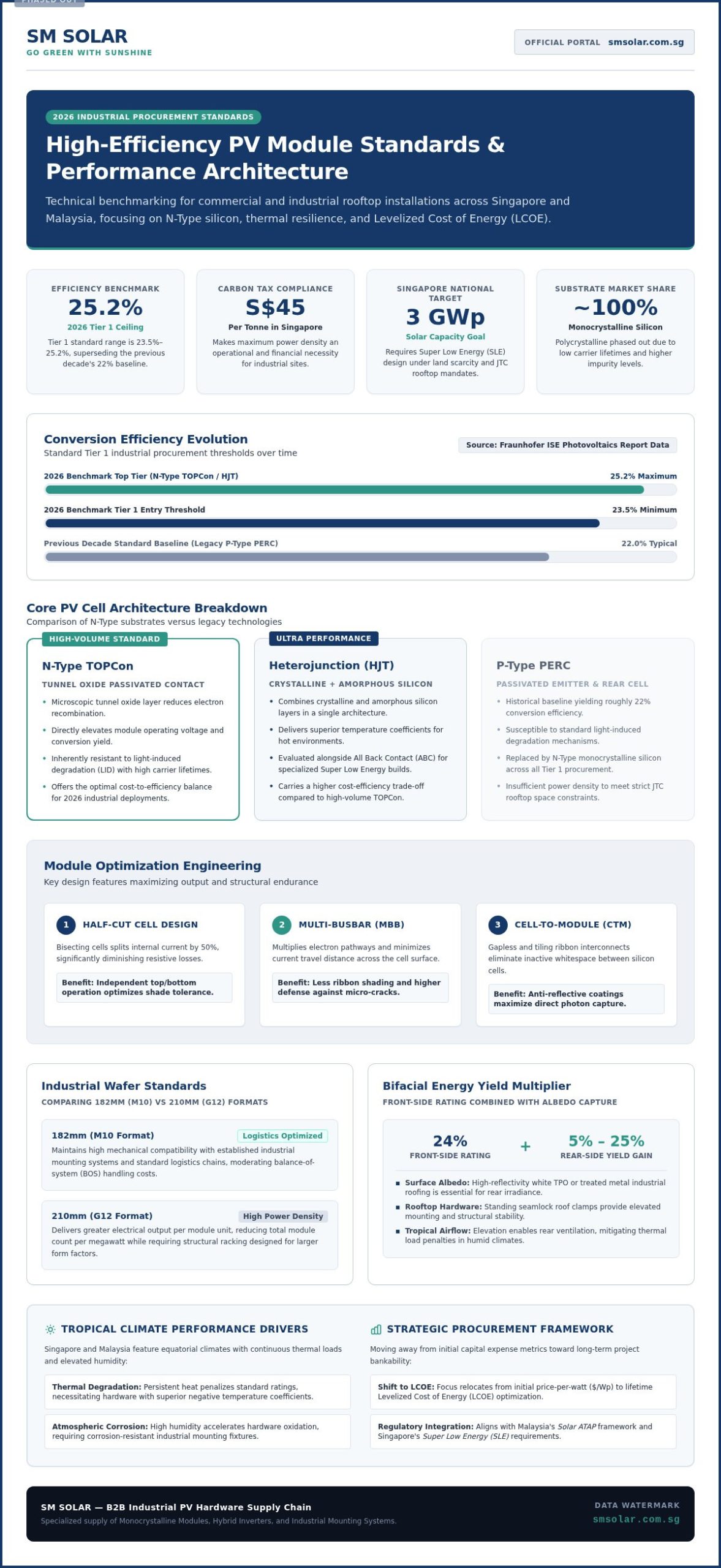
Module efficiency measures the ratio of electrical energy output to the solar footprint of the installation. It’s the primary metric for calculating power density on industrial rooftops. Most commercial procurement now references solar-cell efficiency limits to benchmark performance against theoretical maximums. In 2026, Tier 1 high efficiency solar panels must deliver between 23.5% and 25.2% conversion efficiency to remain competitive. This represents a significant shift from the 22% standards typical of the previous decade.
Singapore’s industrial landscape demands this level of precision. Land scarcity and JTC rooftop mandates make energy density a non-negotiable requirement. With the national carbon tax set at S$45 per tonne, maximizing yield per square meter isn’t just an engineering goal; it’s a financial necessity. High efficiency solar panels allow facilities to achieve Super Low Energy (SLE) status even when usable roof space is restricted by HVAC equipment or structural obstacles.
The Shift to N-Type TOPCon and HJT
The industry has transitioned from P-Type PERC to N-Type architectures. Tunnel Oxide Passivated Contact (TOPCon) technology is now the high-volume standard. It utilizes a microscopic tunnel oxide layer to minimize electron recombination, which directly increases the module’s voltage and efficiency. Heterojunction (HJT) technology offers even higher performance by combining crystalline and amorphous silicon layers. While HJT offers superior temperature coefficients, the cost-efficiency trade-off often favors TOPCon for high-volume industrial projects in 2026. N-type silicon serves as the superior substrate for 2026 modules due to its inherent resistance to light-induced degradation and higher carrier lifetimes.
Bifacial Gain and Efficiency Multipliers
Bifacial modules generate power from both sides, effectively acting as efficiency multipliers. While the front-side rating might be 24%, the total yield can increase by 5% to 25% depending on the installation environment. Success depends on surface albedo. Light-colored industrial roofing materials, such as white TPO or treated metal, provide the necessary reflectivity for rear-side energy capture. Integration with specialized hardware is critical for these systems. Standing seamlock roof clamps provide the required elevation and structural stability for industrial profiles. This setup facilitates optimal airflow and rear-side irradiance, which is vital for maintaining performance in the high-humidity environments of Singapore and Malaysia.
Core Technologies Driving PV Module Efficiency
Monocrystalline silicon (mono-Si) is the exclusive substrate for the 2026 high-performance market. Polycrystalline modules have been phased out of Tier 1 commercial procurement due to lower carrier lifetimes and higher impurity levels. Current data in the Fraunhofer ISE Photovoltaics Report confirms that mono-Si architectures now represent nearly 100% of new industrial capacity. These high efficiency solar panels utilize half-cut cell technology to bisect standard cells; this reduces the internal current by half and lowers resistive losses. It also improves shade tolerance by allowing the top and bottom halves of the module to operate independently.
Multi-busbar (MBB) designs complement this by providing more paths for electron flow. MBB reduces the distance current travels across the cell surface, which minimizes shading from the ribbons and increases structural reliability against micro-cracks. Anti-reflective coatings on the glass surface further maximize photon absorption by reducing reflection losses. Procurement managers can source these monocrystalline solar panels directly for industrial project pipelines to ensure maximum energy density.
Cell-to-Module (CTM) Optimization
Modern module assembly focuses on high-density interconnects to eliminate inactive space between cells. Gapless or tiling ribbon technologies allow manufacturers to fit more active silicon into the same module dimensions. Large-format wafers, specifically the 210mm (G12) and 182mm (M10) standards, are the current benchmarks for industrial EPC projects. Selecting high efficiency solar panels with optimized wafer standards minimizes the total number of modules required per megawatt. While 210mm modules offer higher power per unit, 182mm modules often provide better compatibility with existing mounting hardware and logistics chains. This selection impacts the overall balance of system (BOS) costs, including cabling and racking requirements.
Degradation Rates and Long-Term Reliability
Long-term asset value depends on mitigating Light Induced Degradation (LID) and Light and Elevated Temperature Induced Degradation (LeTID). N-Type modules are fundamentally immune to boron-oxygen related LID, which is a common failure point in legacy P-type PERC modules. This translates to lower annual degradation rates; N-Type modules typically lose 0.4% per year compared to 0.55% for P-type. Industrial assets using N-type technology frequently carry 30-year power warranties that guarantee over 87% of original output. This reliability is critical for Singaporean industrial projects where high ambient temperatures can accelerate chemical degradation pathways.
Performance Factors for Tropical Climates (Singapore & Malaysia)
Tropical installations face a significant “Heat Penalty” where high ambient temperatures directly reduce PV voltage and total system output. While nameplate ratings for high efficiency solar panels are calculated at 25°C, operating cell temperatures on Singaporean industrial roofs frequently reach 60°C to 75°C. This delta of 35°C to 50°C above Standard Test Conditions (STC) necessitates a focus on the Pmax temperature coefficient. In 2026, a coefficient of -0.30%/°C or better is the required benchmark for Tier 1 procurement. Legacy P-type PERC modules typically suffer losses of -0.35% to -0.38%/°C, resulting in 4% to 6% lower actual energy yields compared to modern N-type hardware in equatorial conditions.
High relative humidity in Southeast Asian coastal zones also introduces Potential Induced Degradation (PID) risks. Humidity facilitates the movement of ions from the glass to the cell, which can lead to rapid power loss if the encapsulation isn’t robust. Ensuring adequate airflow and a minimum mounting height of 100mm helps facilitate passive cooling. It’s a simple mechanical adjustment that can drop operating temperatures by several degrees, protecting the long-term output of the system and ensuring the investment meets projected ROI targets.
Optimizing Yield in High-Humidity Environments
Procurement for Singaporean projects prioritizes glass-glass (dual glass) construction over traditional backsheet designs. This architecture provides superior moisture ingress protection and structural rigidity. Aluminum frames and mounting profiles must meet specific corrosion resistance standards to withstand salt-laden air in coastal industrial estates like Jurong or Tuas. Dual-glass modules are the standard for Singaporean industrial projects because they utilize Polyolefin Elastomer (POE) encapsulation to prevent delamination and PID in high-humidity environments.
Mounting Hardware Synergy
The selection of mounting hardware is as critical as the module technology itself. Non-penetrative standing seamlock roof clamps maintain roof integrity while providing the necessary clearance for under-module ventilation. For infrastructure-integrated systems, heavy-duty solar panel pole mounts offer the stability required for high-wind environments. Preventing galvanic corrosion is a primary concern; all fasteners and interfaces between the aluminum module frames and steel mounting structures must use specialized isolation washers or coatings to prevent material degradation in tropical climates. This hardware synergy ensures that the high efficiency solar panels remain structurally sound throughout their 30-year operational life.
Selection Criteria for Industrial Solar Procurement
Professional procurement shifts the focus from initial price-per-watt to the Levelized Cost of Energy (LCOE). High efficiency solar panels optimize LCOE by reducing the total number of modules required for a specific capacity. This directly lowers the expenditure on racking, cabling, and labor. Tier 1 bankability remains a non-negotiable requirement for long-term project financing. It guarantees that the manufacturer possesses the financial liquidity to support 25 to 30-year performance warranties. Evaluating the manufacturer’s regional support network is equally vital for industrial assets in Southeast Asia.
System compatibility is a core technical requirement. Modules must be electrically matched with hybrid inverters and Lithium LiFePO4 batteries to ensure efficient energy conversion and storage. Mismatched components lead to clipping losses or premature hardware failure. Logistical reliability often dictates project timelines. While direct factory orders may offer slight price advantages, local inventory availability in Singapore and Malaysia mitigates the risk of 8 to 12-week lead time delays. Review our current inventory of high efficiency solar panels and mounting hardware to secure Tier 1 components for your next industrial project.
Technical Specification Checklist for EPCs
EPCs must verify Nominal Operating Cell Temperature (NOCT) ratings rather than relying solely on Standard Test Conditions (STC). NOCT provides a more accurate representation of module behavior in the 60°C to 75°C environments typical of Singaporean rooftops. Connector compatibility is another critical safety factor. Adherence to MC4-Evo2 standards is necessary to prevent thermal runaway at junction points. High-current modules utilizing 210mm wafers require specialized solar circuit protection, including DC breakers and surge protective devices (SPDs) rated for the increased short-circuit current levels.
Regulatory Compliance in Singapore and Malaysia
Industrial projects must align with BCA Green Mark and Super Low Energy (SLE) building standards in Singapore. These regulations often mandate specific efficiency tiers for the total solar footprint. Fire safety remains a priority; DC disconnect switches and rapid shutdown capabilities are standard requirements for industrial rooftop permits. For Malaysia-based projects, the Solar Accelerated Transition Action Programme (Solar ATAP) replaced NEM 3.0 on January 1, 2026. This framework settles exports at the System Marginal Price (SMP), making self-consumption and battery integration the primary drivers for system sizing. Cross-border logistics must also account for specific SST exemptions or import duties applicable to renewable energy hardware.
Sourcing High-Efficiency Hardware from SM Solar
SM Solar operates as a specialized master distributor of Tier 1 monocrystalline PV modules for the Southeast Asian market. Established in 2008, the entity focuses on providing the technical infrastructure required for high-volume industrial deployments. The inventory catalog emphasizes high efficiency solar panels with N-type architectures, ensuring compatibility with modern EPC performance requirements. By maintaining a centralized logistical hub in Singapore, the brand provides a stable supply chain for installers across the region. This localized presence eliminates the volatility often associated with international freight and customs delays.
The SM Solar Inventory Advantage
The inventory strategy prioritizes high-density N-Type technology for professional installers. The catalog includes a comprehensive suite of balance of system (BOS) components, such as hybrid inverters and Lithium LiFePO4 batteries. These storage solutions are selected for their cycle life and thermal stability in tropical climates. Circuit protection is also a core focus. The inventory features DC breakers, SPDs, and specialized solar circuit protection hardware necessary for high-current industrial strings. Strategic warehousing in Singapore enables rapid project deployment. This efficiency significantly reduces the lead time risks associated with direct factory procurement for time-sensitive industrial contracts.
Partnering for Industrial Solar Success
SM Solar utilizes a wholesale procurement model designed specifically for EPC contractors and solar installers. This approach ensures that technical proficiency is matched by hardware reliability. Specialized mounting solutions, such as standing seamlock roof clamps and heavy-duty pole mounts, are stocked to address the specific structural requirements of tropical industrial roofs. These components are selected for their corrosion resistance and mechanical stability in high-wind environments. The brand doesn’t just supply panels; it provides the entire mounting and protection ecosystem required for a professional installation.
Project deployments in Singaporean industrial estates demonstrate the efficacy of this hardware-centric approach. By providing Tier 1 high efficiency solar panels alongside specialized mounting profiles, SM Solar ensures that projects meet BCA Green Mark and SLE standards. The brand acts as a knowledgeable logistical partner, providing the essential components without the complexities of consumer-facing marketing. This focus on technical precision supports the 3 GWp national solar target for 2030. Professional procurement officers can View the SM Solar high-efficiency panel inventory to evaluate current specifications and availability for 2026 project pipelines.
Advancing Industrial Energy Standards for 2026
The 2026 energy landscape in Singapore and Malaysia requires a decisive shift toward N-type architectures and superior thermal stability. High efficiency solar panels are now the baseline requirement for industrial projects targeting BCA Green Mark or Solar ATAP compliance. Success depends on selecting hardware that maintains rated output at 75°C and resists the humidity-driven degradation typical of coastal industrial zones. Procurement officers must prioritize Levelized Cost of Energy (LCOE) over initial price-per-watt; this ensures long-term asset bankability and functional reliability.
SM Solar provides the technical infrastructure to meet these rigorous requirements. Established in 2008, we serve as a master distributor for Tier 1 monocrystalline modules and specialized mounting hardware like standing seamlock roof clamps. Our Singapore-based technical support and specialized B2B inventory facilitate rapid deployment for EPCs and industrial installers throughout the region. Request a wholesale quote for high-efficiency solar hardware to secure your 2026 project pipeline and ensure your installation meets the highest performance standards.
Frequently Asked Questions
What is the highest efficiency solar panel available in Singapore in 2026?
The highest commercial module efficiency available in Singapore for 2026 is 25.2% for All Back Contact (ABC) architectures. Mainstream N-Type TOPCon modules currently benchmark between 24.0% and 24.8%. These high efficiency solar panels are optimized for space-constrained industrial rooftops where maximizing power density is a priority. Procurement should focus on Tier 1 manufacturers that provide local technical support to ensure performance stability in the Singaporean market.
How does tropical heat affect the efficiency of high-performance solar panels?
Tropical heat induces a voltage drop that reduces the total power output of a PV system. While standard ratings are calculated at 25°C, Singaporean rooftops often reach 75°C. This 50°C delta can result in a 15% to 18% loss in real-world efficiency if the module has a poor temperature coefficient. Modern N-type modules mitigate this penalty better than legacy P-type hardware, maintaining higher energy yields during peak irradiance periods.
Why is N-Type TOPCon technology preferred over P-Type PERC for industrial projects?
N-Type TOPCon technology is preferred because it eliminates boron-oxygen related Light Induced Degradation (LID) found in P-Type PERC. It offers a higher theoretical efficiency limit and superior low-light performance. For industrial projects, this translates to a lower Levelized Cost of Energy (LCOE) and improved power density. Most Tier 1 manufacturers have transitioned their primary production lines to N-type silicon to meet the 2026 procurement standards for high-performance commercial assets.
What temperature coefficient should I look for in panels for a Malaysia-based project?
Projects in Malaysia should utilize modules with a Pmax temperature coefficient of -0.30%/°C or better. High-performance HJT and Back-Contact modules can achieve coefficients as low as -0.26%/°C. These specifications are critical for the Solar ATAP framework, where maximizing self-consumption requires consistent energy generation throughout the day. Selecting hardware with a lower coefficient ensures that the system maintains its efficiency despite the high ambient temperatures characteristic of the Malaysian climate.
Do high-efficiency panels require special mounting hardware?
High-efficiency modules require mounting solutions that prioritize airflow and structural integrity. Specialized hardware like standing seamlock roof clamps provides the necessary elevation for passive cooling, which is vital for maintaining module efficiency. Industrial installations also require corrosion-resistant aluminum frames and stainless steel fasteners to prevent galvanic corrosion in high-humidity environments. SM Solar stocks these specialized components to ensure that the mounting system matches the 30-year operational lifespan of Tier 1 monocrystalline panels.
How much does bifacial gain add to the overall efficiency of a commercial system?
Bifacial gain typically adds 5% to 25% to the total energy yield of a commercial system. The exact improvement depends on the albedo of the roofing material; light-colored TPO or treated metal roofs provide the highest reflectivity. This gain effectively increases the overall system efficiency beyond the front-side nameplate rating. Utilizing glass-glass module construction is essential for bifacial systems in Singapore to protect against moisture ingress while allowing rear-side irradiance capture.
What is the expected degradation rate for a Tier 1 monocrystalline panel over 25 years?
Tier 1 monocrystalline panels using N-Type technology typically guarantee a linear degradation rate of 0.4% per year or less. This ensures that the module retains approximately 89% of its original rated output after 25 years. In contrast, legacy P-type modules often degrade at 0.55% annually. This difference in long-term reliability significantly impacts the financial modeling of industrial solar assets, providing more predictable energy yields over the multi-decade lifespan of the project.
How do I ensure my solar hardware meets Singapore Green Building standards?
Compliance with Singapore Green Building standards requires hardware that meets specific efficiency and sustainability benchmarks. Utilizing high efficiency solar panels with a minimum 22.5% efficiency rating supports the requirements for Super Low Energy (SLE) building status. Procurement should verify that components are listed under the Singapore Green Building Product (SGBP) certification scheme or meet equivalent international standards. SM Solar provides technical documentation for all distributed hardware to assist EPCs in meeting these regulatory mandates.
Leave a Reply