
Choosing a monocrystalline PV modules supplier involves more than comparing names. The right fit depends on whether the proposed modules match the project design, whether their technical documentation is clear and comparable, and whether the supply scope includes the required hardware. A directory can help identify potential sources, but it cannot show whether a supplier’s products and capabilities fit a specific procurement requirement.
Module specifications can be difficult to compare when ratings, dimensions and supporting documents use different formats. For projects in Singapore, a consistent evaluation framework helps buyers check the details against project requirements and identify gaps before procurement.
This guide explains how to assess supplier fit, compare module documentation and define the wider solar hardware scope. It also outlines how SM Solar’s wholesale supply of monocrystalline solar panels and related hardware, alongside its system integration, installation and after-sales maintenance capabilities, can fit into a project review. Use it to make a supply decision based on documented requirements, not directory presence alone.
Key Takeaways
- Define the project application, system architecture and procurement scope before comparing module offers.
- Assess a monocrystalline PV modules supplier by documented project fit, supply scope and support capabilities, not directory presence alone.
- Use a consistent comparison table to review module specifications and technical documents, keeping verified facts separate from assumptions.
- Make procurement decisions traceable by recording requirements, open questions and document revisions at each review stage.
- Assess how SM Solar’s wholesale supply and documented integration, installation and after-sales capabilities relate to your project requirements.
Why monocrystalline PV modules supplier selection affects project procurement
A module listing identifies a product category, but not whether the supply arrangement fits your project. Establish who manufactures the modules, who supplies them and who is responsible for system integration. These roles affect how specifications are reviewed, what is included in a purchase and how procurement connects with project delivery.
A monocrystalline PV modules supplier provides photovoltaic modules against a defined project requirement; a module manufacturer produces the cells or assembles the modules. The supplier may be the manufacturer or a separate wholesale distributor. The distinction matters: a manufacturer’s technical information describes its product, while a distributor’s offer addresses procurement and supply. Neither role alone establishes that engineering, installation or maintenance is included.
What does a monocrystalline PV modules supplier provide?
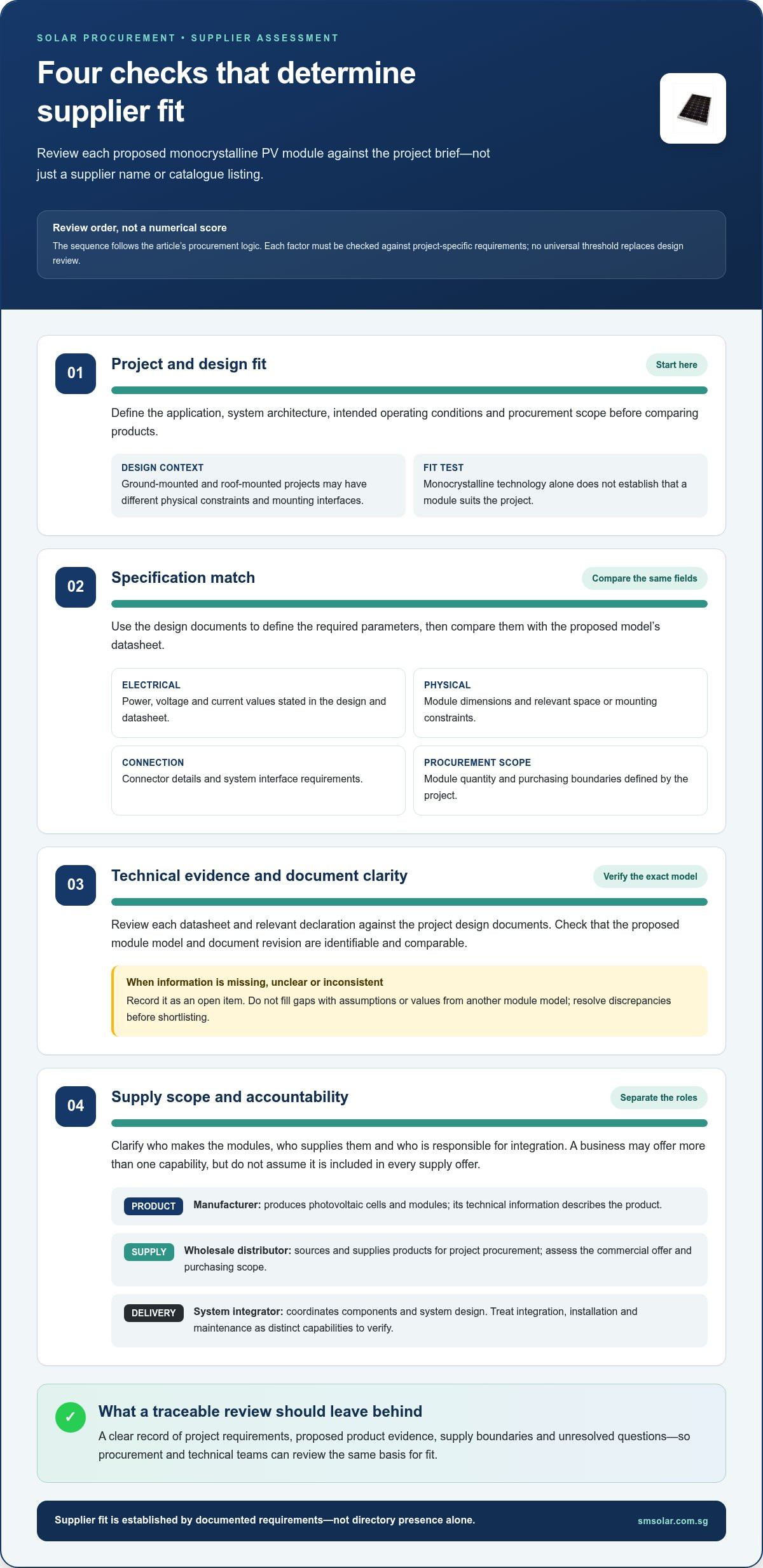
A manufacturer produces photovoltaic cells and modules. A wholesale distributor sources products and supplies them for project procurement, helping buyers match the purchase to the stated requirement and scope. A system integrator has a different role, coordinating components and system design. A business may have more than one capability, but assess each role separately rather than assuming it is part of every supply offer.
Separating these roles clarifies accountability. The technical review can focus on product documents and their match to the project brief. The commercial review can cover the supply scope and purchasing coordination. Any integration or installation work should be treated as a distinct capability. SM Solar wholesales monocrystalline solar panels and has system integration, installation and after-sales maintenance capabilities for end users.
Which project buyers typically source modules wholesale?
Wholesale sourcing is relevant to EPCs, installers, project developers and organisations procuring solar system hardware. Their requirements may include a defined module quantity, design-aligned product information, a clear supply scope and coordination with the wider procurement plan. The appropriate review depends on the project brief, so a directory entry or manufacturer name alone cannot establish fit.
Residential consumers seeking installation have different needs from professional buyers purchasing modules for a project. This guide focuses on supplier and procurement assessment, not household installation enquiries. For background on cell structure and module fundamentals, see Monocrystalline Solar Panels Singapore: Technical Overview 2026. For a broader explanation of the technology and its photovoltaic use, see Monocrystalline silicon in photovoltaics.
Supplier selection also affects the order of project decisions. If product information does not map clearly to the design requirement, technical review can stall while inconsistencies are resolved. If the commercial scope is unclear, purchasing coordination can become detached from the project plan. A practical shortlist records the supplier’s role, the evidence supporting product fit and the boundaries of the offer. This gives procurement, engineering and project teams a shared basis for review before they commit.
Which monocrystalline PV module requirements should buyers define first?
Start with the project brief, not a supplier catalogue. Record the application, system architecture, intended operating conditions and procurement scope before comparing modules. A ground-mounted project and a roof-mounted project, for example, may have different physical constraints and mounting interfaces. Describe the actual design requirements rather than assuming a module will suit the project simply because it is monocrystalline.
Module suitability depends on documented project requirements and evidence that the proposed module matches them. No universal set of thresholds replaces design review. To assess suppliers consistently, compare each candidate against the same project-specific fields.
Which module specifications belong in the procurement brief?
Use the project design documents to set the required parameters. Capture the expected module power, voltage and current values, physical dimensions and connector details. Include any project-specific operating conditions or interface constraints that affect selection. These fields define the project’s needs; the manufacturer’s datasheet provides the model-specific values to review.
- Electrical: Power, voltage and current values stated in the design and datasheet.
- Physical: Module dimensions and any relevant space or mounting constraints.
- Connection: Connector details and interface requirements specified for the system.
- Scope: The module quantity and procurement boundaries defined by the project.
Keep units and document references consistent across supplier submissions. If a field is missing, unclear or inconsistent between documents, log it as an open item. Don’t fill gaps with assumptions or values from a different module model. Resolve discrepancies before shortlisting so the technical comparison reflects the product actually proposed.
How should buyers assess documentation and compatibility?
Review each datasheet and relevant declaration against the design documents. Match the exact module model and document revision to the proposed supply. Then compare its electrical and physical interfaces with the system architecture, including inverter input requirements and the mounting design. Establish compatibility using project documents and component requirements, not a product category or a similar-looking specification.
Use one comparison template for every candidate. Record each stated value, its source document and revision, the project requirement and any unresolved variance. This makes missing information visible and gives engineering and procurement teams a shared review trail. Don’t rank offers by one headline figure while overlooking dimensions, connectors or other design interfaces.
For more background on module fundamentals, consult Monocrystalline Solar Panels Singapore: Technical Overview 2026. Once the project fields are defined, include SM Solar’s wholesale monocrystalline solar panel supply in your procurement review.
How to compare monocrystalline PV modules suppliers objectively
A fair supplier comparison is evidence-based and specific to the project. Use the same evaluation framework for every candidate and record the source for each finding. This helps distinguish documented capabilities from assumptions, directory descriptions and sales language. A manufacturer’s scale or presence in a supplier directory may inform initial research, but neither proves that its modules or supply scope fit a particular project.
For each supplier, compare the same categories against the project brief. Keep technical suitability separate from purchasing scope and support capabilities. A strong result in one category should not conceal missing evidence in another.
What evidence should a supplier comparison include?
Build a record that links each claim to its evidence. Note the product model, datasheet source and revision, then capture the declared specifications relevant to the project. Record procurement, integration and after-sales activities separately, identifying what falls within the stated scope. Mark unavailable, inconsistent or unverified information as unresolved. Don’t treat an assumption or promotional phrase as an established fact.
- Product documentation: Model identification, datasheet, declared specifications, source and revision.
- Project fit: Evidence that the documented product aligns with the project’s stated requirements.
- Supply scope: The products and procurement activities included in the offer.
- Support scope: Stated integration or after-sales capabilities, recorded separately from product supply.
- Open items: Missing documents, conflicting values and claims that still need evidence.
How do distributors and manufacturers differ in a sourcing decision?
A manufacturer produces cells or modules and provides product information for its own products. A wholesale distributor sources and supplies products for procurement. A system integrator coordinates system components or design activities. These roles can overlap, but don’t assume a distributor manufactures modules or a manufacturer provides installation. Identify the responsibility relevant to your project and record who is accountable for each part of the proposed scope.
For example, a manufacturer’s datasheet can support technical review, while a distributor’s proposal can define the procurement supply. If the project requires coordination or integration, assess that capability as a separate line item. For wider context on supplier assessment and hardware scope, see Solar Energy Equipment Supplier: A Buyer’s Guide for 2026.
Use the comparison to create a shortlist that reflects project needs, not a score detached from them. Prioritise unresolved technical or scope questions before purchase coordination, and retain document revisions with the evaluation record. This gives procurement and engineering teams a common basis for decisions. Include SM Solar’s wholesale monocrystalline solar panel supply in the same project-specific review.
How to prepare a monocrystalline PV module procurement workflow
A defined workflow takes a module purchase from project need to a reviewable procurement decision. It also prevents assumptions about quantities, delivery dates or commercial terms from being treated as confirmed information. Assign someone to maintain the record and keep one controlled set of project requirements, supplier responses and document revisions.
- Prepare the project brief. State the application, system architecture, operating conditions and procurement boundaries. Identify the design documents that establish module requirements.
- Prepare the request for quotation. Specify the required electrical and physical parameters, supporting documents and any project-defined quantity or delivery requirement.
- Review technical responses. Compare every offer against the same requirements. Record deviations, missing evidence and questions that need technical resolution.
- Align the scope. Separate module supply from related hardware, integration and other responsibilities. Document the purchasing scope before coordination proceeds.
- Maintain the decision record. Store selected document revisions, assumptions, open items and purchasing decisions together for traceability.
What should a module request for quotation contain?
A useful RFQ gives each monocrystalline PV modules supplier the same basis for responding. Include the project application, module specifications drawn from the design documents and the supporting product documents needed for review. State quantities and delivery requirements once the project team has established them. List related hardware separately so it does not blur the module specification or create ambiguity about what is being quoted.
Keep the request precise, while distinguishing fixed requirements from information still under development. For example, mark a pending quantity as unresolved rather than inserting an estimate as if it were approved. Record the RFQ version and issue date, and compare responses against that same version. This provides a clear reference if project requirements change.
How should project teams review supplier responses?
Review responses against the same specification fields and scope categories used in the RFQ. Match each stated module value to its supporting document and note the model and revision. Log deviations for technical review instead of treating them as accepted substitutions. Keep unverified claims and unresolved assumptions visible in the decision record.
Then check procurement boundaries. Identify which items are included, which activities are assigned to the supplier and whether integration responsibilities are stated separately from module supply. Record delivery details and commercial terms as presented for the specific project. Don’t assume they apply to another order or remain unchanged.
Once requirements and review records are organised, use them to guide purchasing coordination for the selected scope. To review SM Solar’s solar panel range in the context of a project brief, visit Review SM Solar’s solar panel range.
How SM Solar supports monocrystalline PV module supply
SM Solar is a wholesale distributor of solar products, including monocrystalline solar panels and related solar hardware. For procurement teams, the company is a supply-chain source for project requirements, with capabilities that include system integration, installation and after-sales maintenance for end users. Assess these as distinct parts of the scope: wholesale supply can be reviewed separately from any integration or service requirements relevant to the project.
SM Solar was established in 2008 and became a private limited company in 2016. This business history provides context when assessing a monocrystalline PV modules supplier. The more direct procurement questions remain product documentation, project fit and a clearly defined supply scope.
What is SM Solar’s role in solar hardware supply?
SM Solar’s wholesale distribution supports buyers procuring solar hardware against project requirements. Its product categories include solar panels, solar charge controllers, batteries and solar circuit protection devices. Identify the required products in the project brief, then assess the relevant product documentation and supply needs as part of procurement. Base decisions on project-specific product records for details such as module brand, rating, certification, stock and delivery terms.
System integration, installation and after-sales maintenance are capabilities for end users. Consider them separately from wholesale module supply and include them in project planning where relevant. This distinction clarifies responsibilities for procurement and technical teams, particularly when the required scope includes hardware alongside other project work.
How does documented project experience support procurement confidence?
SM Solar’s company profile lists 10 off-grid and 5 on-grid customer organisations. These figures provide context about the organisation’s documented customer portfolio. They are not product endorsements or evidence that a particular module will suit a new project. Base selection on the project design, current module documentation and the proposed scope for your procurement.
Project context is most useful when considered alongside defined responsibilities. The listed off-grid and on-grid organisations show customer activity in both project contexts, while the documented integration and after-sales capabilities provide further information about scope. These details can inform procurement review, but they do not replace technical verification or establish project outcomes.
A practical evaluation keeps the evidence distinct: company background, product documentation, supply scope and capabilities each answer different questions. This lets project teams assess SM Solar as a wholesale solar supply partner while retaining project-specific criteria for module selection and procurement coordination.
Explore SM Solar’s solar product range as you define the supply scope for your project.
Move from supplier review to a controlled procurement decision
Before releasing a purchase order, use the approved project requirements as the procurement baseline. Keep the selected module documentation, agreed supply scope and resolved technical deviations together in the project record. This gives the team a clear reference if specifications change or purchasing coordination passes between departments.
Assess a suitable monocrystalline PV modules supplier against that baseline, including product supply and any relevant integration or after-sales requirements within their defined scope. SM Solar’s wholesale distribution of monocrystalline solar panels and its system integration, installation and after-sales maintenance capabilities can inform that project-specific review.
Use the same requirements to assess the solar hardware needed for the project, and keep unapproved substitutions out of the purchasing record. A disciplined handover helps keep procurement decisions traceable from selection through order coordination.
Explore SM Solar’s solar product range to plan your project procurement. Start with a clear brief and documented review, then align the supply scope with your requirements.
Frequently Asked Questions
What is the difference between a monocrystalline PV module supplier and a manufacturer?
A manufacturer produces photovoltaic cells or assembles modules, while a monocrystalline PV modules supplier provides modules for a buyer’s project. The supplier may be the manufacturer or a separate distributor. For procurement, identify which organisation issued the product documentation and which party is responsible for the supply offer. This keeps technical product claims distinct from purchasing and coordination responsibilities.
What documents should I request from a monocrystalline PV modules supplier?
Request the datasheet for the specific module model, along with applicable product declarations, installation instructions and warranty documentation. Check that model identifiers and revision details are visible so the documents can be matched to the quoted product. If a document refers to a different model or leaves a requirement unclear, record the discrepancy for review instead of relying on a general catalogue description.
Can monocrystalline PV modules work with different inverter types?
They can be used in systems with different inverter types when the module’s electrical characteristics and array configuration meet the inverter’s requirements. Compare the module voltage and current information with the inverter’s input limits and the planned string arrangement. The inverter label alone does not establish compatibility. A system designer should assess the specific module and inverter documents together before selecting the components.
How do I check whether a PV module specification suits my project?
Compare the exact module model’s datasheet with the project design and installation constraints. For example, confirm that its documented dimensions fit the allocated mounting area and its electrical values align with the planned system configuration. Check connector and mounting interfaces as well. Keep the source document and revision with the review, and refer any mismatch to the project’s technical reviewer before purchase.
Are monocrystalline PV modules suitable for off-grid systems?
Yes, monocrystalline PV modules can be used in off-grid systems when the array is designed around the site’s energy requirements and the selected charge-control, inverter and battery configuration. Module choice alone does not determine off-grid suitability. The system design must account for how the components work together and the intended operating conditions. Review project-specific documentation for the complete system rather than selecting modules in isolation.
Does SM Solar provide installation and after-sales maintenance?
Yes. SM Solar’s capabilities include installation, after-sales maintenance for end users and system integration. These are distinct from its wholesale distribution of solar products, including monocrystalline solar panels. For project planning, define the required scope clearly so product supply and any relevant integration, installation or maintenance activities are understood as separate parts of the project arrangement.
Leave a Reply