
Nameplate factory ratings are meaningless if your array cannot withstand sustained 35°C ambient temperatures and 90% relative humidity. Specifying standard industrial solar components without calculating severe environmental derating guarantees accelerated performance degradation, unexpected moisture ingress, and early balance-of-system failures.
You already know that tropical and coastal conditions punish commercial installations. Relentless heat induces steep voltage drops, maritime salt spray drives galvanic corrosion across dissimilar metals, and component mismatches between high-voltage arrays and hybrid inverters create severe operational bottlenecks. Standard commercial equipment simply isn’t engineered for continuous exposure to these atmospheric stressors.
This guide analyzes the critical engineering specifications, thermal tolerances, and structural standards required for commercial and industrial solar hardware in tropical climates. We examine ingress protection benchmarks, DC circuit protection, LiFePO4 battery compatibility, and non-penetrative standing seam mounting hardware designed to maintain structural integrity under high wind loads.
Key Takeaways
- Evaluate high-voltage subarray topologies and multi-MPPT balance-of-system sizing to prevent clipping under elevated tropical operating temperatures.
- Assess lithium iron phosphate (LiFePO4) thermal stability parameters and cycle life degradation profiles under continuous thermal loading.
- Specify corrosion-resistant standing seamlock roof clamps and engineered pole mounts capable of resisting severe tropical wind shear and coastal galvanic attack.
- Select industrial solar components equipped with certified DC circuit protection and ingress ratings engineered to eliminate catastrophic thermal runaway.
- Streamline commercial procurement workflows using systematic bill-of-materials verification protocols before issuing equipment purchase orders.
Core Architecture of Industrial Solar Systems
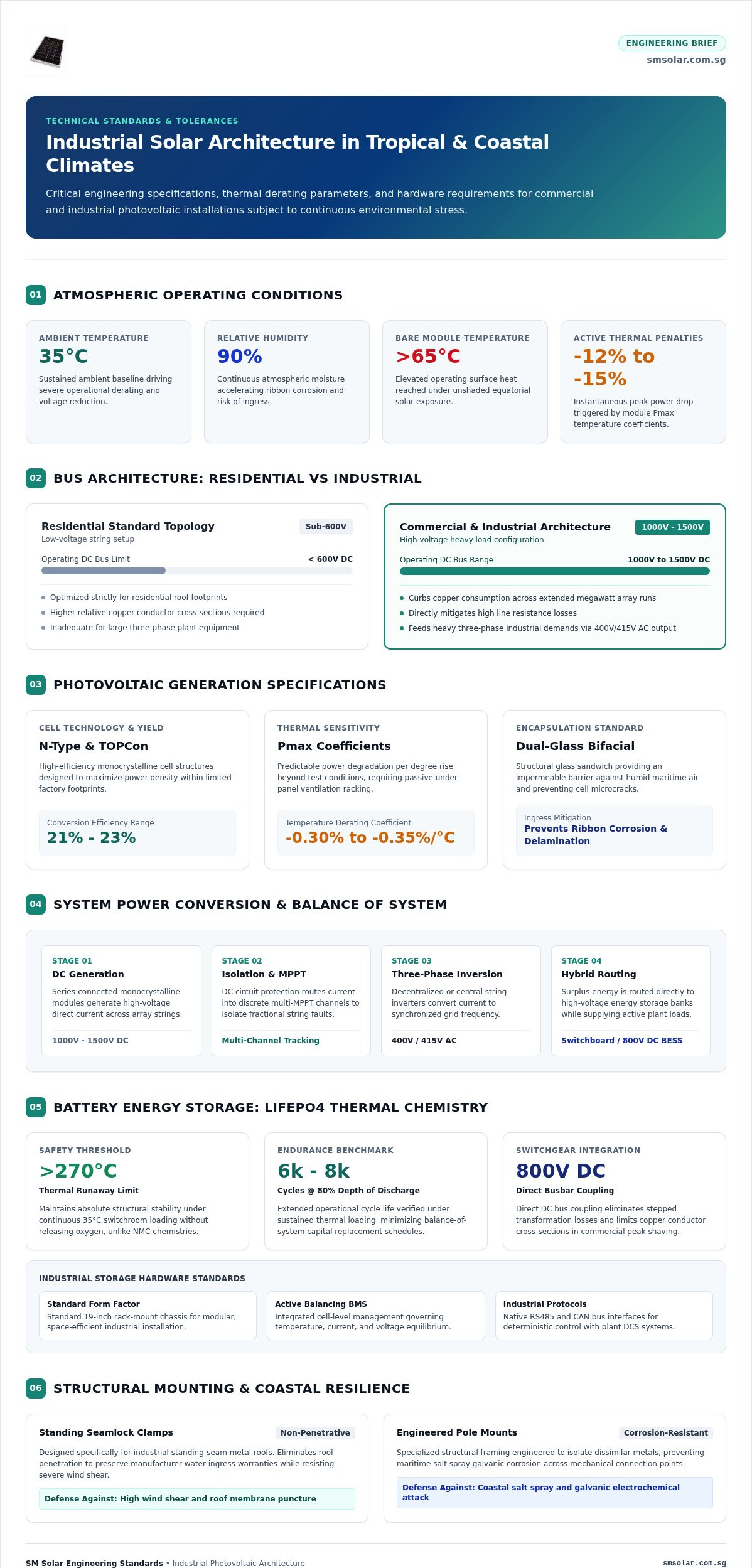
Commercial and industrial photovoltaic installations operate under parameters fundamentally distinct from residential arrays. Where residential setups prioritize low string voltages under 600V, industrial facilities demand 1000V to 1500V DC bus architectures to curb copper consumption, mitigate line resistance losses over extended runs, and satisfy heavy three-phase electrical loads. Specifying hardened photovoltaic system components ensures operational uptime under continuous thermal and electrical stresses.
Industrial Balance of System (BOS) hardware governs overall plant availability. A failure in a single sub-combiner, DC isolator, or conductor can compromise entire megawatt subarrays, making baseline component reliability the primary metric for operational yield.
Primary Photovoltaic Generation Elements
Factory roof space demands maximum power density. High-efficiency monocrystalline solar panels utilize N-type and TOPCon cell architectures to deliver conversion efficiencies between 21% and 23%, extracting maximum generation from restricted industrial footprints. For open-frame structures and reflective industrial roofs, dual-glass bifacial modules provide structural rigidity and an impermeable barrier against equatorial moisture ingress, eliminating internal ribbon corrosion and delamination.
Thermal performance determines actual field output. Equatorial ambient temperatures push bare module operating temperatures above 65°C. With typical monocrystalline Pmax temperature coefficients ranging from -0.30%/°C to -0.35%/°C, thermal derating can reduce instantaneous power output by 12% to 15%. Engineering around these losses requires modules with low temperature coefficients and racking elevations optimized for passive under-panel ventilation.
Power Conversion and Balance of System Equipment
Power conversion architectures in industrial facilities rely on decentralized multi-MPPT string inverters or consolidated central units. Decentralized string inverters offer essential operational redundancy; an inverter fault isolates only a fractional string segment rather than dropping the entire facility offline. For sites integrating energy arbitrage or emergency backup, specialized hybrid inverters manage dynamic power routing between photovoltaic inputs, battery storage banks, and the facility switchboard.
The operational chain moves methodically from generation to plant switchgear:
- High-voltage DC generation occurs across series-connected monocrystalline modules.
- DC circuit protection and disconnects route power through discrete MPPT tracking channels.
- Inversion stages convert direct current into three-phase 400V/415V AC power matched to site frequency.
- Hybrid inverters direct surplus generation into battery storage while feeding active operational switchboards.
Sourcing fully compatible industrial solar components across this conversion chain eliminates harmonic distortion and protects downstream factory infrastructure from transient electrical faults.
Industrial Energy Storage and Conversion Hardware
Energy storage selection for industrial facilities requires balancing chemical safety, thermal resilience, and cycling endurance under continuous ambient heat. While nickel manganese cobalt (NMC) formulations offer high gravimetric energy density, their lower thermal runaway thresholds present substantial hazards in unconditioned tropical switchrooms. Specifying lithium iron phosphate (LiFePO4) chemistry mitigates fire propagation risks, ensuring compliance with evolving solar industry codes and standards governing commercial facilities.
Commercial peak shaving requires high-voltage battery architecture. Coupling battery banks directly to 800V DC busbars minimizes transformation losses and curtails copper conductor sizing across high-capacity switchgear.
Lithium LiFePO4 Chemistry for Commercial Demands
LiFePO4 cells maintain structural stability at elevated temperatures, with thermal runaway thresholds exceeding 270°C. Under continuous 35°C thermal loading, these cells avoid structural oxygen release. The resulting lifecycle spans 6,000 to 8,000 cycles at 80% Depth of Discharge (DoD), drastically outlasting alternative chemistries.
Industrial scalability relies on standardized modularity:
- Standard 19-inch rack-mount battery form factors for space-efficient integration.
- Integrated battery management systems (BMS) with cell-level temperature, current, and voltage balancing.
- Native RS485 and CAN bus protocols for deterministic communications with external plant controllers.
Charge Controllers and Inverter Synchronization
Industrial balance requires exact synchronization between DC charge management and AC distribution. High-amperage MPPT solar charge controllers maintain peak operating efficiency by executing rapid current tracking during sudden tropical cloud-cover transitions. When configuring complex commercial microgrids, pairing high-voltage charge controllers with certified hybrid inverters ensures smooth power distribution without stressing local equipment.
Three-phase hybrid inverters interface directly with low-voltage industrial distribution boards (400V/415V). These units execute bidirectional energy transfer, coordinating instantaneous PV yields, battery discharge, and grid interaction. In remote manufacturing environments or areas with unreliable grid feeds, hybrid inverters provide automated off-grid failover within 10 to 20 milliseconds, maintaining critical production loads without breaker tripping.
Engineering teams sourcing specialized industrial solar components must align BMS communication maps with inverter firmware protocols prior to deployment, eliminating protocol translation lag during rapid load transients.
Mounting Hardware and Structural Durability in Tropical Climates
Industrial solar arrays across Singapore and Malaysia confront persistent environmental degradation vectors. Constant relative humidity above 80%, ambient salt-laden coastal air, and intense ultraviolet exposure rapidly degrade substandard mechanical fixtures. Under these conditions, specifying resilient industrial solar components is necessary to avoid structural mechanical failure, localized metal pitting, and costly roofing penetrations.
Monsoonal storm fronts generate severe uplift forces along roof perimeters and corners. Engineering structural mounting arrays requires verified wind load resistance capable of withstanding turbulent gusts exceeding 145 mph without fastener shearing or rail deflection.
Standing Seamlock Clamping Systems
Commercial factory roofs predominantly utilize standing seam metal profiles. Penetrating these profiles with self-tapping screws introduces persistent leak paths and immediately voids manufacturer warranties. Non-penetrative standing seamlock roof clamps solve this vulnerability by mechanically gripping the rolled metal seam without piercing the metal skin.
Reliable clamping performance depends on strict mechanical standards:
- Torque-calibrated set screws maintaining specific clamping forces between 15 and 20 Nm.
- Certified uplift resistance exceeding 3.5 kN per clamp interface.
- Integrated EPDM rubber gaskets preventing direct contact between dissimilar metals.
Separating aluminum clamp bodies from zinc-coated or coated steel standing seams eliminates galvanic corrosion cells. This preserves the structural roof profile throughout multi-decade operating cycles.
Pole Mounts and Ground Racking Hardware
Auxiliary industrial subsystems, including perimeter surveillance, weather monitoring stations, and remote telemetry nodes, depend on standalone support structures. Heavy-duty solar panel pole mounts provide rigid, elevated positioning above ground-level obstructions and storm surge runoff. These structures use structural AL6005-T5 anodized aluminum rails paired with SUS304 or marine-grade stainless steel hardware, providing robust resistance against tropical salt-spray degradation.
Ground-mounted support designs in equatorial regions require tailored ballast engineering. Saturated soils typical of tropical wet seasons reduce mechanical ground-anchor friction. Poured concrete pier foundations or certified precast surface ballast blocks prevent system displacement during sustained monsoonal storms, ensuring structural equilibrium across all industrial solar components installed in high-exposure environments.
Electrical Protection and Industrial Safety Standards
High-voltage DC circuits in commercial arrays operate under continuous, unidirectional electrical stress. Unlike alternating current, direct current has no natural zero-crossing point. When a fault occurs, extinguishing an electrical arc requires specialized arc chutes and magnetic blowouts capable of stretching and breaking the plasma channel. Standard AC breakers installed in DC environments will fail to quench these faults, leading to catastrophic flashovers and sustained enclosure fires.
Combiner boxes serve as the initial line of defense. They isolate individual strings, consolidate parallel circuits, and integrate monitoring sensors to track anomalies before localized resistance generates dangerous thermal hotspots.
DC Overcurrent and Circuit Interruption Devices
Overcurrent protection hardware must match the operating voltage and short-circuit current ratings of the array. Fast-acting 1000V/1500V gPV cylindrical fuses provide string-level isolation, interrupting reverse-current faults before individual module backsheets sustain damage. Subarray isolation requires calibrated DC molded case circuit breakers (MCCBs) or miniature circuit breakers (MCBs) with high breaking capacities.
Routine servicing and emergency intervention demand visible electrical disconnection:
- Rotary load break disconnect switches rated for full-load circuit breaking under maximum system voltage.
- Lock-out/tag-out (LOTO) mechanisms ensuring complete physical isolation during plant servicing.
- IP65-rated enclosures preventing tropical moisture penetration from degrading mechanical switch contacts.
Surge Protection and System Grounding Architecture
Equatorial Southeast Asia records some of the highest lightning flash densities in the world. Direct strikes and indirect electromagnetic pulses induce destructive voltage spikes across elevated PV arrays. Mitigating these events requires multi-stage Type 1 and Type 2 DC surge protection devices (SPDs) installed at string combiner boxes and inverter DC terminals. These metal-oxide varistor (MOV) systems shunt high-energy transient currents safely to ground, clamping peak voltages well below the dielectric limits of connected hardware.
Grounding architecture requires complete equipotential bonding across all metallic infrastructure. Mechanical fasteners, anodized aluminum frames, support rails, and equipment enclosures must link together through continuous copper conductors. Bonding washers with integrated piercing teeth breach the non-conductive anodized layer of aluminum frames, guaranteeing electrical continuity throughout the structural racking. This low-impedance ground path directs lightning energy straight into the grounding electrode system, keeping plant personnel and sensitive telemetry electronics protected.
To secure your project with certified, standards-compliant balance of system hardware, source your solar circuit protection components directly from our specialized distribution inventory.
Procurement Logistics and Technical Hardware Sourcing
Procuring hardware for commercial solar arrays across Singapore and Malaysia requires rigorous validation before executing purchase orders. Fragmented sourcing across multiple overseas vendors introduces shipment delays, import discrepancies, and component mismatches that stall commissioning timelines. EPCs and electrical contractors mitigate these risks by establishing structured verification workflows and consolidating balance of system procurement through local inventory hubs.
Single-source supply arrangements streamline project delivery. Consolidating racking, balance-of-system hardware, and storage systems under a unified procurement schedule ensures cross-system compatibility and establishes accountability across all active project milestones.
Evaluating Component Interoperability and Certifications
Before releasing equipment purchase orders, engineering teams must cross-reference technical submittals against international compliance standards. Monocrystalline modules require certification under IEC 61215 for design qualification and IEC 61730 for operational safety. Inverter hardware and solar charge controllers must hold IEC 62109 certification to confirm electrical safety across high-voltage power conversion stages.
Physical and electrical compatibility checks involve specific verifications:
- Comparing module frame flange profiles against clamp grip depths to verify mechanical hold down.
- Modeling inverter MPPT operating windows against string open-circuit voltage (Voc) at maximum and minimum ambient site temperatures.
- Confirming physical conductor gauge capacities on DC circuit protection terminals match array cable cross-sections.
Streamlining Regional B2B Hardware Supply Chains
International freight disruptions create serious project vulnerabilities. Relying entirely on factory-direct international sea freight exposes contractors to unpredictable port congestion, customs holdups, and container damage. When commissioning deadlines or maintenance agreements require immediate part swaps, waiting weeks for overseas replacements generates unacceptable plant downtime.
Regional stockholding solves this vulnerability. Warehousing vital industrial solar components within Singapore and Malaysia provides installers with ready access to high-grade monocrystalline panels, LiFePO4 battery modules, and certified mounting hardware. Localized staging allows engineering teams to pull replacement components within 24 to 48 hours, keeping commercial installations fully operational.
To inspect certified stock or align project bills of materials with local warehouse availability, review active inventory through SM Solar hardware distribution.
Engineering Resilient Industrial Arrays for the Tropics
High-temperature, high-humidity operating environments demand hardware chosen specifically for equatorial operational stress. Long-term commercial plant uptime hinges on calculating accurate thermal derating, deploying non-penetrative mounting hardware, and specifying dedicated DC arc-quenching protection. Standard baseline components simply cannot endure decades of persistent maritime atmospheric exposure without degradation.
Protecting commercial solar investments requires strict alignment with international IEC manufacturing benchmarks and reliable regional supply chains. EPCs and contracting teams can eliminate component mismatches and prevent extended project delays through centralized distribution. Source verified commercial hardware through SM Solar industrial component distribution to access high-efficiency monocrystalline panels, thermally stable LiFePO4 storage systems, and engineered standing seamlock clamps designed for continuous tropical resilience. Equipping your arrays with purpose-built industrial solar components guarantees predictable generation and mechanical durability throughout the entire plant lifecycle.
Frequently Asked Questions
What makes industrial solar components different from residential solar equipment?
Industrial solar components are engineered for 1000V to 1500V DC bus architectures rather than residential 600V limits. They incorporate heavy-duty switchgear, specialized DC arc quenching, high-amperage combiner boxes, and multi-channel MPPT string or hybrid inverters capable of handling severe inductive factory loads. Their structural mounting systems also require rigorous testing and structural certifications to withstand monsoonal uplift forces on massive commercial rooftops.
Why is LiFePO4 battery chemistry preferred for industrial energy storage systems?
Lithium iron phosphate (LiFePO4) provides superior chemical and thermal stability, resisting thermal runaway up to 270°C. In unconditioned industrial spaces across Singapore and Malaysia, continuous 35°C ambient temperatures accelerate degradation in nickel-rich chemistries. LiFePO4 delivers 6,000 to 8,000 cycles at 80% depth of discharge without releasing oxygen during high-stress operational cycles, satisfying industrial safety protocols and commercial insurance requirements.
How do tropical climates affect the performance of industrial solar panels?
Sustained tropical heat and 90% relative humidity cause thermal derating, moisture ingress, and accelerated mechanical fatigue. Module operating temperatures exceeding 65°C induce a 12% to 15% drop in instantaneous power due to the cell’s negative temperature coefficient. Additionally, coastal maritime humidity accelerates potential-induced degradation and corrosion along junction seals. Specifying dual-glass monocrystalline panels with low temperature coefficients offsets these regional performance penalties.
Can standing seamlock roof clamps be installed without penetrating the metal roof?
Yes, standing seamlock roof clamps utilize a non-penetrative mechanical friction lock that secures the mounting rail directly to the folded metal seam. Precision-torqued set screws anchor into the seam profile without puncturing the roof sheet. This preserves structural water integrity, prevents voiding factory roof warranties, and employs internal rubber dampening gaskets to eliminate galvanic corrosion between dissimilar metals in humid equatorial environments.
What DC circuit protection devices are mandatory in an industrial solar installation?
Industrial DC circuits require coordinated protection hardware, including fast-acting 1000V/1500V gPV cylindrical fuses for string-level short circuits, DC molded case circuit breakers, and rotary load-break disconnect switches with lock-out/tag-out mechanisms. Installations also mandate multi-stage Type 1 and Type 2 DC surge protection devices to clamp transient lightning strikes, paired with complete equipotential bonding across all module frames and aluminum mounting racks.
How does an industrial hybrid inverter handle grid synchronization and battery backup?
An industrial hybrid inverter monitors incoming utility voltage and frequency, synchronizing its three-phase AC output with site switchboards in real time. During grid outages, an integrated static transfer switch isolates the plant from the utility within 10 to 20 milliseconds, shifting essential loads to the LiFePO4 battery bank. The inverter dynamically routes direct current from the panels to recharge batteries while simultaneously powering operational loads.
What certifications should procurement managers verify for commercial PV hardware?
Procurement teams sourcing industrial solar components across Southeast Asia must verify IEC 61215 for module performance reliability, IEC 61730 for high-voltage electrical safety, and IEC 61701 for salt-mist corrosion resistance. Power conversion equipment must meet IEC 62109-1 and 62109-2 standards. Mechanical racking requires localized structural engineering stamps and wind-tunnel testing certifications validating uplift resistance under regional monsoonal storm conditions.
Leave a Reply