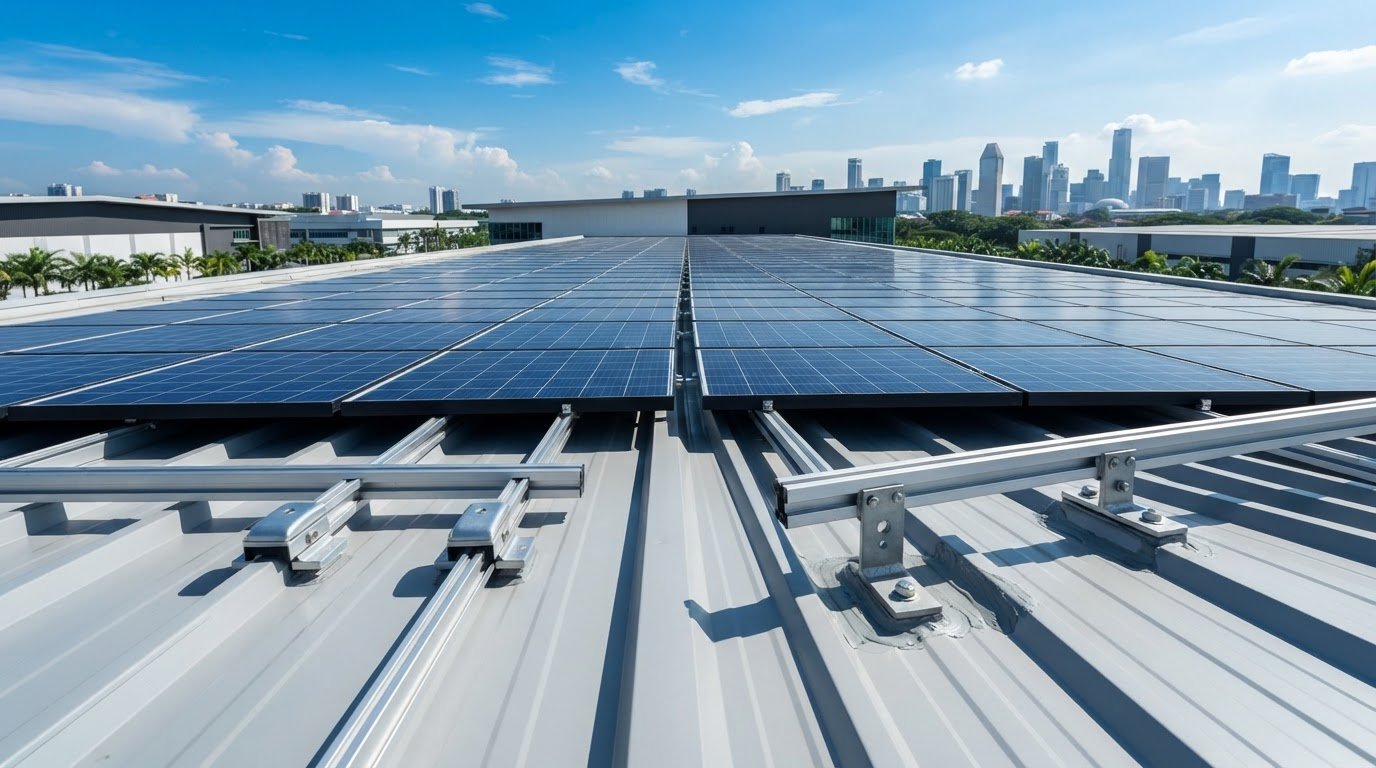
Tag: PV installation

  • Solar Mounting Systems for Metal Roofs: Technical Guide

    Solar Mounting Systems for Metal Roofs: Technical Guide

    What if an attachment that looks like the simplest fit is incompatible with the roof profile? Choosing solar mounting systems for metal roofs starts with the roof, not the hardware catalogue. Seam shape, panel layout, roof construction and project loads all influence the attachment choice.

    It’s reasonable to focus on roof penetrations, water ingress and long-term movement. Clamps can avoid penetrations on compatible standing-seam roofs, while penetrative brackets may suit other roof configurations. Neither approach is universal: the profile, fixing method and system requirements must align.

    This guide explains which roof and module details to assess before specifying hardware. It compares clamp-based and penetrative approaches, then shows how to organise project requirements for review. SM Solar supplies standing seamlock roof clamps and roof mounting brackets for metal-roof PV projects.

    Key Takeaways

    • Use the roof profile and supporting structure to narrow attachment options before selecting hardware.
    • Trace the load path from modules through mounting components to the roof structure, accounting for project-specific design requirements.
    • Compare standing seamlock clamps and roof mounting brackets by roof geometry, attachment method and compatibility requirements.
    • Build a review checklist covering roof-sheet details, supports, module layout and documented hardware compatibility.
    • Specify solar mounting systems for metal roofs as part of the complete PV hardware schedule, separating confirmed component categories from project quantities and requirements.

    Solar Mounting Systems for Metal Roofs: Start with the Roof Profile

    A solar mounting system connects PV modules to a roof structure. Components may include roof attachments, rails or brackets, module clamps and accessories. The roof attachment transfers forces from the array to the building’s supporting structure, so identifying the metal-roof profile is the first selection step. Choosing a clamp, bracket or rail before recording the roof geometry can lead to a mismatch at the attachment point.

    Profile-specific compatibility is central to metal-roof mounting selection: the attachment must engage with the roof geometry and connect appropriately to its supporting structure. Standing seamlock roof clamps and roof mounting brackets are distinct hardware categories, not universal solutions for every metal roof.

    How standing seam, corrugated, and trapezoidal profiles differ

    Standing seam roofing has raised, continuous seams where adjacent panels join. Corrugated roofing has a repeating wave pattern of rounded crests and troughs. Trapezoidal roofing has raised ribs with flatter tops, angled sides and flatter pans between them. These visible forms indicate how a mounting attachment might interface with the sheet, but appearance alone doesn’t establish compatibility.

    Before comparing mounting designs, record the profile shape and dimensions, seam or rib spacing, sheet material and thickness, fixing arrangement, and the location and spacing of supporting members. Note roof condition and any obstructions that affect the planned array. These details help distinguish profiles that look similar but present different attachment surfaces.

    • Identify whether the roof is standing seam, corrugated or trapezoidal.
    • Record the seam, crest, trough and pan geometry relevant to the attachment.
    • Document sheet and support details for project review.

    What a metal-roof mounting system connects

    The connection sequence typically runs from the roof attachment to a rail or bracket, then to the PV module interface. Some designs use rails; others use a more direct attachment arrangement. The right configuration depends on the roof and system design. Roof clamps attach mounting hardware to a compatible roof feature. Module clamps secure the PV module to a rail or designated mounting interface. They perform different functions and aren’t interchangeable.

    Accessories complete the connection according to the selected system. Their role and placement depend on the hardware configuration, module dimensions and layout. For the module-side interface, review the panel’s relevant dimensions and mounting details alongside its electrical characteristics. The monocrystalline solar panel technical overview provides context for evaluating monocrystalline modules in a PV project.

    A useful general reference is Photovoltaic mounting systems, which outlines common components and roof-mounted arrangements. For project selection, start with a measured roof profile and documented support details. Match those inputs to the intended attachment and module interface. Don’t assume a clamp that fits one seam, rib or sheet configuration will suit another.

    How Metal-Roof Mounting Transfers Loads and Protects Roof Integrity

    A mounting design must account for how forces travel from the PV array into the building. The load path typically runs from the module through its module clamps to a rail or bracket, then through the roof attachment and into the roof structure. Every connection matters. A secure-looking attachment to the metal sheet alone doesn’t establish that the roof assembly can carry the system’s design loads.

    The supporting roof structure, not sheet appearance alone, informs whether a mounting arrangement can transfer project loads appropriately. This distinction is central to evaluating solar mounting systems for metal roofs.

    Load path and structural assessment

    Roofing sheets may span between purlins or other supports, so assess the sheet and the building’s supporting structure as separate parts of the load path. Review available roof drawings, construction details and project design criteria. The assessment should account for array dead load and wind uplift, with the design professional determining applicable demands and capacities for the specific building and layout.

    • Locate purlins, rafters or other supporting members using drawings or verified site information.
    • Record sheet construction, support spacing and attachment details.
    • Provide the array layout, module configuration and project design criteria for structural review.

    Wind can impose uplift on the array and transfer force through the attachments to the roof structure. Dead load acts continuously through the same path. Neither should be assessed using a generic load or span assumption: roof condition, support arrangement, attachment locations and project requirements all affect the review. Any proposed capacity, span or load figure needs engineering verification against the actual roof and mounting configuration.

    Movement matters, too. Metal roofing can expand and contract as its temperature changes. The mounting layout and attachment details should accommodate movement in line with the roof construction and system design, rather than restraining the sheet in a way that creates unwanted stress. How movement is managed depends on the roof profile and attachment arrangement.

    Water ingress, corrosion, and material interfaces

    Attachment details can affect roof integrity, particularly when a design penetrates the sheet or alters an existing fixing. Penetrations need details suited to the roof assembly; non-penetrating attachments still require profile and interface compatibility. Neither approach alone guarantees protection against water ingress. Review project documentation for specified sealing methods, coatings and fastener materials rather than assuming one detail applies to every roof.

    Material pairing also warrants review. Dissimilar metals in electrical contact, with moisture present, can create conditions for galvanic corrosion. The actual risk depends on the materials and interface, so confirm compatibility using project and component documentation. Consider the roof sheet, attachment, fasteners and any protective coating as a system, and document any required separation or sealing details.

    SM Solar supplies standing seamlock roof clamps and roof mounting brackets for project-led specification. Reviewing roof details alongside the proposed attachment helps organise the information needed for design and procurement. Explore metal-roof mounting hardware as part of that project review.

    Standing Seam Clamps vs. Roof Brackets: Compare by Metal-Roof Type

    Attachment selection starts with comparing documented roof construction against the mounting hardware’s intended interface. Standing seamlock clamps are an option to assess on compatible standing-seam profiles. Roof mounting brackets may be considered for other metal-roof geometries, subject to their attachment design and the supporting structure. Neither category is a universal fit.

    The comparison below separates an initial profile-based evaluation from the checks needed to make a project-specific selection. Suitability depends on documented compatibility and engineering review.

    Standing seam profile

    Attachment principle: A seam clamp engages the standing seam, rather than using the same fixing approach as a bracket attached through the roof sheet. Design checks: Seam geometry, clamp interface, structural requirements and manufacturer documentation. Limitations: A clamp intended for one seam configuration cannot be assumed to suit another.

    Corrugated profile

    Attachment principle: A roof bracket’s interface and fixing method must correspond to the corrugated sheet and project design. Design checks: Sheet profile, attachment location, roof integrity and supporting structure. Limitations: The general label “corrugated” isn’t enough to select a bracket. Geometry and fixing details matter.

    Trapezoidal profile

    Attachment principle: Bracket selection depends on the specific rib and pan geometry, as well as how the attachment connects to the roof assembly. Design checks: Roof shape, fixing method, structural requirements and relevant documentation. Limitations: Similar-looking profiles may not share an attachment interface or suitable fixing arrangement.

    When standing seamlock roof clamps enter the evaluation

    Evaluate standing seamlock roof clamps when the roof has a standing-seam profile that matches the clamp’s documented interface. Record the seam shape and dimensions, then compare them with the manufacturer’s documentation. Review how the clamp transfers loads and whether the proposed arrangement meets project structural requirements. SM Solar supplies standing seamlock roof clamps as a hardware category; this doesn’t mean every clamp suits every standing-seam roof.

    When roof mounting brackets may be considered

    For corrugated and trapezoidal roofs, assess brackets against the actual sheet geometry and specified attachment method. A penetrative approach passes through the roof sheet; a non-penetrative approach relies on another compatible interface. Both need roof-specific evaluation. Include the fixing detail, roof-integrity implications, connection to the supporting structure and engineering review in the comparison.

    For solar mounting systems for metal roofs, use the profile to establish which attachment categories merit review, then compare the documented interface and design requirements. A practical selection record should identify the roof type, proposed attachment, fixing approach, structural assumptions and supporting documentation. This gives the specification stage a clear basis for evaluating clamps or brackets without treating visual similarity as proof of fit.

    Solar Mounting Systems for Metal Roofs: Technical Guide

    Metal-Roof Solar Mounting Specification: A Project Review Checklist

    A procurement-ready mounting specification translates site information into documented component requirements. It should let a reviewer follow the connection from roof construction to PV module and identify the design assumptions behind the selected attachment. A complete mounting specification combines roof, structure, module and attachment data. Use the sequence below to assemble that record before finalising hardware quantities.

    1. Survey the roof. Record the profile, sheet construction, condition and relevant dimensions. Note seams, ribs, troughs, existing fixings, penetrations and obstructions that could affect attachment locations.
    2. Document the supporting structure. Capture available drawings and verified details for purlins, rafters or other supports, including their locations and relationship to the roof sheet. Flag missing information for project review instead of assuming the sheet alone provides the required support.
    3. Define the array layout. Include module dimensions, orientation, row arrangement and intended attachment locations. Show how the layout relates to roof features and supports so component placement can be reviewed against site conditions.
    4. Capture design inputs. Include project engineering criteria and relevant environmental exposure information, such as wind demands and moisture conditions. Use criteria supplied for the specific project; don’t substitute generic load, span or capacity assumptions.
    5. Record the proposed assembly. Identify the roof attachment, rail or bracket arrangement, module interface and associated hardware. List the documentation used to support compatibility and note any engineering review still required.

    Record roof and project inputs

    Keep the roof survey, structural information and module layout together as one review package. Include photographs or marked-up drawings where they clarify attachment locations, roof features or support positions. Record the source of each structural detail, such as a project drawing or verified site information, so reviewers can distinguish measured inputs from assumptions. Add project exposure and design criteria from the engineering brief.

    Check component interfaces and documentation

    Compare the proposed clamp or bracket with the documented roof profile and attachment method. Then review the complete connection: attachment to roof, rail or bracket interface, module clamp, fasteners and material pairings. Keep load values, spans and compatibility statements tied to project-specific engineering and component documentation. Record document references and unresolved assumptions alongside the hardware schedule.

    This workflow turns site observations into a reviewable specification rather than a list of generic parts. For procurement, separate confirmed hardware categories from project-dependent quantities and technical selections. SM Solar supplies standing seamlock roof clamps and roof mounting brackets as part of its solar hardware range. Aligning the schedule with the recorded roof and module inputs supports a clearer project review without assuming a universal fit.

    Explore roof clamps and mounting brackets for your metal-roof PV hardware specification.

    Sourcing Metal-Roof Mounting Hardware for a Complete PV Project

    Mounting hardware is one part of a coordinated PV bill of materials. Roof clamps or mounting brackets connect the array to the roof assembly; rails, module interfaces and related accessories complete the mechanical connection. Depending on the project architecture, the wider schedule may also include modules, inverters, batteries, charge controllers and circuit protection. Treat these as coordinated procurement categories, not interchangeable items.

    For a broader procurement framework, the solar energy equipment supplier buyer’s guide covers considerations beyond the roof attachment itself. A project schedule should distinguish product categories from design-dependent details: quantities, exact component specifications and compatibility evidence should come from the project requirements, not be inferred from a category name.

    Coordinate mounting hardware with adjacent system components

    Start with the mechanical interfaces. The selected roof attachment connects to a rail or bracket arrangement, which must then interface with the PV module’s mounting points. Module dimensions and layout inform that coordination. Monocrystalline solar panels may appear in the same bill of materials as mounting components, but panel selection doesn’t establish roof-attachment compatibility.

    Electrical equipment belongs in the broader system schedule, but serves a different function. Solar circuit protection devices support electrical system design; they don’t determine whether a clamp or bracket suits a roof profile. The solar circuit protection devices guide is a related procurement reference for that separate part of the project.

    Prepare the handoff from specification to supply

    A clear supply handoff should carry forward the documented roof profile, selected attachment approach, module layout, component interfaces and supporting review documents. Attach drawings or schedules that show intended locations and identify assumptions requiring project-specific review. This gives procurement a defined basis for distinguishing proposed hardware categories from the quantities and specifications set by the project.

    • Mounting categories: roof clamp accessories, standing seamlock roof clamps and roof mounting brackets.
    • Adjacent PV categories: monocrystalline solar panels, hybrid inverters, lithium LiFePO4 batteries, solar charge controllers and solar circuit protection.
    • Project-specific schedule data: quantities, selected specifications and documented compatibility.

    SM Solar is a wholesale distributor of solar hardware, including roof clamp accessories, standing seamlock roof clamps and roof mounting brackets. Its stated capabilities also include system integration. For solar mounting systems for metal roofs, carry a reviewed, project-specific attachment specification into the wider hardware schedule. Don’t assume universal fit or substitute category descriptions for verified component details.

    Use the completed project schedule to review SM Solar’s solar hardware range alongside the documented mounting requirements.

    Move from Design Review to a Project-Ready Hardware Schedule

    Before procurement, turn the reviewed mounting design into a controlled project record. Keep the roof survey, attachment selection, component interfaces and supporting documentation together, and identify assumptions that still require resolution. This gives the project team a consistent reference as the specification moves from design review into the wider PV schedule.

    For solar mounting systems for metal roofs, the next step isn’t simply choosing a part. Align documented project requirements with the relevant hardware categories, then carry that basis forward through procurement and coordination. Clear records make decisions easier to track as the project develops.

    SM Solar’s wholesale solar hardware range includes roof clamp accessories, standing seamlock roof clamps and roof mounting brackets. Review SM Solar’s solar hardware range as you prepare the project schedule. A well-documented specification gives your team a practical foundation for the next stage.

    Frequently Asked Questions

    Can solar panels be mounted on any metal roof?

    No. A metal roof isn’t automatically suitable for every PV mounting arrangement. The roof’s construction, condition, profile, supporting structure and attachment options all affect feasibility. For example, deteriorated sheets or inaccessible supports may need further assessment before hardware selection. The module layout and project design requirements matter, too. Treat each roof as a specific assembly, not simply as a generic metal surface.

    Are standing seam roof clamps compatible with every standing seam roof?

    No. Standing seam clamps must match the seam geometry and the clamp’s documented interface. Seam height, shape and joint construction can vary, so a clamp that fits one roof may not fit another. Compare product documentation with measured roof details, and include the intended attachment arrangement in the review. The term “standing seam” identifies a profile category, not a universal clamp dimension or compatibility guarantee.

    Do solar mounting systems damage metal roofs?

    Not necessarily, but an unsuitable attachment or poorly executed installation can affect the roof. Penetrative fixing introduces openings that require suitable detailing; clamp-based attachment still needs to match the seam and roof construction. For example, tightening an incompatible clamp may stress a seam, while an unsuitable fastener location may affect a sheet. Review the roof condition and attachment instructions before work begins. No mounting method should be assumed to be damage-free.

    Can solar panels be mounted on corrugated metal roofing?

    Yes, corrugated metal roofing can be considered for PV, but the attachment must suit the specific roof profile and structural arrangement. A bracket intended for a different rib shape may not seat or fix correctly. A practical review should distinguish the corrugation’s crests and troughs, locate the supporting members and document the intended fixing position. The mounting design then needs project-specific assessment, not selection by roof category alone.

    Does thermal expansion affect solar mounting on metal roofs?

    Yes. Temperature changes can cause metal roof sheets and mounting components to expand or contract, which may affect interfaces over time. The design needs to account for movement in a way that suits the roof assembly and attachment method. For example, a mounting layout shouldn’t inadvertently restrain a sheet where the roof design requires movement. Use component documentation and project design review to determine how movement is accommodated.

    Do metal-roof solar mounting systems always require rails?

    No. Some configurations use rails to support modules, while others connect modules through a more direct mounting arrangement. The suitable configuration depends on the attachment, module interface, roof profile and system design. Rails can provide a shared mounting path across attachment points, but they aren’t required for every project. Confirm that the complete hardware arrangement is compatible with the module and intended roof attachment.

  • Trina Solar SG: Tech Spec Guide for Installers

    Trina Solar SG: Tech Spec Guide for Installers

    The performance gap between high-efficiency N-type modules and standard PERC technology is widest in high-temperature, high-humidity environments like Singapore. You’ve likely encountered the technical hurdles of managing Potential Induced Degradation (PID) while trying to secure reliable local warranty support for large-scale deployments. It’s a common operational challenge. EPCs need precise hardware compatibility and immediate stock availability to meet tight project timelines. This guide serves as a comprehensive technical reference for procuring and installing high-efficiency Trina solar panels SG within the local tropical context.

    We provide the specific data necessary to ensure full compliance with Singapore electrical standards and optimize system longevity. You’ll find detailed specifications on module efficiency, thermal coefficients, and mechanical load ratings. Integration matters. We address compatibility with standing seamlock roof clamps and specialized circuit protection. This analysis streamlines the procurement process by verifying local inventory parameters and technical benchmarks for professional-grade PV installations. By aligning module selection with localized hardware, you can maintain high energy yields and secure long-term asset performance.

    Key Takeaways

    • Evaluate the performance advantages of N-type i-TOPCon technology over P-type PERC cells to optimize energy yield for high-density urban deployments.
    • Analyze temperature coefficients to mitigate power degradation and manage thermal impacts on Trina solar panels SG within Singapore’s high-humidity environment.
    • Verify mechanical compatibility with standing seamlock roof clamps to ensure non-penetrative mounting that adheres to Singapore CP1 wind load standards.
    • Streamline project timelines by accessing verified wholesale inventory and technical documentation through established B2B logistical channels.

    Trina Solar Modules in the Singapore Energy Market

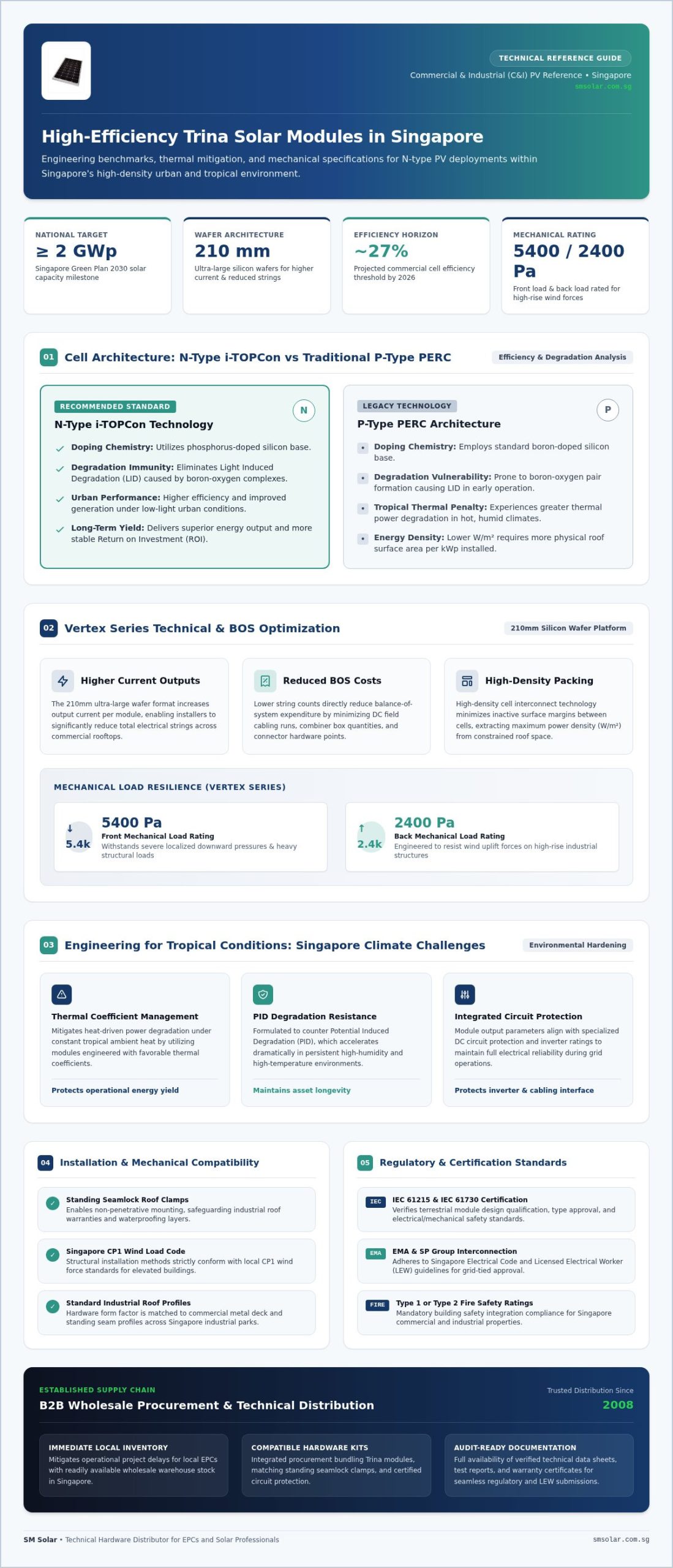
    Trina Solar maintains a significant presence in Singapore’s commercial and industrial (C&I) sectors, providing the high-efficiency hardware necessary for dense urban deployments. The manufacturer’s global scale and technological milestones, documented by Trina Solar, support large-scale projects requiring monocrystalline technology. This module type dominates the local landscape because of its superior power density compared to older polycrystalline alternatives. These high-performance modules align with the Singapore Green Plan 2030, which targets at least 2 gigawatt-peak (GWp) of solar capacity by 2030. Since 2008, SM Solar has operated as a technical hardware distributor, functioning as a logistical partner for EPCs procuring Trina solar panels SG alongside compatible mounting systems.

    Module Efficiency Standards for Urban Environments

    Singapore’s industrial rooftops often present limited surface area, making power density (W/m²) a primary procurement metric. High-efficiency monocrystalline modules allow installers to maximize energy output within these restricted footprints. Standardizing on high-wattage modules reduces the total number of mounting components and electrical connections required per kilowatt-peak (kWp).

    • N-type i-TOPCon technology: Delivers higher efficiency and better performance in low-light urban conditions compared to traditional P-type cells.
    • Fire Safety Compliance: Modules must meet Type 1 or Type 2 fire rating certifications for building safety integration.
    • Interconnect Density: High-density cell packing technology minimizes inactive space on the module surface to increase total output.

    Regulatory Compliance and EMA Guidelines

    All grid-tied systems in Singapore must comply with technical requirements established by the Energy Market Authority (EMA) and SP Group. Procuring Trina solar panels SG ensures that the core generating components meet the necessary international testing benchmarks for safety and reliability. Industrial project approval depends on the submission of comprehensive technical documentation during the commissioning phase.

    • IEC 61215: Verification of design qualification and type approval for terrestrial PV modules.
    • IEC 61730: Certification for photovoltaic module safety, addressing electrical and mechanical requirements.
    • Grid Connection: Compliance with the Singapore Electrical Code, ensuring that module output parameters align with inverter specifications and circuit protection ratings.

    Installers must verify that all hardware, including standing seamlock roof clamps and solar circuit protection, maintains the integrity of the total system. Reliable procurement through established B2B channels ensures that technical data sheets and warranty documentation are available for regulatory audits.

    Technical Specifications: Vertex and Vertex S+ Series Analysis

    The transition to 210mm ultra-large silicon wafer technology represents a shift in photovoltaic architecture. These larger wafers enable Trina solar panels SG to deliver higher current outputs, which reduces the total number of strings required in a commercial array. This reduction directly lowers Balance of System (BOS) costs by minimizing cabling and combiner box requirements. For industrial installers, the weight-to-power ratio remains a critical structural consideration. Modern Vertex modules provide high power density while maintaining a physical footprint that fits standard industrial roof profiles. Mechanical load specifications are equally vital for high-rise installations. These modules are typically rated for 5400 Pa front load and 2400 Pa back load, providing the necessary resilience against localized wind pressures. Installers should consult the EMA solar implementation guide to ensure system designs meet all Licensed Electrical Worker (LEW) and grid interconnection requirements.

    N-Type i-TOPCon Technology Overview

    N-type i-TOPCon (Industrial Tunnel Oxide Passivated Contact) cells represent the current efficiency benchmark for professional deployments. Unlike P-type PERC cells, N-type architecture uses phosphorus-doped silicon, which eliminates Light Induced Degradation (LID) caused by boron-oxygen complexes. This results in superior long-term energy yields and a more stable Return on Investment (ROI). By 2026, N-type technology is expected to push commercial cell efficiencies toward 27%, establishing a high-performance standard for urban energy systems. Higher bifaciality factors also allow for increased energy harvest in specific mounting configurations where rear-side light is available. Choosing Trina solar panels SG with N-type cells ensures that projects remain technologically relevant for the duration of their 25 to 30 year lifespan.

    Vertex S+ Dual-Glass Specifications

    The Vertex S+ series features a dual-glass structure that replaces the traditional backsheet with a second layer of heat-strengthened glass. This design achieves a Class A fire safety rating, which is essential for meeting Singapore industrial safety standards. The glass-on-glass construction provides an impermeable barrier against moisture and corrosive agents. This durability is particularly relevant for projects in coastal Singapore regions where salt spray and high humidity accelerate degradation in standard modules. These units carry extended product and power warranties, reflecting their structural stability. For technical procurement, you can verify hardware specifications and local availability through established distribution channels.

    Engineering for Tropical Environments: Heat and Humidity

    High ambient temperatures in Singapore directly impact PV voltage and total power output. While standard test conditions (STC) assume 25°C, actual cell temperatures in local industrial zones often exceed 60°C during peak irradiance. This thermal elevation triggers a linear decline in efficiency based on the specific temperature coefficient of the module. Deploying Trina solar panels SG requires a precise assessment of these thermal parameters to ensure accurate energy yield projections. Research from the Solar Energy Research Institute of Singapore confirms that durability testing under local conditions is essential to mitigate long-term degradation. Dual-glass module architectures manage thermal stress more effectively than traditional backsheet designs by providing uniform heat dissipation across the laminate structure.

    Temperature Coefficient and Energy Yield

    Singapore’s daily average temperature of 30°C to 34°C necessitates modules with low Pmax coefficients to maintain system performance. For every degree above the 25°C benchmark, power output decreases. Trina’s N-type modules typically feature a Pmax coefficient of approximately -0.30% per degree Celsius, which is superior to standard P-type alternatives. Lower Nominal Operating Cell Temperature (NOCT) ratings further enhance performance by allowing the module to maintain a lower internal temperature during operation. The Pmax temperature coefficient determines the specific percentage of power loss for every degree Celsius above standard test conditions, directly impacting the cumulative annual energy yield in tropical climates.

    Humidity Resistance and PID Prevention

    High-humidity environments exceeding 80% relative humidity accelerate Potential Induced Degradation (PID). This phenomenon occurs when stray currents leak from the PV cells to the module frame, causing significant power loss over time. Trina addresses this risk through the use of Polyolefin Elastomer (POE) encapsulation. POE provides superior water vapor resistance and lower ionic conductivity compared to standard Ethylene Vinyl Acetate (EVA) films. This material choice is critical for maintaining the dielectric strength of the module in wet conditions.

    • IP68 Junction Boxes: Sealed enclosures prevent moisture ingress during intense monsoon rain cycles.
    • Anodized Aluminum Frames: High corrosion resistance protects structural integrity in salt-laden coastal industrial sectors.
    • Dual-Glass Barrier: The impermeable nature of glass-on-glass construction eliminates the moisture-related cell corrosion common in backsheet-based modules.

    Selecting Trina solar panels SG with these specific tropical engineering features ensures that industrial arrays maintain their rated output despite the environmental rigors of the region. Technical procurement should prioritize these material specifications to secure long-term asset reliability.

    Trina Solar SG: Tech Spec Guide for Installers

    Installation and Mounting Compatibility Standards

    Mechanical integration of Trina solar panels SG requires strict adherence to Singapore CP1 standards for wind load resistance. High-rise industrial buildings in the region are subject to significant wind pressures, particularly during monsoon cycles. Structural compliance depends on the precision of the clamp-to-rib interface and the load-bearing capacity of the mounting rails. Installers must verify that the chosen mounting hardware supports the specific frame dimensions and mechanical load ratings of the Vertex series modules. Grounding and bonding remain mandatory to prevent electrical hazards and ensure system longevity. Frame-to-rail continuity must be established using certified bonding washers or integrated grounding pins within the module clamps. These components ensure that the entire array maintains a common potential, reducing the risk of static buildup and electrical faults.

    Non-Penetrative Mounting for Industrial Roofs

    Industrial deployments often utilize standing seam metal roofs where penetration is prohibited by building warranties. Utilizing Standing Seamlock Roof Clamps allows for secure module attachment without compromising the weatherproof layer. This method distributes mechanical loads across the roof ribs, maintaining structural compliance without the need for drilling. It’s essential for installers to match clamp torque specifications with the module manufacturer’s requirements to avoid frame deformation. This hardware configuration supports the high-wattage Vertex series, ensuring that large-format modules remain stable under localized wind pressures. Non-penetrative solutions are the preferred standard for maintaining the long-term integrity of industrial roof assets while facilitating rapid PV deployment.

    Circuit Protection and Safety Gear

    Electrical safety in 1500V system architectures necessitates specialized DC circuit protection. Singapore’s high lightning density requires the integration of Type 2 surge protection devices (SPDs) within DC combiner boxes. These components protect both the PV array and the downstream power electronics from transient overvoltages. Compatibility with industrial hybrid inverters and MPPT charge controllers must be verified against the module’s maximum power current (Imp) and open-circuit voltage (Voc) values. Proper sizing of solar circuit protection prevents thermal events and equipment failure during system faults.

    • DC Disconnect Switches: Must be rated for full load breaking capacity at maximum system voltage.
    • MPPT Input Windows: Ensure module string configurations stay within the operating voltage range of the inverter.
    • Bonding Conductors: Use of UV-resistant copper cabling for all external grounding paths.

    System reliability depends on the quality of these protective elements and their correct installation. You can procure industrial-grade circuit protection and compatible mounting hardware through our local distribution network to ensure full compliance with Singapore engineering standards.

    Procurement Logistics and Inventory Availability

    Professional procurement requires a dependable logistical partner. SM Solar functions as a master distributor, ensuring the availability of Tier 1 monocrystalline PV modules for high-volume EPC projects. Securing Trina solar panels SG through established B2B channels minimizes the risk of project delays. We maintain inventory reliability by managing the technical hardware supply chain, providing components that meet the rigorous standards of industrial solar deployments. This systematic approach ensures that hardware arrives on-site according to project timelines. Our organization prioritizes functional reliability over marketing narrative, acting as a robust link in the professional supply chain for seasoned industry veterans.

    Wholesale Distribution to Malaysia and Singapore

    Efficient cross-border logistics are essential for regional industrial solar projects. We facilitate bulk procurement pathways for installers operating in both markets, managing the complexities of international transport and inventory allocation. Lead times for bulk orders are optimized through strategic inventory management, ensuring that Tier 1 hardware is accessible for large-scale arrays. Installers seeking Wholesale Solar Panels Malaysia can leverage our established distribution network to streamline their hardware acquisition. This logistical support reduces the administrative burden on EPCs, allowing them to focus on engineering and execution. Consistent stock availability across both regions supports the rapid deployment of high-efficiency PV systems. We ensure that every shipment meets the exact technical requirements specified in the project engineering phase.

    Technical Support and Warranty Claims

    Reliability in the supply chain extends beyond delivery. We provide local technical support for manufacturer warranty verification, serving as a direct point of contact for EPCs. In the event of damaged or defective modules, replacement protocols are managed with technical precision to minimize downtime. Accessing technical data sheets, installation manuals, and certification documents is streamlined through our professional catalog. This ensures that all Trina solar panels SG deployments are backed by the necessary documentation for regulatory compliance and long-term asset management. Our role as a silent partner provides the stability required for high-volume industrial projects. We maintain a high technical register in all communications, providing precise data for engineering reviews and project commissioning. This methodical pacing ensures that procurement professionals feel they’re dealing with a highly organized and efficient operation.

    Optimizing Industrial PV Performance in Singapore

    Successful solar deployment in Singapore’s tropical climate depends on aligning module technology with specialized mounting and circuit protection. N-type i-TOPCon architecture provides the necessary resistance to Potential Induced Degradation (PID) while maintaining high energy yields during peak thermal cycles. Verification of mechanical compatibility with non-penetrative hardware, such as standing seamlock roof clamps, ensures adherence to local engineering standards and protects building warranties. Integration matters for system longevity. Technical precision remains the baseline for all professional arrays.

    SM Solar has operated as a Tier 1 hardware distributor since 2008, specializing in industrial mounting solutions and high-volume logistics. We provide the technical precision required for large-scale EPC projects involving Trina solar panels SG. Professional-grade procurement through a local partner ensures inventory reliability and full compliance with Singapore electrical codes. Inquire for Trina Solar Wholesale Specifications to secure high-efficiency PV modules for your next project.

    Selecting the correct technical specifications and compatible hardware streamlines the installation process and secures long-term asset performance.

    Frequently Asked Questions

    Are Trina solar panels available for immediate wholesale in Singapore?

    SM Solar maintains local inventory for immediate wholesale procurement of Trina solar panels SG. We function as a logistical partner for EPCs, ensuring that Tier 1 monocrystalline modules are available for industrial project timelines. Warehouse operations in Singapore and Malaysia support bulk distribution, reducing lead times for regional installers. Inventory levels are managed to provide consistent access to high-efficiency modules for commercial and industrial deployments.

    What is the difference between Trina Vertex S and Vertex S+ modules?

    The primary difference lies in cell architecture and structural composition. The Vertex S series typically utilizes P-type PERC cells with a traditional backsheet. In contrast, the Vertex S+ series features N-type i-TOPCon technology and a dual-glass structure. This dual-glass design achieves a Class A fire rating and provides superior resistance to moisture ingress. S+ modules generally offer longer product and power warranties due to their enhanced durability.

    How do Trina solar panels perform in Singapore’s high humidity?

    Trina modules are engineered with Polyolefin Elastomer (POE) encapsulation to mitigate the risks associated with Singapore’s high relative humidity. POE provides a superior moisture barrier compared to standard EVA films, effectively preventing Potential Induced Degradation (PID). This material choice maintains the dielectric strength of the module during intense monsoon cycles. These technical specifications ensure that the array maintains its rated output in high-humidity tropical environments over its entire lifespan.

    Can Trina modules be used with non-penetrative standing seam clamps?

    These modules are fully compatible with non-penetrative mounting hardware for industrial standing seam roofs. SM Solar supplies specialized standing seamlock roof clamps that secure the module frame to the roof rib without piercing the weatherproof layer. This configuration preserves building warranties and meets Singapore CP1 wind load requirements. Installers must ensure that clamp torque settings align with Trina’s mechanical load specifications for the Vertex series to prevent frame deformation.

    What is the warranty period for Trina Solar panels in the SG market?

    Warranty terms vary by module series and technology type. Standard Vertex S modules typically carry a 15-year product warranty and a 25-year linear power warranty. The Vertex S+ dual-glass series often features an extended 25-year product warranty and a 30-year power warranty. These warranties cover manufacturing defects and specify maximum annual degradation rates. Local support for warranty verification is available through SM Solar’s distribution office in Singapore.

    Do I need specific circuit protection for a 1500V Trina Solar system?

    High-voltage 1500V system architectures require specialized DC circuit protection to ensure operational safety. This includes DC disconnect switches and surge protection devices (SPDs) rated specifically for 1500V DC operation. Standard 1000V components are insufficient and present a thermal hazard. Proper protection prevents equipment failure during transient overvoltages, which are common in Singapore’s lightning-prone environment. SM Solar stocks compatible 1500V solar circuit protection hardware for industrial arrays.

    Does SM Solar provide installation services for Trina panels?

    SM Solar does not provide installation services, residential cleaning, or consumer financing. Our operations are strictly focused on the B2B distribution of solar energy equipment and hardware. We act as a logistical partner for EPCs and professional installers by providing monocrystalline panels, LiFePO4 batteries, and mounting systems. Installation and commissioning must be performed by a Licensed Electrical Worker (LEW) or a Qualified Person (QP) to meet Singapore standards.

    How does the temperature coefficient of Trina panels affect SG energy yield?

    The temperature coefficient determines the rate of power loss as cell temperatures exceed 25°C. In Singapore, cell temperatures frequently reach 60°C, making a lower coefficient essential for high energy yields. Trina’s N-type modules feature a Pmax coefficient of approximately -0.30% per degree Celsius. This performance metric ensures that Trina solar panels SG maintain higher efficiency during peak midday irradiance compared to older P-type technology with higher thermal degradation rates.