Category: Uncategorized

  • Tropical Off-Grid Solar Hardware Guide (2026)

    Tropical Off-Grid Solar Hardware Guide (2026)

    Standard off-grid solar hardware will fail prematurely when deployed in equatorial environments without specialized thermal and corrosion engineering. Field engineers and project developers frequently observe nameplate ratings collapse under sustained ambient temperatures above 40°C, chronic relative humidity, and airborne marine salinity. When balance of system components lack tropical hardening, installations suffer from accelerated battery cell degradation, recurring inverter thermal derating, and galvanic corrosion across structural roof attachments.

    Designing for industrial reliability requires equipment specifications that account directly for tropical operating stress rather than standard laboratory conditions. This technical guide details the precise parameters required to select, size, and deploy resilient balance of system hardware engineered for harsh microclimates. You’ll review component-level thermal derating calculations, mandatory ingress protection benchmarks, and verified distribution channels for sourcing Tier-1 hardware directly within Singapore and Malaysia.

    Key Takeaways

    • Engineering resilient off-grid solar hardware requires applying Pmax temperature coefficients to calculate true PV module wattage at 65°C cell operating thresholds.
    • Lithium LiFePO4 batteries deliver superior thermal stability and higher round-trip efficiency over legacy chemistries under sustained ambient heat.
    • Non-penetrative standing seamlock roof clamps and heavy-duty pole mounts prevent structural galvanic corrosion across high-humidity and marine-exposed sites.
    • Dedicated DC solar circuit protection paired with properly derated hybrid inverters isolates transient inductive surges and prevents catastrophic system trips.
    • Procuring Tier-1 balance of system components directly from regional stockists in Singapore and Malaysia eliminates project lead times and ensures standard electrical compliance.

    Fundamental Architecture of Tropical Off-Grid Solar Systems

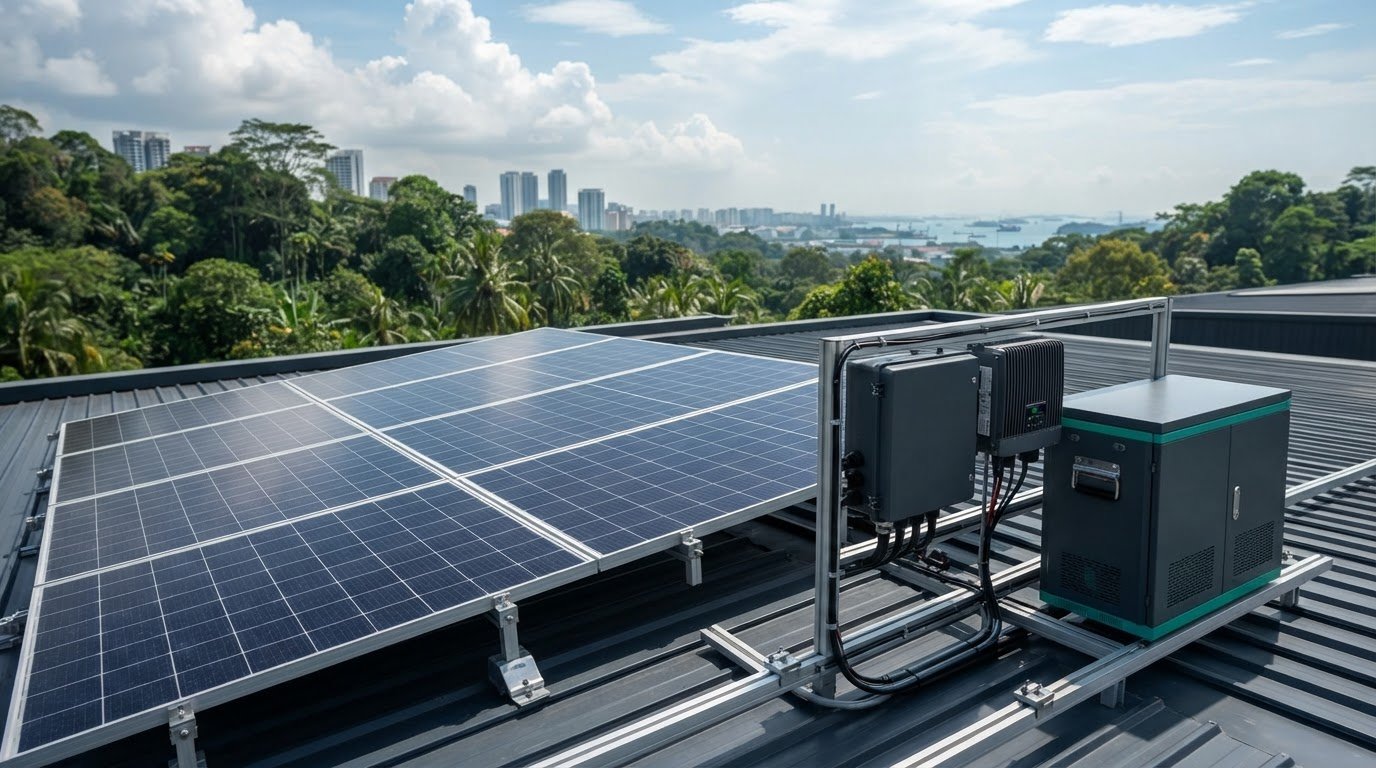
    A resilient Stand-alone power system (SAPS) relies on four core engineering blocks: photovoltaic power generation, solid-state voltage conversion, chemical energy storage, and balance of system circuit protection. Equatorial deployments capture intense global horizontal irradiance (GHI), but high irradiance is coupled with extreme ambient thermal loads that depress module voltage. Deploying industrial off-grid solar hardware in this climate requires strict hardware hardening. Enclosures housing sensitive power electronics must achieve IP65 ingress protection at minimum to seal internal circuitry against fine atmospheric particulates and driven monsoonal rain. System continuity depends on matching PV string voltage windows under maximum operating temperatures with charge controller tracking thresholds.

    Core Operating Challenges in Equatorial Environments

    Equatorial microclimates introduce distinct failure mechanisms that standard temperate balance of system designs fail to mitigate:

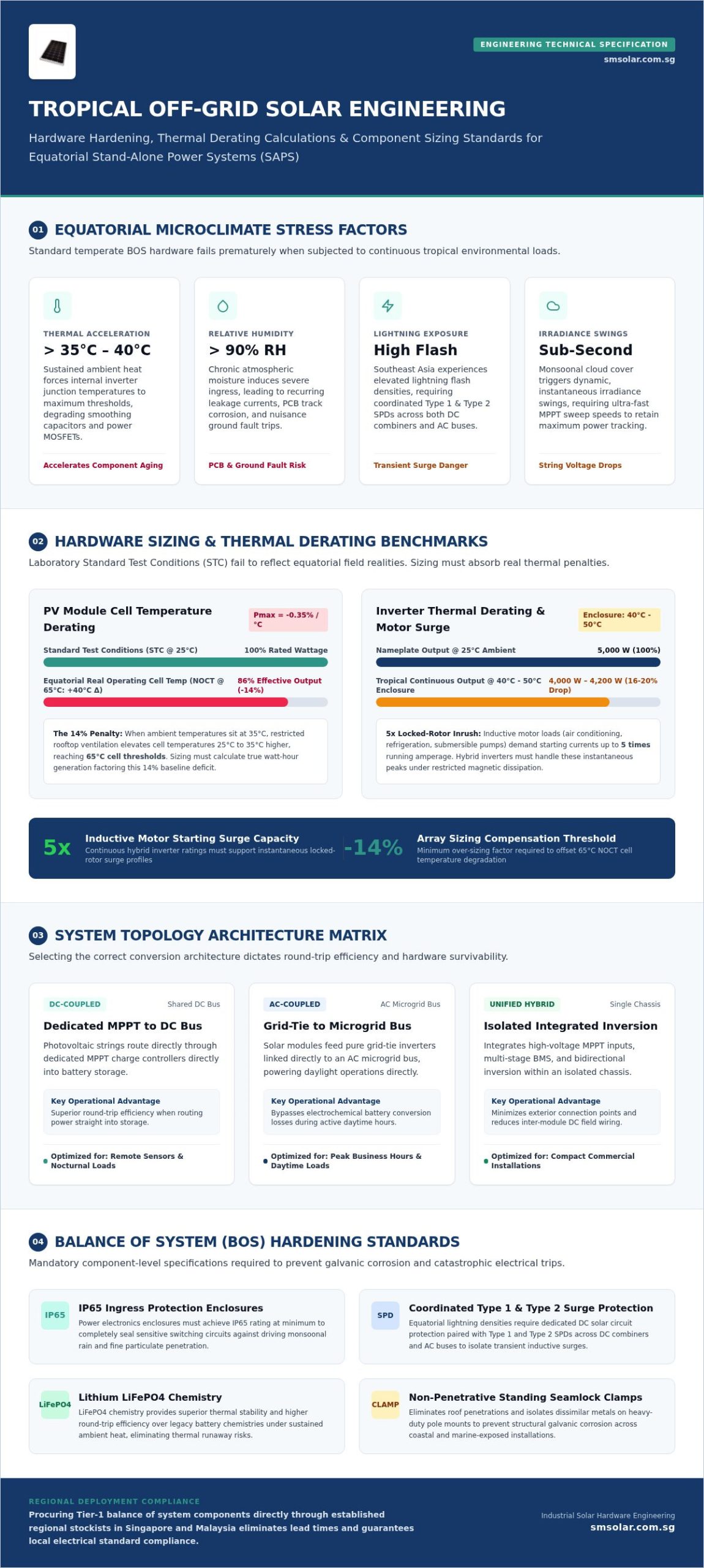
    • Thermal acceleration: Ambient temperatures continuously above 35°C push internal inverter junction temperatures near maximum design thresholds, degrading smoothing capacitors and power switching MOSFETs.
    • Relative humidity: Atmospheric moisture levels consistently exceeding 90% induce moisture ingress, leading to leakage currents, PCB track corrosion, and ground fault trips.
    • Dynamic irradiance swings: Monsoonal cloud cover causes severe, instantaneous irradiance fluctuations. Solar charge controllers require sub-second MPPT sweep speeds to retain maximum power extraction without dropping string voltage.
    • Lightning exposure: High localized lightning flash densities across Southeast Asia demand coordinated Type 1 and Type 2 surge protection devices installed across both DC combiner outputs and AC distribution buses.

    AC-Coupled vs DC-Coupled System Architectures

    Selecting an architecture dictates conversion efficiency and component survivability based on operational duty cycles:

    • DC-Coupled Topologies: Photovoltaic strings route directly through dedicated MPPT solar charge controllers to a shared DC bus. This configuration delivers superior round-trip efficiency when routing solar power directly into battery storage, making it the preferred standard for remote sensor systems and nocturnal load profiles.
    • AC-Coupled Topologies: Modules feed pure grid-tie inverters linked directly to an AC microgrid bus. Energy feeds daytime operational loads immediately without passing through the battery bank, bypassing electrochemical conversion losses during peak business hours.
    • Unified Hybrid Inverters: Modern commercial off-grid solar hardware frequently integrates high-voltage MPPT inputs, multi-stage battery management, and bidirectional inversion within an isolated, single-chassis hybrid inverter, reducing inter-module DC wiring and exterior connection points.

    How to Size Off-Grid Solar Hardware for High-Temperature Climates

    Accurate hardware sizing in tropical zones begins with an audit of the continuous operational load combined with inductive motor starting surges. Air conditioning, industrial refrigeration, and submersible pumping equipment impose locked-rotor current draw up to five times higher than running amperage. Hybrid inverters must handle these instantaneous peaks without triggering overload faults. Because high ambient heat limits the natural heat dissipation of magnetic components, continuous inverter output must be evaluated at elevated operating thresholds. A unit rated for 5,000 W at 25°C typically delivers only 4,000 W to 4,200 W under sustained 40°C to 50°C enclosure temperatures.

    Quantifying Temperature Coefficient Losses on PV Modules

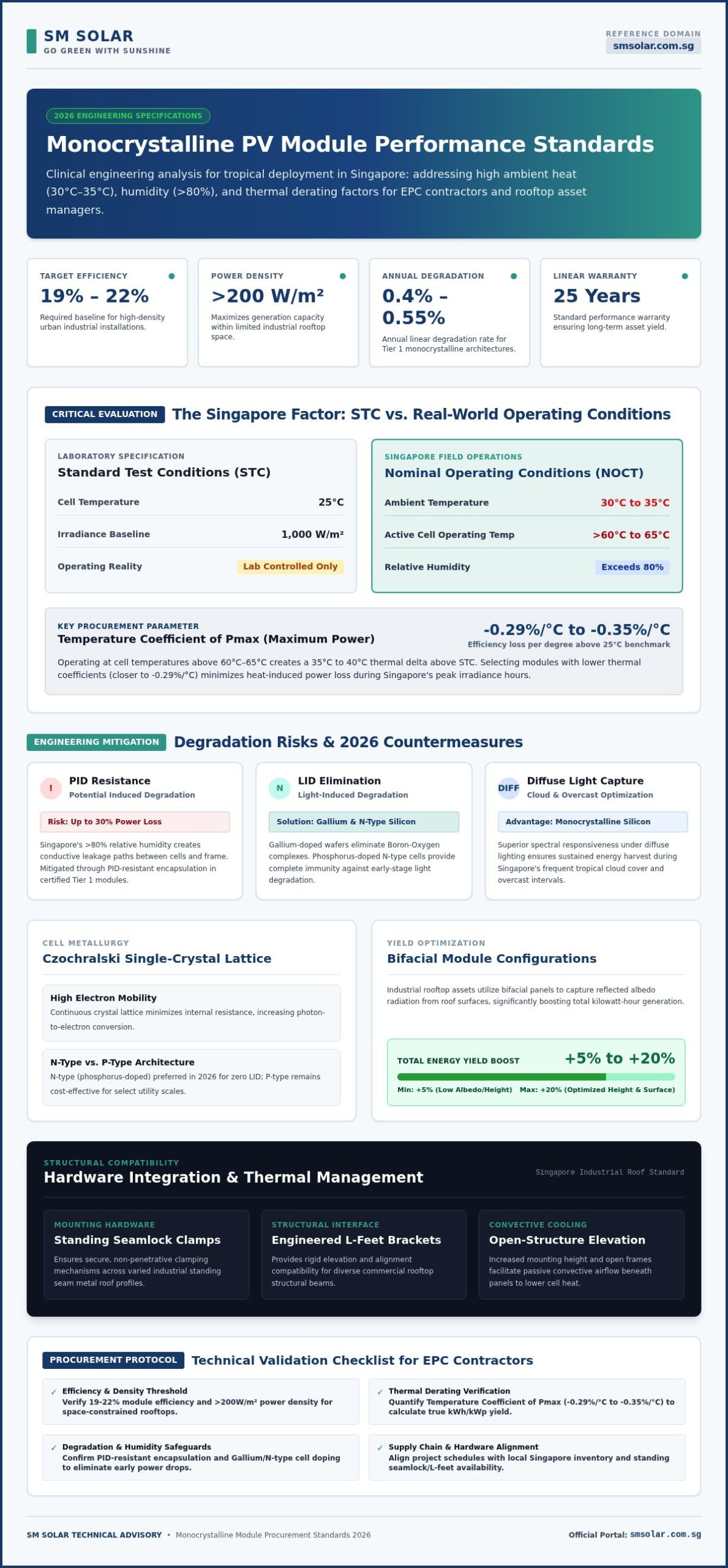
    Standard Test Conditions (STC) evaluate module output at 25°C, a benchmark disconnected from equatorial site reality. Flush rooftop installations restrict ventilation, driving cell temperatures 25°C to 35°C above ambient levels. When ambient temperatures hover around 35°C, real operating cell temperatures (NOCT) routinely hit 65°C. Industrial monocrystalline solar panels exhibit a maximum power temperature coefficient (Pmax) around -0.35%/°C. Operating at a 40°C delta over STC causes a 14% drop in peak power wattage. Sizing the PV array requires factoring in this thermal penalty to guarantee sufficient daily watt-hour generation.

    High temperatures also depress module voltage (Voc and Vmp). Engineers must calculate minimum string voltage at 65°C to ensure the array’s maximum power voltage remains safely within the MPPT solar charge controllers tracking window during noon peak irradiance hours.

    Calculating Energy Storage Autonomy and Thermal Derating

    Storage sizing demands a buffer against protracted monsoonal weather patterns across the region:

    • Autonomy margins: System engineers should incorporate a minimum of 2 to 3 days of autonomy to maintain continuous operations throughout prolonged overcast periods.
    • Depth-of-Discharge (DoD) boundaries: Lithium LiFePO4 batteries should operate within an 80% DoD profile. This operational window preserves cell chemistry and guarantees 6,000+ cycle service life.
    • Thermal management: Chemical cell degradation accelerates significantly when batteries sit above 30°C. Storage banks require shaded, cross-ventilated battery enclosures or climate-controlled rooms to preserve capacity retention.

    For industrial deployments requiring balanced arrays and verified component compatibility, engineering teams source regional off-grid solar hardware to meet exact thermal derating specifications.

    Component Selection Matrix: Industrial Off-Grid Hardware Specifications

    Deploying industrial off-grid solar hardware requires selecting components rated for extreme mechanical, thermal, and electrical stress. Generic balance-of-system hardware fails to deliver sustained output when exposed to persistent heat and monsoonal humidity. Systems must leverage specialized semiconductor topologies, resilient chemical storage cells, and robust enclosures designed specifically for unconditioned operating environments.

    Monocrystalline Solar Panels and Inverter Matching

    Modern off-grid generation relies on high-efficiency monocrystalline solar panels. Half-cut PERC and TOPCon cell architectures maximize diffuse irradiance capture during overcast periods while lowering internal cell resistance. This layout mitigates hot-spot formation under localized debris or shading.

    Matching modules to hybrid inverters requires assessing inductive load dynamics alongside steady-state demand:

    • Inductive surge handling: Hybrid inverters must sustain three times their continuous wattage rating for a minimum of 5 to 10 seconds. This headroom starts heavy compressor and motor loads without voltage sags.
    • PCB environmental protection: Industrial transformerless inverters require conformal-coated printed circuit boards (IPC-A-610 Class 3). This barrier prevents short-circuit tracking caused by airborne condensation and ionic salt deposits.
    • Auxiliary power control: Integrated dry-contact relays automate auxiliary diesel generator start cycles, triggering automatically when battery state-of-charge breaches preset lower limits during consecutive rain days.

    Lithium LiFePO4 Battery Storage Specifications

    Energy storage selection has transitioned entirely toward Lithium Iron Phosphate (LiFePO4) chemistry. Lithium LiFePO4 batteries eliminate the thermal runaway hazards inherent in cobalt-based lithium formulations (NMC/LCO). They feature an elevated thermal decomposition threshold of approximately 270°C, delivering essential stability in tropical installations.

    Key parameters for industrial storage banks include:

    • BMS communication integration: Integrated Battery Management Systems must maintain closed-loop communications with the hybrid inverter via CAN bus or RS485 protocols. Closed-loop control enables precise dynamic regulation of charge currents based on real-time cell temperatures.
    • Charge acceptance rates: Industrial LiFePO4 units handle continuous 0.5C to 1C charge rates. This rapid acceptance allows storage banks to absorb high current during short, intense clear-sky intervals between monsoonal squalls.
    • Form factor scalability: Modular 19-inch rack-mounted enclosures simplify deployment inside ventilated cabinets, allowing EPC contractors to expand storage capacity in parallel without requiring custom busbar retrofits.

    Pairing these storage units with rapid-tracking MPPT solar charge controllers ensures dynamic optimization across unpredictable cloud cover, keeping industrial off-grid solar hardware running without power interruptions.
    Tropical Off-Grid Solar Hardware Guide (2026)

    Mounting Mechanics and Electrical Circuit Protection Standards

    Mechanical stability and electrical safety represent critical engineering priorities across coastal equatorial installations. Airborne chlorides and constant ambient moisture create an active electrolyte layer on structural surfaces. Without correct material isolation, dissimilar metals trigger rapid galvanic corrosion, seizing fasteners and compromising structural integrity. Off-grid solar hardware also requires specialized DC circuit protection. Direct current lacks the natural zero-crossing point found in AC alternating currents, meaning sustained DC arcs can cause catastrophic terminal burnouts and equipment failure.

    Structural Hardware and Corrosion Prevention

    Marine salinity accelerates chemical oxidation across unhardened structural metals. Deployments demand structural AL6005-T5 anodized aluminum racking paired exclusively with SUS304 or marine-grade SUS316 stainless steel fasteners:

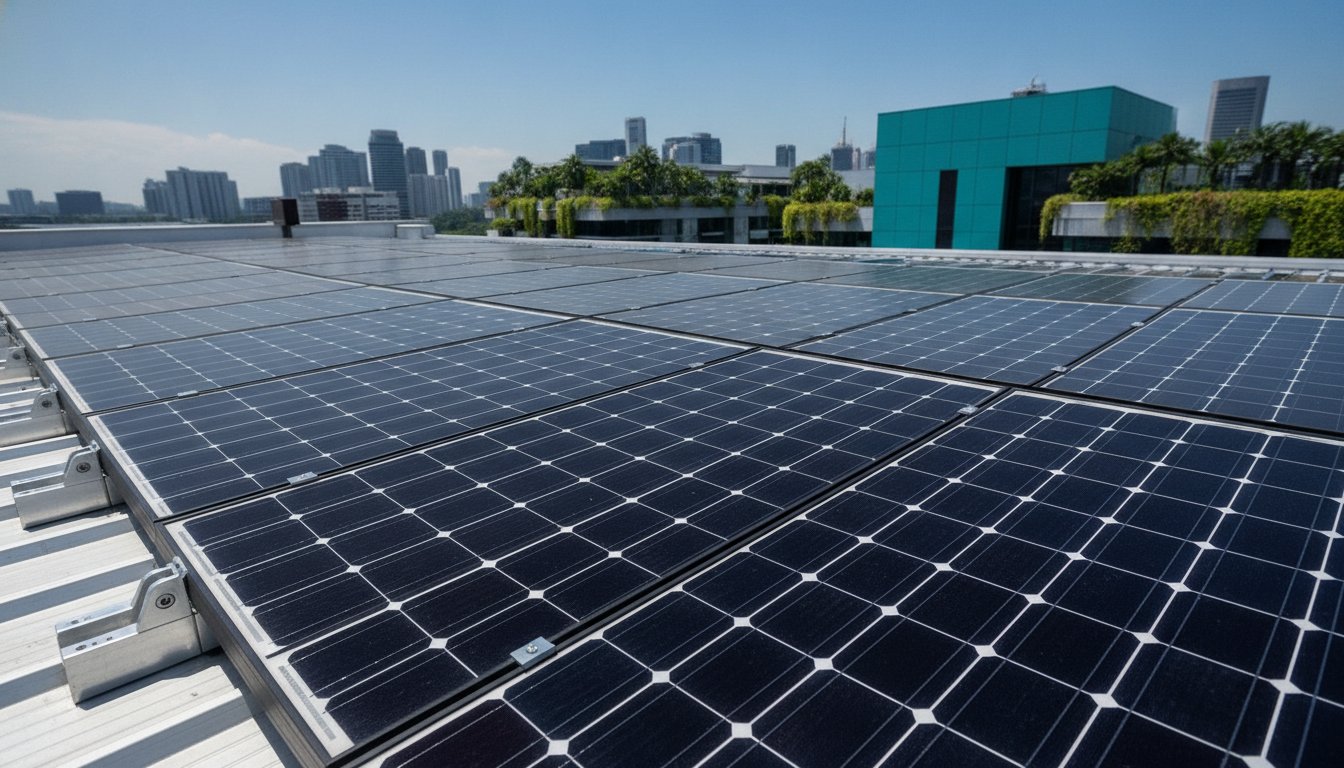
    • Non-penetrative standing seam clamps: Standing seamlock roof clamps secure arrays to industrial standing-seam profiles without piercing roof sheets. This mechanical clamping eliminates leak paths during torrential monsoonal downpours. Integrated high-density EPDM rubber isolation pads prevent galvanic reactions between aluminum clamp bodies and coated steel roofing.
    • Industrial pole mount assemblies: Heavy-duty solar panel pole mounts anchor off-grid telemetry, marine navigation aids, and perimeter security arrays. These assemblies utilize hot-dip galvanized steel masts engineered to withstand monsoonal wind loads exceeding 35 m/s.

    DC Circuit Breakers, Disconnects, and Surge Protection

    Protecting balance-of-system hardware requires dedicated electrical components built to extinguish continuous direct current arcs:

    • DC miniature and molded case breakers: Standard AC circuit breakers cannot be retrofitted for solar applications because their contact gaps are insufficient to quench DC arcs. Installers must deploy dedicated DC circuit breakers rated for maximum open-circuit array voltages and prospective short-circuit currents.
    • Rotary DC disconnect switches: Load-break disconnect switches installed line-of-sight to hybrid inverters enable rapid, safe physical isolation of battery banks and solar arrays during scheduled maintenance.
    • Transient surge suppression: Installing Type 2 DC Surge Protection Devices (SPDs) across array combiner boxes clamps high-voltage spikes induced by equatorial lightning activity before transient overvoltages reach sensitive charge controller circuitry.

    To ensure balance-of-system durability across challenging equatorial environments, source industrial mounting hardware and DC protection components directly from regional stockists.

    Sourcing and Deploying Off-Grid Solar Hardware in Southeast Asia

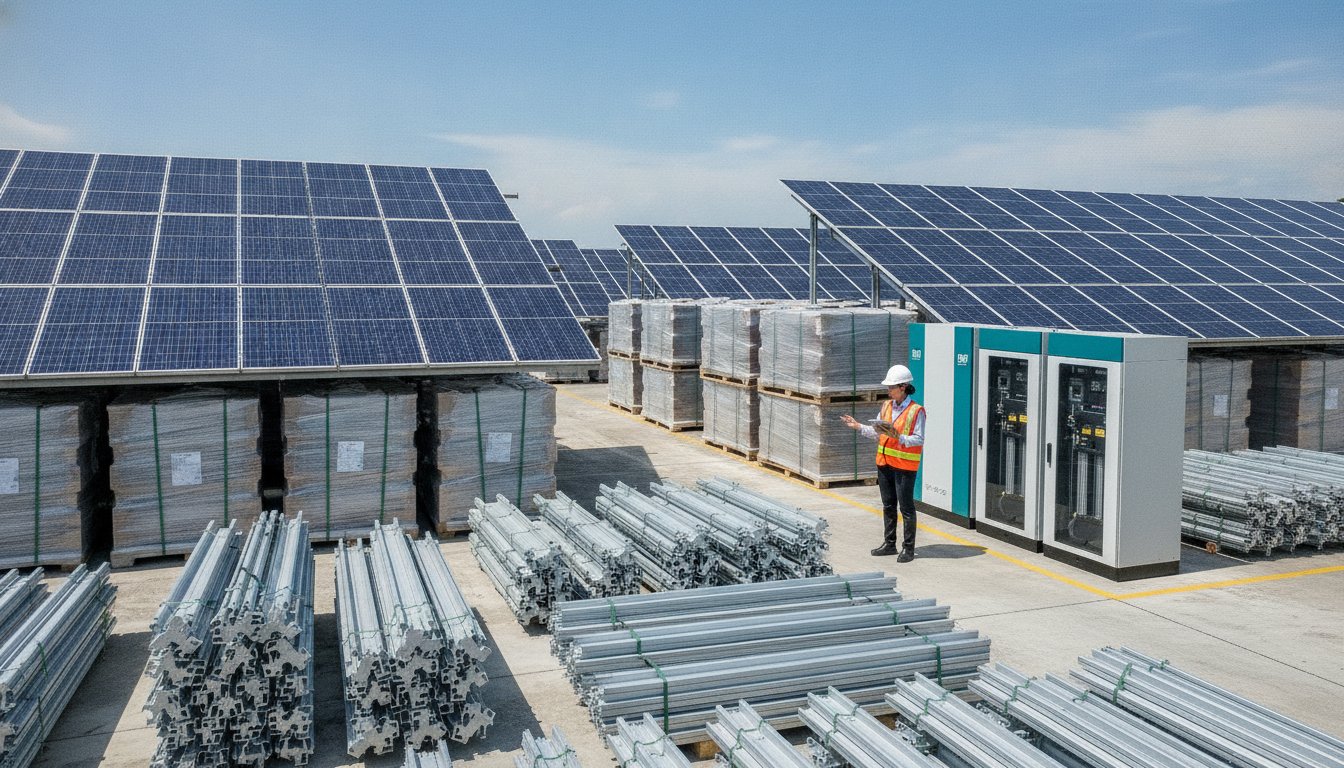
    Direct component procurement eliminates lengthy international freight backlogs for commercial infrastructure projects. Sourcing off-grid solar hardware through verified regional stockists ensures adherence to electrical standards across Singapore and Malaysia while bypassing volatile cross-continental customs bottlenecks. Centralized warehousing in Singapore enables rapid overland and maritime dispatch to remote project locations throughout the region, keeping installation schedules predictable.

    Supply Chain Consistency for Industrial EPC Installers

    EPC contractors managing off-grid microgrid installations require predictable delivery schedules and rigorous component verification. Relying on fragmented overseas dropshipping introduces severe schedule vulnerabilities and warranty risks:

    • Warehouse inventory security: Local stockholding allows contractors to draw down balance-of-system hardware on demand, eliminating the 12- to 16-week lead times typical of factory-direct overseas orders.
    • Synchronized delivery staging: Consolidating panels, storage units, inverters, and structural racking into synchronized batch shipments lowers site staging expenses and mitigates equipment loss in unconditioned field storage.
    • Enforceable regional warranties: Procuring hardware through established regional channels ensures direct access to engineering datasheets, factory compliance documentation, and rapid return-merchandise authorization (RMA) processing without international shipping disputes.

    Procuring Commercial Solar Hardware via SM Solar

    Established in 2008 with headquarters in Singapore, SM Solar serves as a specialized master distributor delivering industrial-grade equipment across Singapore and Malaysia. Direct inventory management provides commercial contractors with rapid access to verified balance of system hardware engineered for extreme tropical conditions.

    Available wholesale inventory lines include:

    • Generation and Storage: High-efficiency monocrystalline solar panels alongside high-cycle lithium LiFePO4 batteries engineered for high-temperature resilience.
    • Power Conversion: Industrial MPPT solar charge controllers and rugged hybrid inverters with conformal-coated electronics.
    • Mounting and Safety: Non-penetrative standing seamlock roof clamps, heavy-duty solar panel pole mounts, and dedicated high-voltage DC solar circuit protection devices.

    EPC contractors and commercial developers can access technical specifications and review component availability directly through SM Solar to support upcoming regional microgrid deployments.

    Deploying Long-Term Reliability in Equatorial Solar Infrastructure

    Operating autonomous power systems under persistent tropical heat and humidity requires hardware engineered beyond standard laboratory ratings. Calculating precise thermal derating on monocrystalline arrays, deploying intrinsically safe lithium LiFePO4 battery chemistry, and isolating conductors with dedicated DC circuit protection prevents catastrophic field failures. Pairing these electrical safeguards with non-penetrative standing seamlock clamps ensures mechanical longevity against coastal corrosion and high-velocity monsoonal winds.

    As an established Singapore distributor operating since 2008, SM Solar maintains immediate warehouse stock of high-efficiency monocrystalline panels, LiFePO4 batteries, hybrid inverters, and complete balance of system hardware. Securing industrial components from a dedicated regional master distributor eliminates overseas freight backlogs and guarantees strict specification compliance across Singapore and Malaysia. Procure certified off-grid solar hardware from SM Solar to build high-uptime microgrid infrastructure engineered for equatorial operating environments.

    Frequently Asked Questions

    Is an off-grid solar system reliable during prolonged tropical rainy seasons?

    Yes, an off-grid solar system maintains continuous reliability during monsoonal weather when sized with adequate autonomy margins. Systems deployed in Singapore and Malaysia typically integrate two to three days of battery storage autonomy alongside rapid-tracking MPPT solar charge controllers. These controllers capture diffuse sunlight through thick cloud bands, while hybrid inverters with dry-contact relays automatically activate backup generator inputs if storage levels fall below predefined reserve limits.

    Can lithium LiFePO4 batteries operate safely in high ambient humidity and heat?

    Lithium LiFePO4 batteries provide excellent thermal stability under high ambient heat, eliminating the thermal runaway risks seen in cobalt chemistries. They withstand cell temperatures up to 55°C without decomposing. However, preserving their 6,000-cycle design life requires housing them in IP54 or IP65 ventilated enclosures. This shielding protects the integrated Battery Management System electronics from condensation, fungal growth, and track corrosion caused by sustained 90% humidity.

    How much power do monocrystalline solar panels lose in tropical temperatures?

    Monocrystalline solar panels typically lose 10% to 15% of their rated output when operating on tropical rooftops. While standard nameplate wattage is measured at 25°C, tropical cell temperatures regularly reach 65°C under direct equatorial sun. Applying a standard Pmax temperature coefficient of -0.35%/°C results in a direct 14% power drop. System designers must account for this loss when calculating daily watt-hour yields for off-grid solar hardware.

    What happens if you use standard AC breakers instead of dedicated DC circuit protection?

    Using standard AC circuit breakers in direct-current solar circuits creates an immediate fire hazard. Direct current doesn’t pass through a natural zero-voltage point, meaning continuous electrical arcs don’t extinguish automatically when contacts open under load. AC breakers lack the magnetic arc chutes and contact gaps required to quench DC arcs, resulting in contact welding, terminal burnout, and complete loss of circuit isolation during electrical faults.

    Can standing seamlock roof clamps withstand monsoonal wind loads without penetrating the roof?

    Yes, precision-engineered standing seamlock roof clamps withstand extreme monsoonal uplift pressures without puncturing metal roofing. These structural aluminum clamps grip the rolled standing seams using high-tensile stainless steel set screws, preserving the building’s watertight barrier entirely. Certified clamp assemblies deliver mechanical pull-out resistance designed to meet local building codes and resist regional wind velocities exceeding 35 m/s across Singapore and Malaysia industrial structures.

    How do you prevent galvanic corrosion on tropical solar panel mounting structures?

    Preventing galvanic corrosion requires isolating dissimilar metals that possess different electrochemical potentials. In marine or humid tropical microclimates, technicians must never place bare copper or structural steel in direct physical contact with aluminum mounting rails. Standard practice requires using marine-grade SUS304 or SUS316 stainless steel fasteners, structural anodized aluminum framing, and non-conductive EPDM rubber isolation pads beneath every roof clamp and rail connection.

  • Trina Solar SG: Tech Spec Guide for Installers

    Trina Solar SG: Tech Spec Guide for Installers

    The performance gap between high-efficiency N-type modules and standard PERC technology is widest in high-temperature, high-humidity environments like Singapore. You’ve likely encountered the technical hurdles of managing Potential Induced Degradation (PID) while trying to secure reliable local warranty support for large-scale deployments. It’s a common operational challenge. EPCs need precise hardware compatibility and immediate stock availability to meet tight project timelines. This guide serves as a comprehensive technical reference for procuring and installing high-efficiency Trina solar panels SG within the local tropical context.

    We provide the specific data necessary to ensure full compliance with Singapore electrical standards and optimize system longevity. You’ll find detailed specifications on module efficiency, thermal coefficients, and mechanical load ratings. Integration matters. We address compatibility with standing seamlock roof clamps and specialized circuit protection. This analysis streamlines the procurement process by verifying local inventory parameters and technical benchmarks for professional-grade PV installations. By aligning module selection with localized hardware, you can maintain high energy yields and secure long-term asset performance.

    Key Takeaways

    • Evaluate the performance advantages of N-type i-TOPCon technology over P-type PERC cells to optimize energy yield for high-density urban deployments.
    • Analyze temperature coefficients to mitigate power degradation and manage thermal impacts on Trina solar panels SG within Singapore’s high-humidity environment.
    • Verify mechanical compatibility with standing seamlock roof clamps to ensure non-penetrative mounting that adheres to Singapore CP1 wind load standards.
    • Streamline project timelines by accessing verified wholesale inventory and technical documentation through established B2B logistical channels.

    Trina Solar Modules in the Singapore Energy Market

    Trina Solar maintains a significant presence in Singapore’s commercial and industrial (C&I) sectors, providing the high-efficiency hardware necessary for dense urban deployments. The manufacturer’s global scale and technological milestones, documented by Trina Solar, support large-scale projects requiring monocrystalline technology. This module type dominates the local landscape because of its superior power density compared to older polycrystalline alternatives. These high-performance modules align with the Singapore Green Plan 2030, which targets at least 2 gigawatt-peak (GWp) of solar capacity by 2030. Since 2008, SM Solar has operated as a technical hardware distributor, functioning as a logistical partner for EPCs procuring Trina solar panels SG alongside compatible mounting systems.

    Module Efficiency Standards for Urban Environments

    Singapore’s industrial rooftops often present limited surface area, making power density (W/m²) a primary procurement metric. High-efficiency monocrystalline modules allow installers to maximize energy output within these restricted footprints. Standardizing on high-wattage modules reduces the total number of mounting components and electrical connections required per kilowatt-peak (kWp).

    • N-type i-TOPCon technology: Delivers higher efficiency and better performance in low-light urban conditions compared to traditional P-type cells.
    • Fire Safety Compliance: Modules must meet Type 1 or Type 2 fire rating certifications for building safety integration.
    • Interconnect Density: High-density cell packing technology minimizes inactive space on the module surface to increase total output.

    Regulatory Compliance and EMA Guidelines

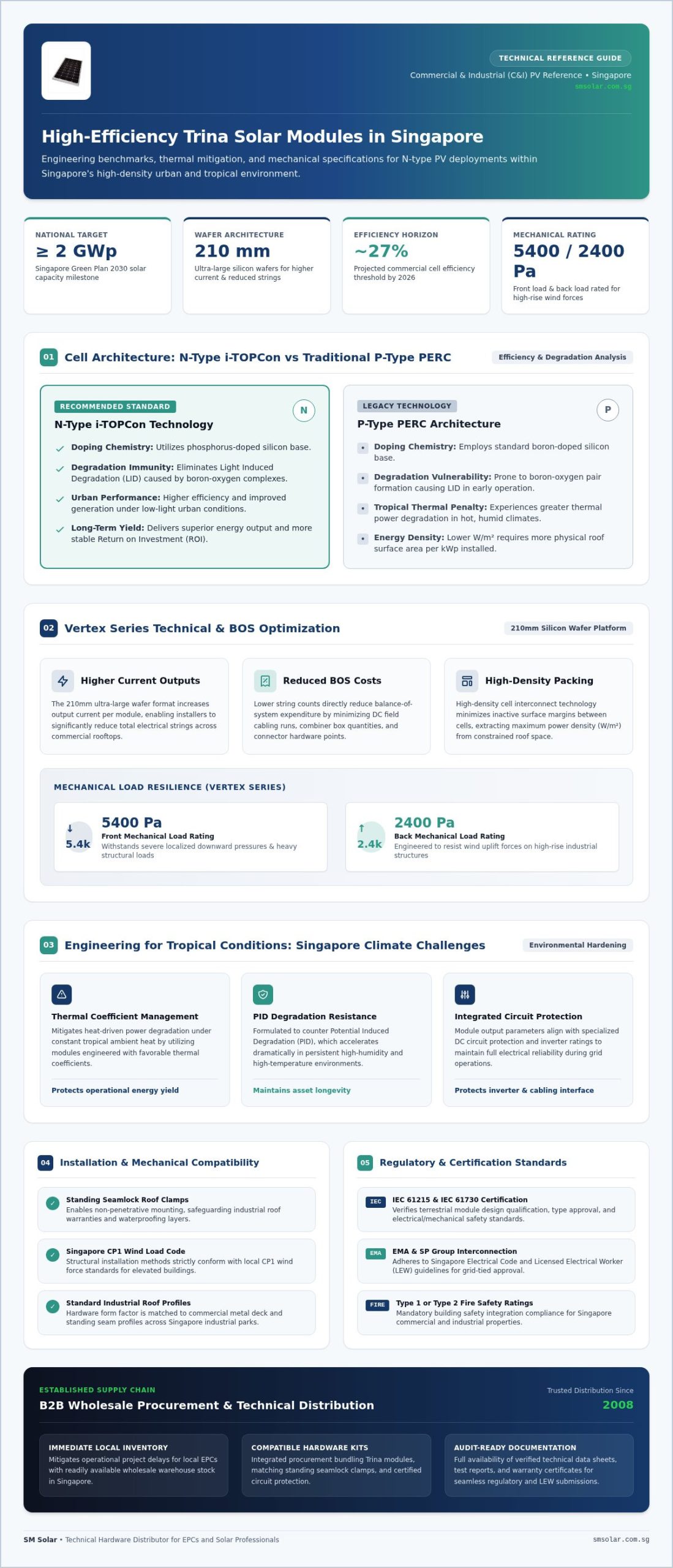
    All grid-tied systems in Singapore must comply with technical requirements established by the Energy Market Authority (EMA) and SP Group. Procuring Trina solar panels SG ensures that the core generating components meet the necessary international testing benchmarks for safety and reliability. Industrial project approval depends on the submission of comprehensive technical documentation during the commissioning phase.

    • IEC 61215: Verification of design qualification and type approval for terrestrial PV modules.
    • IEC 61730: Certification for photovoltaic module safety, addressing electrical and mechanical requirements.
    • Grid Connection: Compliance with the Singapore Electrical Code, ensuring that module output parameters align with inverter specifications and circuit protection ratings.

    Installers must verify that all hardware, including standing seamlock roof clamps and solar circuit protection, maintains the integrity of the total system. Reliable procurement through established B2B channels ensures that technical data sheets and warranty documentation are available for regulatory audits.

    Technical Specifications: Vertex and Vertex S+ Series Analysis

    The transition to 210mm ultra-large silicon wafer technology represents a shift in photovoltaic architecture. These larger wafers enable Trina solar panels SG to deliver higher current outputs, which reduces the total number of strings required in a commercial array. This reduction directly lowers Balance of System (BOS) costs by minimizing cabling and combiner box requirements. For industrial installers, the weight-to-power ratio remains a critical structural consideration. Modern Vertex modules provide high power density while maintaining a physical footprint that fits standard industrial roof profiles. Mechanical load specifications are equally vital for high-rise installations. These modules are typically rated for 5400 Pa front load and 2400 Pa back load, providing the necessary resilience against localized wind pressures. Installers should consult the EMA solar implementation guide to ensure system designs meet all Licensed Electrical Worker (LEW) and grid interconnection requirements.

    N-Type i-TOPCon Technology Overview

    N-type i-TOPCon (Industrial Tunnel Oxide Passivated Contact) cells represent the current efficiency benchmark for professional deployments. Unlike P-type PERC cells, N-type architecture uses phosphorus-doped silicon, which eliminates Light Induced Degradation (LID) caused by boron-oxygen complexes. This results in superior long-term energy yields and a more stable Return on Investment (ROI). By 2026, N-type technology is expected to push commercial cell efficiencies toward 27%, establishing a high-performance standard for urban energy systems. Higher bifaciality factors also allow for increased energy harvest in specific mounting configurations where rear-side light is available. Choosing Trina solar panels SG with N-type cells ensures that projects remain technologically relevant for the duration of their 25 to 30 year lifespan.

    Vertex S+ Dual-Glass Specifications

    The Vertex S+ series features a dual-glass structure that replaces the traditional backsheet with a second layer of heat-strengthened glass. This design achieves a Class A fire safety rating, which is essential for meeting Singapore industrial safety standards. The glass-on-glass construction provides an impermeable barrier against moisture and corrosive agents. This durability is particularly relevant for projects in coastal Singapore regions where salt spray and high humidity accelerate degradation in standard modules. These units carry extended product and power warranties, reflecting their structural stability. For technical procurement, you can verify hardware specifications and local availability through established distribution channels.

    Engineering for Tropical Environments: Heat and Humidity

    High ambient temperatures in Singapore directly impact PV voltage and total power output. While standard test conditions (STC) assume 25°C, actual cell temperatures in local industrial zones often exceed 60°C during peak irradiance. This thermal elevation triggers a linear decline in efficiency based on the specific temperature coefficient of the module. Deploying Trina solar panels SG requires a precise assessment of these thermal parameters to ensure accurate energy yield projections. Research from the Solar Energy Research Institute of Singapore confirms that durability testing under local conditions is essential to mitigate long-term degradation. Dual-glass module architectures manage thermal stress more effectively than traditional backsheet designs by providing uniform heat dissipation across the laminate structure.

    Temperature Coefficient and Energy Yield

    Singapore’s daily average temperature of 30°C to 34°C necessitates modules with low Pmax coefficients to maintain system performance. For every degree above the 25°C benchmark, power output decreases. Trina’s N-type modules typically feature a Pmax coefficient of approximately -0.30% per degree Celsius, which is superior to standard P-type alternatives. Lower Nominal Operating Cell Temperature (NOCT) ratings further enhance performance by allowing the module to maintain a lower internal temperature during operation. The Pmax temperature coefficient determines the specific percentage of power loss for every degree Celsius above standard test conditions, directly impacting the cumulative annual energy yield in tropical climates.

    Humidity Resistance and PID Prevention

    High-humidity environments exceeding 80% relative humidity accelerate Potential Induced Degradation (PID). This phenomenon occurs when stray currents leak from the PV cells to the module frame, causing significant power loss over time. Trina addresses this risk through the use of Polyolefin Elastomer (POE) encapsulation. POE provides superior water vapor resistance and lower ionic conductivity compared to standard Ethylene Vinyl Acetate (EVA) films. This material choice is critical for maintaining the dielectric strength of the module in wet conditions.

    • IP68 Junction Boxes: Sealed enclosures prevent moisture ingress during intense monsoon rain cycles.
    • Anodized Aluminum Frames: High corrosion resistance protects structural integrity in salt-laden coastal industrial sectors.
    • Dual-Glass Barrier: The impermeable nature of glass-on-glass construction eliminates the moisture-related cell corrosion common in backsheet-based modules.

    Selecting Trina solar panels SG with these specific tropical engineering features ensures that industrial arrays maintain their rated output despite the environmental rigors of the region. Technical procurement should prioritize these material specifications to secure long-term asset reliability.

    Trina Solar SG: Tech Spec Guide for Installers

    Installation and Mounting Compatibility Standards

    Mechanical integration of Trina solar panels SG requires strict adherence to Singapore CP1 standards for wind load resistance. High-rise industrial buildings in the region are subject to significant wind pressures, particularly during monsoon cycles. Structural compliance depends on the precision of the clamp-to-rib interface and the load-bearing capacity of the mounting rails. Installers must verify that the chosen mounting hardware supports the specific frame dimensions and mechanical load ratings of the Vertex series modules. Grounding and bonding remain mandatory to prevent electrical hazards and ensure system longevity. Frame-to-rail continuity must be established using certified bonding washers or integrated grounding pins within the module clamps. These components ensure that the entire array maintains a common potential, reducing the risk of static buildup and electrical faults.

    Non-Penetrative Mounting for Industrial Roofs

    Industrial deployments often utilize standing seam metal roofs where penetration is prohibited by building warranties. Utilizing Standing Seamlock Roof Clamps allows for secure module attachment without compromising the weatherproof layer. This method distributes mechanical loads across the roof ribs, maintaining structural compliance without the need for drilling. It’s essential for installers to match clamp torque specifications with the module manufacturer’s requirements to avoid frame deformation. This hardware configuration supports the high-wattage Vertex series, ensuring that large-format modules remain stable under localized wind pressures. Non-penetrative solutions are the preferred standard for maintaining the long-term integrity of industrial roof assets while facilitating rapid PV deployment.

    Circuit Protection and Safety Gear

    Electrical safety in 1500V system architectures necessitates specialized DC circuit protection. Singapore’s high lightning density requires the integration of Type 2 surge protection devices (SPDs) within DC combiner boxes. These components protect both the PV array and the downstream power electronics from transient overvoltages. Compatibility with industrial hybrid inverters and MPPT charge controllers must be verified against the module’s maximum power current (Imp) and open-circuit voltage (Voc) values. Proper sizing of solar circuit protection prevents thermal events and equipment failure during system faults.

    • DC Disconnect Switches: Must be rated for full load breaking capacity at maximum system voltage.
    • MPPT Input Windows: Ensure module string configurations stay within the operating voltage range of the inverter.
    • Bonding Conductors: Use of UV-resistant copper cabling for all external grounding paths.

    System reliability depends on the quality of these protective elements and their correct installation. You can procure industrial-grade circuit protection and compatible mounting hardware through our local distribution network to ensure full compliance with Singapore engineering standards.

    Procurement Logistics and Inventory Availability

    Professional procurement requires a dependable logistical partner. SM Solar functions as a master distributor, ensuring the availability of Tier 1 monocrystalline PV modules for high-volume EPC projects. Securing Trina solar panels SG through established B2B channels minimizes the risk of project delays. We maintain inventory reliability by managing the technical hardware supply chain, providing components that meet the rigorous standards of industrial solar deployments. This systematic approach ensures that hardware arrives on-site according to project timelines. Our organization prioritizes functional reliability over marketing narrative, acting as a robust link in the professional supply chain for seasoned industry veterans.

    Wholesale Distribution to Malaysia and Singapore

    Efficient cross-border logistics are essential for regional industrial solar projects. We facilitate bulk procurement pathways for installers operating in both markets, managing the complexities of international transport and inventory allocation. Lead times for bulk orders are optimized through strategic inventory management, ensuring that Tier 1 hardware is accessible for large-scale arrays. Installers seeking Wholesale Solar Panels Malaysia can leverage our established distribution network to streamline their hardware acquisition. This logistical support reduces the administrative burden on EPCs, allowing them to focus on engineering and execution. Consistent stock availability across both regions supports the rapid deployment of high-efficiency PV systems. We ensure that every shipment meets the exact technical requirements specified in the project engineering phase.

    Technical Support and Warranty Claims

    Reliability in the supply chain extends beyond delivery. We provide local technical support for manufacturer warranty verification, serving as a direct point of contact for EPCs. In the event of damaged or defective modules, replacement protocols are managed with technical precision to minimize downtime. Accessing technical data sheets, installation manuals, and certification documents is streamlined through our professional catalog. This ensures that all Trina solar panels SG deployments are backed by the necessary documentation for regulatory compliance and long-term asset management. Our role as a silent partner provides the stability required for high-volume industrial projects. We maintain a high technical register in all communications, providing precise data for engineering reviews and project commissioning. This methodical pacing ensures that procurement professionals feel they’re dealing with a highly organized and efficient operation.

    Optimizing Industrial PV Performance in Singapore

    Successful solar deployment in Singapore’s tropical climate depends on aligning module technology with specialized mounting and circuit protection. N-type i-TOPCon architecture provides the necessary resistance to Potential Induced Degradation (PID) while maintaining high energy yields during peak thermal cycles. Verification of mechanical compatibility with non-penetrative hardware, such as standing seamlock roof clamps, ensures adherence to local engineering standards and protects building warranties. Integration matters for system longevity. Technical precision remains the baseline for all professional arrays.

    SM Solar has operated as a Tier 1 hardware distributor since 2008, specializing in industrial mounting solutions and high-volume logistics. We provide the technical precision required for large-scale EPC projects involving Trina solar panels SG. Professional-grade procurement through a local partner ensures inventory reliability and full compliance with Singapore electrical codes. Inquire for Trina Solar Wholesale Specifications to secure high-efficiency PV modules for your next project.

    Selecting the correct technical specifications and compatible hardware streamlines the installation process and secures long-term asset performance.

    Frequently Asked Questions

    Are Trina solar panels available for immediate wholesale in Singapore?

    SM Solar maintains local inventory for immediate wholesale procurement of Trina solar panels SG. We function as a logistical partner for EPCs, ensuring that Tier 1 monocrystalline modules are available for industrial project timelines. Warehouse operations in Singapore and Malaysia support bulk distribution, reducing lead times for regional installers. Inventory levels are managed to provide consistent access to high-efficiency modules for commercial and industrial deployments.

    What is the difference between Trina Vertex S and Vertex S+ modules?

    The primary difference lies in cell architecture and structural composition. The Vertex S series typically utilizes P-type PERC cells with a traditional backsheet. In contrast, the Vertex S+ series features N-type i-TOPCon technology and a dual-glass structure. This dual-glass design achieves a Class A fire rating and provides superior resistance to moisture ingress. S+ modules generally offer longer product and power warranties due to their enhanced durability.

    How do Trina solar panels perform in Singapore’s high humidity?

    Trina modules are engineered with Polyolefin Elastomer (POE) encapsulation to mitigate the risks associated with Singapore’s high relative humidity. POE provides a superior moisture barrier compared to standard EVA films, effectively preventing Potential Induced Degradation (PID). This material choice maintains the dielectric strength of the module during intense monsoon cycles. These technical specifications ensure that the array maintains its rated output in high-humidity tropical environments over its entire lifespan.

    Can Trina modules be used with non-penetrative standing seam clamps?

    These modules are fully compatible with non-penetrative mounting hardware for industrial standing seam roofs. SM Solar supplies specialized standing seamlock roof clamps that secure the module frame to the roof rib without piercing the weatherproof layer. This configuration preserves building warranties and meets Singapore CP1 wind load requirements. Installers must ensure that clamp torque settings align with Trina’s mechanical load specifications for the Vertex series to prevent frame deformation.

    What is the warranty period for Trina Solar panels in the SG market?

    Warranty terms vary by module series and technology type. Standard Vertex S modules typically carry a 15-year product warranty and a 25-year linear power warranty. The Vertex S+ dual-glass series often features an extended 25-year product warranty and a 30-year power warranty. These warranties cover manufacturing defects and specify maximum annual degradation rates. Local support for warranty verification is available through SM Solar’s distribution office in Singapore.

    Do I need specific circuit protection for a 1500V Trina Solar system?

    High-voltage 1500V system architectures require specialized DC circuit protection to ensure operational safety. This includes DC disconnect switches and surge protection devices (SPDs) rated specifically for 1500V DC operation. Standard 1000V components are insufficient and present a thermal hazard. Proper protection prevents equipment failure during transient overvoltages, which are common in Singapore’s lightning-prone environment. SM Solar stocks compatible 1500V solar circuit protection hardware for industrial arrays.

    Does SM Solar provide installation services for Trina panels?

    SM Solar does not provide installation services, residential cleaning, or consumer financing. Our operations are strictly focused on the B2B distribution of solar energy equipment and hardware. We act as a logistical partner for EPCs and professional installers by providing monocrystalline panels, LiFePO4 batteries, and mounting systems. Installation and commissioning must be performed by a Licensed Electrical Worker (LEW) or a Qualified Person (QP) to meet Singapore standards.

    How does the temperature coefficient of Trina panels affect SG energy yield?

    The temperature coefficient determines the rate of power loss as cell temperatures exceed 25°C. In Singapore, cell temperatures frequently reach 60°C, making a lower coefficient essential for high energy yields. Trina’s N-type modules feature a Pmax coefficient of approximately -0.30% per degree Celsius. This performance metric ensures that Trina solar panels SG maintain higher efficiency during peak midday irradiance compared to older P-type technology with higher thermal degradation rates.

  • Wholesale Solar Panels Malaysia: Procurement and Logistics Guide 2026

    Wholesale Solar Panels Malaysia: Procurement and Logistics Guide 2026

    A standard P-type PERC module loses up to 5% more annual yield than N-type TOPCon alternatives when operating in 75°C roof environments. For EPC contractors, procurement of wholesale solar panels Malaysia requires more than just identifying Tier-1 brands. It demands hardware with a temperature coefficient of -0.29%/°C or lower and IEC 62804 PID resistance to withstand 85% relative humidity. You’re already aware that hardware degradation in equatorial climates and supply chain volatility remain the primary risks to project IRR. This guide delivers a technical framework for sourcing high-efficiency hardware and managing complex cross-border logistics within the Singapore-Malaysia corridor.

    We provide a clinical analysis of the 2026 procurement landscape, focusing on N-type TOPCon performance metrics and SIRIM QAS International certification standards. The following sections detail localized inventory strategies for monocrystalline modules, LiFePO4 battery storage, and specialized mounting hardware like standing seamlock roof clamps. You’ll gain a structured approach to minimizing procurement risk through established logistical channels and technical specification auditing. This ensures your hardware meets the rigorous durability standards required for industrial deployments in high-humidity tropical environments. We focus on the transition from legacy systems to the Solar ATAP framework to maintain project viability.

    Key Takeaways

    • Analyze the impact of the Solar Accelerated Transition Action Programme (Solar ATAP) and CRESS framework on commercial procurement and 10-year contract durations.
    • Identify critical performance benchmarks for wholesale solar panels Malaysia, specifically N-type TOPCon modules rated for high-humidity tropical environments.
    • Navigate cross-border logistics requirements, including SIRIM consignment certificates and MIDA tax exemptions for efficient SG-to-Malaysia hardware transit.
    • Secure specialized industrial components like standing seamlock roof clamps and LiFePO4 storage to meet specific mounting and energy density requirements.
    • Establish a procurement framework based on inventory depth and technical documentation availability to support multi-megawatt EPC project timelines.

    The Wholesale Solar Landscape in Malaysia and Singapore

    Industrial solar deployment in 2026 operates under the Solar Accelerated Transition Action Programme (Solar ATAP) and the Corporate Renewable Energy Supply Scheme (CRESS). These frameworks mandate high-efficiency hardware to optimize the “use-it-or-lose-it” credit mechanisms defined in Energy Commission Guideline GP/ST/No. 60/2025. Procurement of wholesale solar panels Malaysia has transitioned from legacy P-type PERC modules to N-type TOPCon monocrystalline technology, driven by the need for superior temperature coefficients in equatorial environments. EPC contractors manage multi-megawatt projects where hardware reliability and immediate availability are non-negotiable. The market now prioritizes modules with linear performance warranties of 30 years and degradation rates below 0.4% annually.

    Market Drivers for Industrial Solar in 2026

    The CRESS framework allows corporate consumers to execute direct physical Power Purchase Agreements (PPAs) with Independent Power Producers. This shift has increased demand for utility-scale components capable of handling fixed System Access Charges (SAC) of 25 sen/kWh for firm output. While the photovoltaics manufacturing in Malaysia sector supports global supply, specialized Tier-1 modules often require regional distribution hubs to bypass domestic lead time volatility. Remote infrastructure projects in East Malaysia and rural Peninsular regions increasingly utilize off-grid hybrid systems. These installations combine high-wattage monocrystalline PV with LiFePO4 storage to ensure grid stability in areas with 4.2 to 5.6 kWh/m²/day irradiance levels. EPC procurement cycles now integrate Battery Energy Storage Systems (BESS) as standard components for firm capacity delivery.

    Singapore vs. Malaysia: The Logistics Corridor

    Singapore functions as a critical master distribution node for the Malaysian market. Localized inventory buffers in Singapore mitigate risks associated with port congestion at Port Klang or Tanjung Pelepas. For Malaysian installers, sourcing wholesale solar panels Malaysia through Singapore-based partners provides access to diverse SKU availability without the 12-week lead times typical of direct factory orders. This proximity allows for just-in-time delivery for large-scale commercial installations. Strategic staging in bonded warehouses simplifies the management of SST exemptions and SIRIM QAS International certification requirements. The August 2026 conditional approval of 900 MW in solar imports from Johor to Singapore has further solidified this corridor as a strategic renewable energy hub. Reliability is maintained through high-volume logistical coordination across the Causeway and Second Link, ensuring that hardware arrives at project sites in sync with construction phases.

    Technical Specifications for Tropical Performance

    Tropical environments require hardware with specific thermal and electrochemical stability. Standard PV modules often suffer from accelerated power loss due to relative humidity exceeding 80% and roof temperatures hitting 75°C. A Malaysian Investment Development Authority analysis confirms that the region’s solar transition depends on high-performance hardware that meets SIRIM QAS International standards. Procurement for wholesale solar panels Malaysia must prioritize N-type TOPCon cells over legacy P-type PERC to ensure project longevity. They don’t suffer the same heat-induced derating as older technologies, making them the standard for 2026 industrial deployments.

    Monocrystalline PV Module Evaluation

    N-type TOPCon modules provide a temperature coefficient of -0.29%/°C. This outperforms P-type PERC’s -0.35%/°C, resulting in 3% to 5% higher annual yields in Kuala Lumpur or Singapore. PID resistance is critical for equatorial zones. Modules must comply with IEC 62804 testing protocols at 85°C and 85% relative humidity for a minimum of 96 hours. For industrial sites, bifacial glass-glass modules offer superior durability compared to backsheet options. They resist moisture ingress and electrochemical delamination more effectively. This construction prevents the “snail trail” defects common in high-humidity environments.

    Mounting Hardware and Circuit Protection

    Corrosion resistance is mandatory for coastal and industrial zones like Pasir Gudang or Jurong. It’s mandatory for mounting hardware to meet IEC 61701 Severity 6 standards. Anodized aluminum frames require a minimum 15 to 20 μm coating thickness to prevent pitting. Specialized standing seamlock roof clamps are essential for maintaining metal roof integrity without penetration. For ground-mounted or infrastructure projects, engineer-rated solar panel pole mounts must withstand local wind load requirements. Solar circuit protection must include DC breakers and surge protection devices (SPD) rated for high-frequency tropical lightning strikes. These components ensure the system survives voltage spikes during monsoon seasons.

    Lithium LiFePO4 batteries are the preferred chemistry for tropical energy storage due to their high thermal runaway threshold. They maintain stability at higher ambient temperatures compared to standard lithium-ion variants. Hybrid inverters require robust thermal management, including high-grade heat sinks and active cooling, to prevent efficiency drops. Ratings should remain stable even when ambient temperatures exceed 40°C. You can view our current inventory of monocrystalline solar panels and LiFePO4 batteries to match these specific technical requirements.

    Procurement Framework: Evaluating Wholesale Suppliers

    Procurement for industrial solar projects requires a shift from transactional purchasing to strategic supply chain management. EPC contractors must audit suppliers based on inventory depth and technical proficiency. The IEA report on solar PV global supply chains highlights that manufacturing concentration increases the necessity for localized inventory buffers. For wholesale solar panels Malaysia, the evaluation framework should prioritize distributors capable of supporting multi-megawatt deployments without relying on volatile factory lead times. Reliability is defined by the supplier’s ability to maintain immediate stock of Tier-1 hardware during peak demand cycles. It’s not just about the lowest price; it’s about the security of the supply chain.

    Verification of certification standards remains a mandatory step. This includes TUV and IEC certifications for safety and performance, alongside local SIRIM QAS International compliance for the Malaysian market. Documented proof of these standards ensures project bankability and facilitates smooth grid-connection approvals. EPCs shouldn’t overlook the importance of having these documents readily available for regulatory submissions.

    Inventory and Availability Metrics

    Industrial installers require substantial buffer stock to prevent project downtime. A reliable partner maintains deep inventory across all Balance of System (BOS) components. This includes specialized hardware like solar panel pole mounts and standing seamlock roof clamps, which are often overlooked in generic procurement. Assessing a supplier’s historical performance in the B2B sector reveals their capacity to handle high-volume logistical demands. Immediate availability of solar circuit protection and DC cables allows EPCs to remain on schedule despite regional port congestion. You don’t want your installation crew waiting on a single shipment of clamps to finish a megawatt-scale roof.

    Technical Compatibility and System Design

    System efficiency depends on the seamless integration of monocrystalline solar panels with hybrid inverters and lithium LiFePO4 batteries. MPPT charge controllers must be specifically matched to the high-current output of modern N-type modules to avoid clipping or thermal overload. Sourcing from a single-point distributor ensures that all components, from the solar battery to the mounting racks, are pre-validated for electrical and mechanical compatibility. This reduces engineering overhead and minimizes the risk of DC arc faults caused by mismatched connectors or incompatible protection gear. Technical support documentation, including detailed SLDs and warranty terms, is essential for professional EPC planning and client handovers. Using a unified hardware ecosystem simplifies long-term maintenance and troubleshooting for the end-user.

    Wholesale Solar Panels Malaysia: Procurement and Logistics Guide 2026

    Cross-Border Logistics and Inventory Management

    Movement of solar hardware across the Singapore-Malaysia border requires precise adherence to customs protocols and technical verification. For wholesale solar panels Malaysia, the process begins with staging at Singaporean master distribution hubs. This localized staging bypasses the volatility of direct factory shipping and provides a buffer against regional port congestion. Effective logistics management ensures that high-value components arrive at project sites in sync with installation phases, preventing costly crew downtime.

    Documentation requirements remain the primary bottleneck in cross-border transit. Assembled PV modules fall under HS Code 8541.43, which currently enjoys a 0% baseline customs import duty rate in Malaysia. However, clearing the Royal Malaysian Customs Department requires an electronic K1 form and valid SIRIM QAS International consignment certificates. Procurement of large-scale lithium LiFePO4 batteries necessitates compliance with Class 9 dangerous goods regulations. Managing these requirements through a Singapore-based partner simplifies the transition between Singapore’s GST framework and Malaysia’s SST exemptions via MIDA Schedule C certificates.

    Logistics Optimization for Malaysian Installers

    Coordinating hardware arrival with site mobilization is critical for project IRR. Bulk handling of monocrystalline panels involves double-stacked palletization and reinforced corner protection to prevent micro-cracks during transit across the Causeway or Second Link. Professional industrial packing is mandatory for hybrid inverters and sensitive solar circuit protection gear. Customs clearance strategies involve pre-filing for tax exemptions to avoid the standard 10% Sales Tax. This proactive approach ensures that hardware moves from Singaporean warehouses to Malaysian project sites within predictable windows, regardless of seasonal shipping spikes.

    Wholesale Inventory Strategies

    The transition from Just-in-Time (JIT) to safety stock procurement models provides stability against 12-week factory lead times. Singaporean warehouses function as critical inventory nodes, maintaining immediate availability for EPCs. Tracking systems for industrial hardware provide real-time visibility from order placement to final site delivery. This visibility allows project managers to coordinate crane schedules and labor deployment with precision. By maintaining localized safety stock of specialized components like standing seamlock roof clamps and solar panel pole mounts, installers can respond to project variations without delaying the commissioning date. You can secure your project timeline by accessing our ready-stock inventory for cross-border distribution.

    Strategic Sourcing with SM Solar: B2B Hardware Solutions

    SM Solar functions as a master distributor for the Singapore-Malaysia corridor. We specialize in the high-volume supply of monocrystalline solar panels and lithium LiFePO4 batteries. Our inventory supports industrial-scale deployments where hardware reliability is a functional requirement. We maintain immediate stock levels to bypass the 12-week lead times associated with direct factory procurement. This localized availability ensures that EPC contractors can secure wholesale solar panels Malaysia without compromising project timelines. We operate as a technical partner, providing the essential components for large-scale solar infrastructure. Our role is to act as the silent link in the supply chain, prioritizing technical specifications and availability over marketing narrative.

    Industrial Grade Components and Protection

    Our inventory includes specialized solar circuit protection and high-spec DC hardware. We provide mounting profiles designed for specific Malaysian roofing systems, including standing seamlock roof clamps for non-penetrative industrial installations. For ground-mounted systems, we supply engineer-rated solar panel pole mounts. Our selection of hybrid inverters and MPPT solar charge controllers is pre-validated for compatibility with high-current N-type modules. This technical alignment reduces the risk of field failures and simplifies the commissioning process for off-grid and grid-tied systems. We also stock high-density lithium LiFePO4 battery banks designed for thermal stability in equatorial climates, ensuring energy storage systems maintain performance at 40°C ambient temperatures.

    The SM Solar Advantage for Installers

    Founded in 2008, SM Solar possesses technical expertise in tropical solar applications. We understand the specific degradation risks associated with high humidity and elevated ambient temperatures. Our cross-border distribution network facilitates the movement of hardware between Singapore and Malaysia with logistical precision. We handle the complexities of inventory staging and technical documentation, allowing installers to focus on site execution. This established supply chain provides a robust link for professional EPCs operating in the region. We ensure that every component, from the solar battery to the circuit protection, meets the rigorous standards required for industrial infrastructure. Our organization is built on the depth of its inventory and the reliability of its logistical partners.

    Contact SM Solar for wholesale procurement and technical specifications

    Optimizing Renewable Infrastructure Procurement for 2026

    Industrial solar success in the Singapore-Malaysia corridor requires a transition to high-efficiency N-type TOPCon modules and integrated LiFePO4 storage. Technical precision in selecting hardware with low temperature coefficients and IEC 62804 PID resistance ensures long-term IRR in equatorial climates. Managing the procurement of wholesale solar panels Malaysia involves more than just selecting Tier-1 brands. It’s about a localized logistics strategy that utilizes regional warehouses to mitigate port congestion and volatile factory lead times. Implementing a unified hardware ecosystem, from specialized standing seamlock roof clamps to DC circuit protection, reduces engineering risks and installation downtime.

    SM Solar has functioned as a specialized B2B hardware supplier since 2008. We provide direct distribution of LiFePO4 batteries and monocrystalline PV modules, maintaining expertise in tropical-grade solar mounting and protection systems. Our established distribution network simplifies the cross-border movement of industrial components, ensuring your project remains on schedule. Request a Wholesale Quote for Industrial Solar Hardware to secure your 2026 project pipeline. We look forward to supporting your next large-scale deployment with technical reliability and logistical efficiency.

    Frequently Asked Questions

    What are the lead times for wholesale solar panel orders from Singapore to Malaysia?

    Lead times for wholesale solar panels Malaysia typically range from 3 to 7 working days for ex-stock items staged in our Singapore warehouses. This localized inventory strategy bypasses the 12-week manufacturing lead times associated with direct factory orders. Bulk shipments clearing the Causeway or Second Link require electronic K1 forms and SIRIM consignment certificates. We coordinate with logistical partners to ensure hardware arrival aligns with specific project installation phases.

    How do I ensure solar mounting hardware is resistant to corrosion in high-humidity areas?

    Ensuring resistance requires hardware compliant with IEC 61701 Severity 6 for salt mist corrosion. Anodized aluminum frames must have a minimum coating thickness of 15 to 20 μm to prevent pitting in industrial or coastal zones. We supply fasteners made from 304 or 316-grade stainless steel to prevent galvanic corrosion. These specifications are mandatory for hardware used in high-humidity tropical environments where relative humidity frequently exceeds 80%. It’s a critical durability benchmark for tropical performance.

    Are LiFePO4 batteries better than AGM for industrial solar storage in Malaysia?

    Lithium LiFePO4 batteries are superior to AGM for industrial applications due to their high thermal runaway threshold and energy density. They maintain operational stability at ambient temperatures exceeding 40°C, which is critical for Malaysian climates. LiFePO4 chemistries offer over 3,000 cycles at 80% depth of discharge, compared to 500 cycles for standard AGM variants. This longevity reduces the total cost of ownership for large-scale energy storage projects. It’s the standard for 2026 industrial storage.

    What technical certifications are required for solar panels used in commercial projects?

    All PV modules must hold SIRIM QAS International certification under MS IEC 61215 for design qualification and MS IEC 61730 for safety. Grid-connected solar inverters require a Certificate of Approval (COA) from Suruhanjaya Tenaga. They must comply with MS IEC 62109-1 and -2 standards. Verification of these documents is a prerequisite for grid-connection approval and project bankability in the commercial and utility sectors. It’s necessary to ensure compliance with Energy Commission Guideline GP/ST/No. 60/2025.

    Can SM Solar provide specialized mounting hardware for standing seam metal roofs?

    SM Solar maintains a specialized inventory of standing seamlock roof clamps designed for non-penetrative industrial installations. These clamps provide mechanical stability without compromising the integrity of metal roofing systems. We also supply solar panel pole mounts and L-feet mounting profiles to accommodate diverse structural requirements. Our hardware is engineered to withstand local wind loads while adhering to the technical standards required for industrial-grade solar infrastructure. It doesn’t require roof penetration, maintaining warranty integrity.

    What is the benefit of sourcing solar hardware from a Singapore-based distributor?

    Sourcing from a Singapore-based distributor provides access to immediate safety stock and reduces supply chain volatility. Singaporean warehouses act as critical nodes that mitigate port congestion at Port Klang or Tanjung Pelepas. This proximity allows EPCs to manage wholesale solar panels Malaysia procurement with just-in-time delivery models. It simplifies the management of SST exemptions and ensures all hardware meets regional technical standards before arriving at the project site. It’s a strategic advantage for project IRRs.

    How do I calculate the correct circuit protection for a large industrial PV array?

    Calculating circuit protection requires adherence to MS IEC 60364-7-712 electrical codes. Large industrial arrays must include DC circuit breakers and surge protection devices (SPD) rated for tropical lightning strike frequencies. Protection gear must match the maximum string voltage and short-circuit current of the specific N-type TOPCon modules used. Mismatched components or cross-mating incompatible connectors are leading causes of DC arc faults. It’s essential to verify compatibility before site mobilization.

    Does SM Solar offer technical support for inverter and battery integration?

    We function as a direct technical partner for large-scale solar procurement, providing documentation for inverter and battery integration. Our support includes verifying the compatibility of hybrid inverters with lithium LiFePO4 battery banks to ensure seamless energy management. We provide detailed technical specifications and SLDs for professional EPC planning. This technical alignment ensures all balance-of-system components operate within their rated thermal and electrical parameters. It’s a standard part of our B2B service.

  • High Efficiency Solar Panels: 2026 Procurement Guide

    High Efficiency Solar Panels: 2026 Procurement Guide

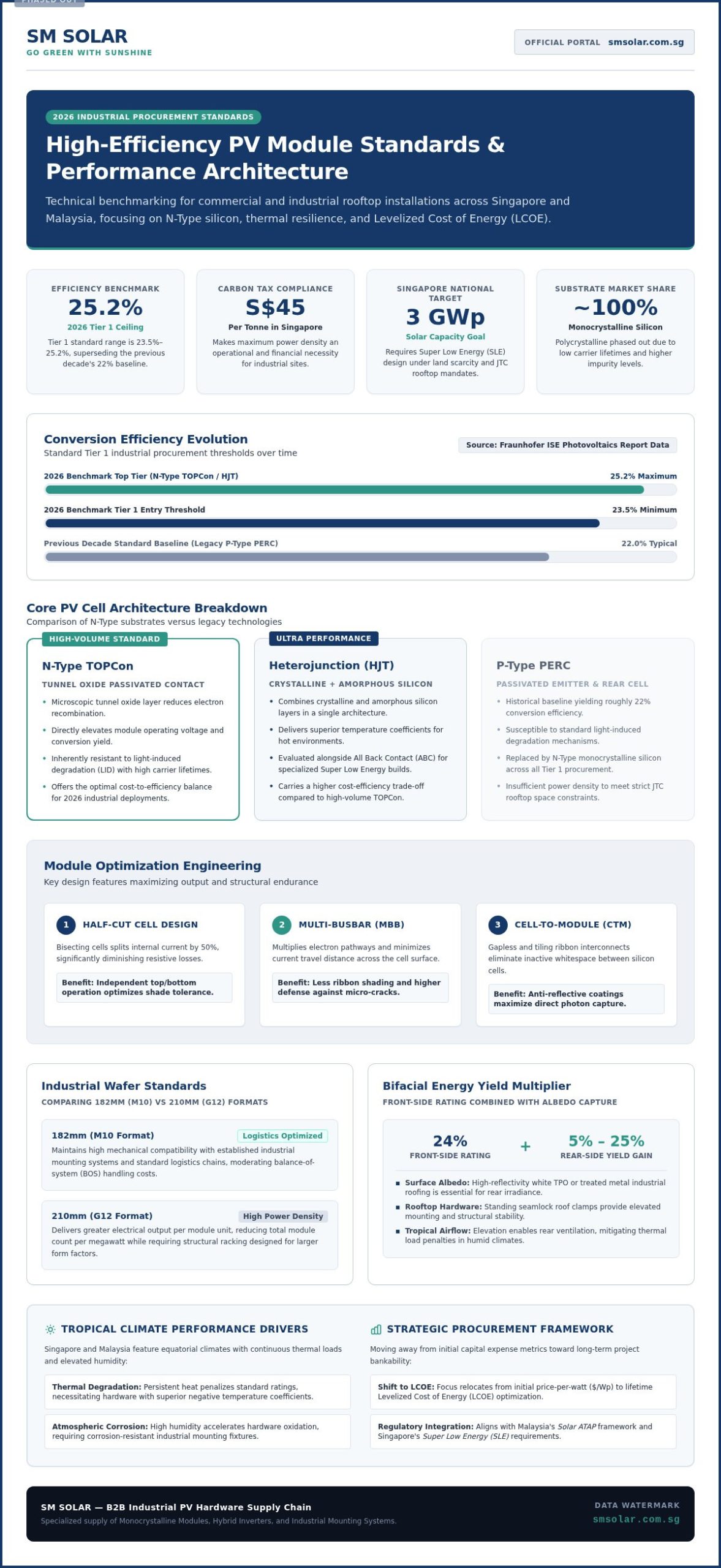
    Commercial procurement standards for 2026 establish 25.2% as the current benchmark for module efficiency. With Singapore’s national solar target reaching 3 GWp and the carbon tax set at S$45 per tonne, high efficiency solar panels are essential for industrial energy compliance. You’ve likely observed that standard performance ratings often degrade under the persistent thermal loads and high humidity of equatorial climates. Rapid thermal degradation and hardware corrosion are the primary drivers of sub-optimal system performance in local industrial deployments.

    This technical guide provides a detailed analysis of PV module architectures and procurement standards for Singapore and Malaysia. It offers the data required to identify modules with superior temperature coefficients and secure a reliable supply chain for monocrystalline hardware. We’ll evaluate N-Type TOPCon, All Back Contact, and Heterojunction technologies against Super Low Energy building requirements. The following sections detail the shift to Malaysia’s Solar ATAP framework and the technical specifications necessary for professional-grade component selection.

    Key Takeaways

    • Establish 2026 efficiency benchmarks between 23.5% and 25.2% for Tier 1 industrial procurement standards.
    • Analyze the impact of temperature coefficients on tropical energy yields to mitigate the specific heat penalties found in Singapore and Malaysia.
    • Compare N-Type TOPCon and half-cut cell architectures to select high efficiency solar panels that maximize power density and shade tolerance.
    • Shift procurement focus from initial price-per-watt to Levelized Cost of Energy (LCOE) for improved long-term project bankability.
    • Access a specialized B2B supply chain for monocrystalline hardware, hybrid inverters, and corrosion-resistant industrial mounting systems.

    Defining High-Efficiency Solar Standards in 2026

    Module efficiency measures the ratio of electrical energy output to the solar footprint of the installation. It’s the primary metric for calculating power density on industrial rooftops. Most commercial procurement now references solar-cell efficiency limits to benchmark performance against theoretical maximums. In 2026, Tier 1 high efficiency solar panels must deliver between 23.5% and 25.2% conversion efficiency to remain competitive. This represents a significant shift from the 22% standards typical of the previous decade.

    Singapore’s industrial landscape demands this level of precision. Land scarcity and JTC rooftop mandates make energy density a non-negotiable requirement. With the national carbon tax set at S$45 per tonne, maximizing yield per square meter isn’t just an engineering goal; it’s a financial necessity. High efficiency solar panels allow facilities to achieve Super Low Energy (SLE) status even when usable roof space is restricted by HVAC equipment or structural obstacles.

    The Shift to N-Type TOPCon and HJT

    The industry has transitioned from P-Type PERC to N-Type architectures. Tunnel Oxide Passivated Contact (TOPCon) technology is now the high-volume standard. It utilizes a microscopic tunnel oxide layer to minimize electron recombination, which directly increases the module’s voltage and efficiency. Heterojunction (HJT) technology offers even higher performance by combining crystalline and amorphous silicon layers. While HJT offers superior temperature coefficients, the cost-efficiency trade-off often favors TOPCon for high-volume industrial projects in 2026. N-type silicon serves as the superior substrate for 2026 modules due to its inherent resistance to light-induced degradation and higher carrier lifetimes.

    Bifacial Gain and Efficiency Multipliers

    Bifacial modules generate power from both sides, effectively acting as efficiency multipliers. While the front-side rating might be 24%, the total yield can increase by 5% to 25% depending on the installation environment. Success depends on surface albedo. Light-colored industrial roofing materials, such as white TPO or treated metal, provide the necessary reflectivity for rear-side energy capture. Integration with specialized hardware is critical for these systems. Standing seamlock roof clamps provide the required elevation and structural stability for industrial profiles. This setup facilitates optimal airflow and rear-side irradiance, which is vital for maintaining performance in the high-humidity environments of Singapore and Malaysia.

    Core Technologies Driving PV Module Efficiency

    Monocrystalline silicon (mono-Si) is the exclusive substrate for the 2026 high-performance market. Polycrystalline modules have been phased out of Tier 1 commercial procurement due to lower carrier lifetimes and higher impurity levels. Current data in the Fraunhofer ISE Photovoltaics Report confirms that mono-Si architectures now represent nearly 100% of new industrial capacity. These high efficiency solar panels utilize half-cut cell technology to bisect standard cells; this reduces the internal current by half and lowers resistive losses. It also improves shade tolerance by allowing the top and bottom halves of the module to operate independently.

    Multi-busbar (MBB) designs complement this by providing more paths for electron flow. MBB reduces the distance current travels across the cell surface, which minimizes shading from the ribbons and increases structural reliability against micro-cracks. Anti-reflective coatings on the glass surface further maximize photon absorption by reducing reflection losses. Procurement managers can source these monocrystalline solar panels directly for industrial project pipelines to ensure maximum energy density.

    Cell-to-Module (CTM) Optimization

    Modern module assembly focuses on high-density interconnects to eliminate inactive space between cells. Gapless or tiling ribbon technologies allow manufacturers to fit more active silicon into the same module dimensions. Large-format wafers, specifically the 210mm (G12) and 182mm (M10) standards, are the current benchmarks for industrial EPC projects. Selecting high efficiency solar panels with optimized wafer standards minimizes the total number of modules required per megawatt. While 210mm modules offer higher power per unit, 182mm modules often provide better compatibility with existing mounting hardware and logistics chains. This selection impacts the overall balance of system (BOS) costs, including cabling and racking requirements.

    Degradation Rates and Long-Term Reliability

    Long-term asset value depends on mitigating Light Induced Degradation (LID) and Light and Elevated Temperature Induced Degradation (LeTID). N-Type modules are fundamentally immune to boron-oxygen related LID, which is a common failure point in legacy P-type PERC modules. This translates to lower annual degradation rates; N-Type modules typically lose 0.4% per year compared to 0.55% for P-type. Industrial assets using N-type technology frequently carry 30-year power warranties that guarantee over 87% of original output. This reliability is critical for Singaporean industrial projects where high ambient temperatures can accelerate chemical degradation pathways.

    Performance Factors for Tropical Climates (Singapore & Malaysia)

    Tropical installations face a significant “Heat Penalty” where high ambient temperatures directly reduce PV voltage and total system output. While nameplate ratings for high efficiency solar panels are calculated at 25°C, operating cell temperatures on Singaporean industrial roofs frequently reach 60°C to 75°C. This delta of 35°C to 50°C above Standard Test Conditions (STC) necessitates a focus on the Pmax temperature coefficient. In 2026, a coefficient of -0.30%/°C or better is the required benchmark for Tier 1 procurement. Legacy P-type PERC modules typically suffer losses of -0.35% to -0.38%/°C, resulting in 4% to 6% lower actual energy yields compared to modern N-type hardware in equatorial conditions.

    High relative humidity in Southeast Asian coastal zones also introduces Potential Induced Degradation (PID) risks. Humidity facilitates the movement of ions from the glass to the cell, which can lead to rapid power loss if the encapsulation isn’t robust. Ensuring adequate airflow and a minimum mounting height of 100mm helps facilitate passive cooling. It’s a simple mechanical adjustment that can drop operating temperatures by several degrees, protecting the long-term output of the system and ensuring the investment meets projected ROI targets.

    Optimizing Yield in High-Humidity Environments

    Procurement for Singaporean projects prioritizes glass-glass (dual glass) construction over traditional backsheet designs. This architecture provides superior moisture ingress protection and structural rigidity. Aluminum frames and mounting profiles must meet specific corrosion resistance standards to withstand salt-laden air in coastal industrial estates like Jurong or Tuas. Dual-glass modules are the standard for Singaporean industrial projects because they utilize Polyolefin Elastomer (POE) encapsulation to prevent delamination and PID in high-humidity environments.

    Mounting Hardware Synergy

    The selection of mounting hardware is as critical as the module technology itself. Non-penetrative standing seamlock roof clamps maintain roof integrity while providing the necessary clearance for under-module ventilation. For infrastructure-integrated systems, heavy-duty solar panel pole mounts offer the stability required for high-wind environments. Preventing galvanic corrosion is a primary concern; all fasteners and interfaces between the aluminum module frames and steel mounting structures must use specialized isolation washers or coatings to prevent material degradation in tropical climates. This hardware synergy ensures that the high efficiency solar panels remain structurally sound throughout their 30-year operational life.

    High Efficiency Solar Panels: 2026 Procurement Guide

    Selection Criteria for Industrial Solar Procurement

    Professional procurement shifts the focus from initial price-per-watt to the Levelized Cost of Energy (LCOE). High efficiency solar panels optimize LCOE by reducing the total number of modules required for a specific capacity. This directly lowers the expenditure on racking, cabling, and labor. Tier 1 bankability remains a non-negotiable requirement for long-term project financing. It guarantees that the manufacturer possesses the financial liquidity to support 25 to 30-year performance warranties. Evaluating the manufacturer’s regional support network is equally vital for industrial assets in Southeast Asia.

    System compatibility is a core technical requirement. Modules must be electrically matched with hybrid inverters and Lithium LiFePO4 batteries to ensure efficient energy conversion and storage. Mismatched components lead to clipping losses or premature hardware failure. Logistical reliability often dictates project timelines. While direct factory orders may offer slight price advantages, local inventory availability in Singapore and Malaysia mitigates the risk of 8 to 12-week lead time delays. Review our current inventory of high efficiency solar panels and mounting hardware to secure Tier 1 components for your next industrial project.

    Technical Specification Checklist for EPCs

    EPCs must verify Nominal Operating Cell Temperature (NOCT) ratings rather than relying solely on Standard Test Conditions (STC). NOCT provides a more accurate representation of module behavior in the 60°C to 75°C environments typical of Singaporean rooftops. Connector compatibility is another critical safety factor. Adherence to MC4-Evo2 standards is necessary to prevent thermal runaway at junction points. High-current modules utilizing 210mm wafers require specialized solar circuit protection, including DC breakers and surge protective devices (SPDs) rated for the increased short-circuit current levels.

    Regulatory Compliance in Singapore and Malaysia

    Industrial projects must align with BCA Green Mark and Super Low Energy (SLE) building standards in Singapore. These regulations often mandate specific efficiency tiers for the total solar footprint. Fire safety remains a priority; DC disconnect switches and rapid shutdown capabilities are standard requirements for industrial rooftop permits. For Malaysia-based projects, the Solar Accelerated Transition Action Programme (Solar ATAP) replaced NEM 3.0 on January 1, 2026. This framework settles exports at the System Marginal Price (SMP), making self-consumption and battery integration the primary drivers for system sizing. Cross-border logistics must also account for specific SST exemptions or import duties applicable to renewable energy hardware.

    Sourcing High-Efficiency Hardware from SM Solar

    SM Solar operates as a specialized master distributor of Tier 1 monocrystalline PV modules for the Southeast Asian market. Established in 2008, the entity focuses on providing the technical infrastructure required for high-volume industrial deployments. The inventory catalog emphasizes high efficiency solar panels with N-type architectures, ensuring compatibility with modern EPC performance requirements. By maintaining a centralized logistical hub in Singapore, the brand provides a stable supply chain for installers across the region. This localized presence eliminates the volatility often associated with international freight and customs delays.

    The SM Solar Inventory Advantage

    The inventory strategy prioritizes high-density N-Type technology for professional installers. The catalog includes a comprehensive suite of balance of system (BOS) components, such as hybrid inverters and Lithium LiFePO4 batteries. These storage solutions are selected for their cycle life and thermal stability in tropical climates. Circuit protection is also a core focus. The inventory features DC breakers, SPDs, and specialized solar circuit protection hardware necessary for high-current industrial strings. Strategic warehousing in Singapore enables rapid project deployment. This efficiency significantly reduces the lead time risks associated with direct factory procurement for time-sensitive industrial contracts.

    Partnering for Industrial Solar Success

    SM Solar utilizes a wholesale procurement model designed specifically for EPC contractors and solar installers. This approach ensures that technical proficiency is matched by hardware reliability. Specialized mounting solutions, such as standing seamlock roof clamps and heavy-duty pole mounts, are stocked to address the specific structural requirements of tropical industrial roofs. These components are selected for their corrosion resistance and mechanical stability in high-wind environments. The brand doesn’t just supply panels; it provides the entire mounting and protection ecosystem required for a professional installation.

    Project deployments in Singaporean industrial estates demonstrate the efficacy of this hardware-centric approach. By providing Tier 1 high efficiency solar panels alongside specialized mounting profiles, SM Solar ensures that projects meet BCA Green Mark and SLE standards. The brand acts as a knowledgeable logistical partner, providing the essential components without the complexities of consumer-facing marketing. This focus on technical precision supports the 3 GWp national solar target for 2030. Professional procurement officers can View the SM Solar high-efficiency panel inventory to evaluate current specifications and availability for 2026 project pipelines.

    Advancing Industrial Energy Standards for 2026

    The 2026 energy landscape in Singapore and Malaysia requires a decisive shift toward N-type architectures and superior thermal stability. High efficiency solar panels are now the baseline requirement for industrial projects targeting BCA Green Mark or Solar ATAP compliance. Success depends on selecting hardware that maintains rated output at 75°C and resists the humidity-driven degradation typical of coastal industrial zones. Procurement officers must prioritize Levelized Cost of Energy (LCOE) over initial price-per-watt; this ensures long-term asset bankability and functional reliability.

    SM Solar provides the technical infrastructure to meet these rigorous requirements. Established in 2008, we serve as a master distributor for Tier 1 monocrystalline modules and specialized mounting hardware like standing seamlock roof clamps. Our Singapore-based technical support and specialized B2B inventory facilitate rapid deployment for EPCs and industrial installers throughout the region. Request a wholesale quote for high-efficiency solar hardware to secure your 2026 project pipeline and ensure your installation meets the highest performance standards.

    Frequently Asked Questions

    What is the highest efficiency solar panel available in Singapore in 2026?

    The highest commercial module efficiency available in Singapore for 2026 is 25.2% for All Back Contact (ABC) architectures. Mainstream N-Type TOPCon modules currently benchmark between 24.0% and 24.8%. These high efficiency solar panels are optimized for space-constrained industrial rooftops where maximizing power density is a priority. Procurement should focus on Tier 1 manufacturers that provide local technical support to ensure performance stability in the Singaporean market.

    How does tropical heat affect the efficiency of high-performance solar panels?

    Tropical heat induces a voltage drop that reduces the total power output of a PV system. While standard ratings are calculated at 25°C, Singaporean rooftops often reach 75°C. This 50°C delta can result in a 15% to 18% loss in real-world efficiency if the module has a poor temperature coefficient. Modern N-type modules mitigate this penalty better than legacy P-type hardware, maintaining higher energy yields during peak irradiance periods.

    Why is N-Type TOPCon technology preferred over P-Type PERC for industrial projects?

    N-Type TOPCon technology is preferred because it eliminates boron-oxygen related Light Induced Degradation (LID) found in P-Type PERC. It offers a higher theoretical efficiency limit and superior low-light performance. For industrial projects, this translates to a lower Levelized Cost of Energy (LCOE) and improved power density. Most Tier 1 manufacturers have transitioned their primary production lines to N-type silicon to meet the 2026 procurement standards for high-performance commercial assets.

    What temperature coefficient should I look for in panels for a Malaysia-based project?

    Projects in Malaysia should utilize modules with a Pmax temperature coefficient of -0.30%/°C or better. High-performance HJT and Back-Contact modules can achieve coefficients as low as -0.26%/°C. These specifications are critical for the Solar ATAP framework, where maximizing self-consumption requires consistent energy generation throughout the day. Selecting hardware with a lower coefficient ensures that the system maintains its efficiency despite the high ambient temperatures characteristic of the Malaysian climate.

    Do high-efficiency panels require special mounting hardware?

    High-efficiency modules require mounting solutions that prioritize airflow and structural integrity. Specialized hardware like standing seamlock roof clamps provides the necessary elevation for passive cooling, which is vital for maintaining module efficiency. Industrial installations also require corrosion-resistant aluminum frames and stainless steel fasteners to prevent galvanic corrosion in high-humidity environments. SM Solar stocks these specialized components to ensure that the mounting system matches the 30-year operational lifespan of Tier 1 monocrystalline panels.

    How much does bifacial gain add to the overall efficiency of a commercial system?

    Bifacial gain typically adds 5% to 25% to the total energy yield of a commercial system. The exact improvement depends on the albedo of the roofing material; light-colored TPO or treated metal roofs provide the highest reflectivity. This gain effectively increases the overall system efficiency beyond the front-side nameplate rating. Utilizing glass-glass module construction is essential for bifacial systems in Singapore to protect against moisture ingress while allowing rear-side irradiance capture.

    What is the expected degradation rate for a Tier 1 monocrystalline panel over 25 years?

    Tier 1 monocrystalline panels using N-Type technology typically guarantee a linear degradation rate of 0.4% per year or less. This ensures that the module retains approximately 89% of its original rated output after 25 years. In contrast, legacy P-type modules often degrade at 0.55% annually. This difference in long-term reliability significantly impacts the financial modeling of industrial solar assets, providing more predictable energy yields over the multi-decade lifespan of the project.

    How do I ensure my solar hardware meets Singapore Green Building standards?

    Compliance with Singapore Green Building standards requires hardware that meets specific efficiency and sustainability benchmarks. Utilizing high efficiency solar panels with a minimum 22.5% efficiency rating supports the requirements for Super Low Energy (SLE) building status. Procurement should verify that components are listed under the Singapore Green Building Product (SGBP) certification scheme or meet equivalent international standards. SM Solar provides technical documentation for all distributed hardware to assist EPCs in meeting these regulatory mandates.

  • Monocrystalline Solar Panels Singapore: Technical Overview 2026

    Monocrystalline Solar Panels Singapore: Technical Overview 2026

    Peak wattage ratings often fail to reflect actual energy yield when operating in the 30°C to 35°C ambient temperatures typical of Southeast Asia. Engineering teams and EPC contractors recognize that high humidity and heat-induced degradation remain the primary threats to long-term PV performance. Selecting monocrystalline solar panels Singapore requires a focus on specific thermal coefficients and PID resistance rather than baseline efficiency metrics alone.

    You likely acknowledge that project success depends on component durability and the immediate availability of compatible hardware. This article provides a clinical evaluation of the 2026 technical standards for monocrystalline PV modules, procurement protocols, and hardware integration requirements. We examine the performance parameters of high-efficiency modules alongside specialized mounting solutions, such as standing seamlock clamps and L-feet. The following sections outline a structured framework for technical validation, degradation mitigation, and logistical planning for professional-grade solar hardware in the Singapore market.

    Key Takeaways

    • Analyze the 2026 performance benchmarks for monocrystalline solar panels Singapore, focusing on the 19-22% efficiency range required for high-density urban deployments.
    • Quantify the impact of the Temperature Coefficient of Pmax to accurately project energy yield and Levelized Cost of Energy (LCOE) in tropical climates.
    • Verify hardware compatibility with standing seamlock clamps and L-feet to ensure secure, non-penetrative mounting across various Singapore industrial roof profiles.
    • Optimize procurement logistics by aligning project schedules with local inventory availability and established wholesale distribution channels.

    Fundamental Characteristics of Monocrystalline PV Modules

    Monocrystalline photovoltaic (PV) technology represents the current industry standard for high-efficiency energy conversion in land-constrained environments. These modules are manufactured using the Czochralski process, which produces a single, continuous crystal lattice structure. This uniformity in monocrystalline silicon PV cells facilitates significantly higher electron mobility compared to multicrystalline alternatives. Reduced internal resistance within the cell architecture allows for superior photon-to-electron conversion rates, maximizing the output of every square meter of installed hardware.

    For monocrystalline solar panels Singapore deployments, space efficiency remains the critical procurement metric. High power density, often exceeding 200W/m², enables EPC contractors to maximize system capacity on limited industrial rooftop areas. The uniform dark-blue or black aesthetic profile also provides a professional finish for high-visibility commercial assets. Beyond visual integration, these modules offer high mechanical stability and low annual degradation rates, typically averaging 0.4% to 0.55% per year. Most Tier 1 manufacturers provide a 25-year linear performance warranty, ensuring long-term asset reliability for the institutional and industrial sectors.

    Silicon Purity and Cell Architecture

    The single-crystal structure directly influences the electrical characteristics of the PV module. N-type monocrystalline cells, which utilize phosphorus-doped silicon, are increasingly preferred in 2026 for their immunity to Light-Induced Degradation (LID). In contrast, P-type cells remain a cost-effective standard for specific large-scale utility projects despite slightly higher degradation profiles. Industrial setups also utilize bifacial module configurations. These capture albedo radiation from the roof surface to increase total energy yield by 5% to 20%, depending on the mounting height and surface reflectivity.

    Standard Test Conditions (STC) vs. Real-World Performance

    Technical specifications for PV modules are measured at Standard Test Conditions (STC). This is defined as 1000W/m² irradiance at a 25°C cell temperature. However, these figures rarely reflect the operating environment in tropical regions. Nominal Operating Cell Temperature (NOCT) provides a more accurate performance baseline for the local market. While STC assumes 25°C, local ambient temperatures and high solar irradiance frequently drive cell temperatures above 60°C. Engineers must calculate expected output using local irradiance data and the specific temperature coefficient of the monocrystalline solar panels Singapore to determine the actual kilowatt-hour (kWh) yield per installed kilowatt-peak (kWp).

    Performance Metrics in Tropical Climates: The Singapore Factor

    Operating monocrystalline solar panels Singapore requires accounting for specific thermal derating factors. Standard ratings are based on a 25°C cell temperature, but local conditions frequently drive cell temperatures above 65°C. The Temperature Coefficient of Pmax (Maximum Power) indicates the efficiency loss for every degree above the benchmark. Modern modules typically range from -0.29%/°C to -0.35%/°C. A lower coefficient is essential for maintaining yield during peak irradiance hours in Southeast Asia. Engineering teams must prioritize these values to ensure that the actual energy harvest aligns with projected financial models.

    Ongoing crystalline silicon photovoltaic research emphasizes the importance of material purity in preventing Potential Induced Degradation (PID). Singapore’s relative humidity, which often exceeds 80%, creates a conductive path for leakage currents between the cells and the frame. High humidity environments accelerate this effect, potentially causing power losses up to 30% if the module lacks PID-resistant encapsulation. Monocrystalline modules demonstrate superior spectral response under the diffuse light conditions common during Singapore’s overcast periods. Advanced cell designs also mitigate Light Induced Degradation (LID) through Gallium-doped silicon wafers, which eliminate the Boron-Oxygen complexes responsible for early-stage power loss. This technical refinement is standard in 2026 Tier 1 hardware.

    Mitigating Heat-Related Efficiency Loss

    Thermal management is a function of system design and hardware selection. Increasing the mounting height and using open-structure frames promotes passive convective cooling. Selecting modules with optimized thermal profiles minimizes the impact of high ambient heat on the semiconductor material. Contractors should evaluate the specific NOCT (Nominal Operating Cell Temperature) ratings to ensure compatibility with local rooftop heat signatures. Review the technical specifications of our monocrystalline solar panels Singapore inventory to find modules optimized for high-temperature environments.

    Durability Against Tropical Weather Extremes

    Environmental stressors in Singapore extend beyond heat. High-intensity rainfall and wind loads during the Northeast Monsoon require robust mechanical load ratings, typically 5400 Pa for static loads and 2400 Pa for wind. Junction boxes must maintain an IP68 rating to prevent moisture ingress during torrential downpours. In coastal areas like Jurong or Tuas, anodized aluminum frames and MC4-EVO2 connectors provide the necessary salt-mist corrosion resistance. These specifications ensure the physical integrity of the array throughout its 25-year operational lifespan.

    Comparative Analysis: Monocrystalline vs. Polycrystalline Efficiency

    Current 2026 industry standards confirm a significant conversion efficiency gap between cell technologies. Monocrystalline modules achieve 19% to 22% efficiency. Polycrystalline alternatives typically plateau between 15% and 17%. In the Singapore B2B sector, this 4% to 5% delta is decisive. High-efficiency monocrystalline cells utilize superior silicon purity to maintain electron mobility during the diffuse light conditions of the Northeast and Southwest monsoon seasons. This ensures a more consistent energy harvest when solar irradiance falls below peak levels.

    The Levelized Cost of Energy (LCOE) for 1MW+ systems favors monocrystalline technology despite higher initial module pricing. Higher power density reduces the total module count required to meet capacity targets. This reduction directly lowers Balance of System (BoS) costs, including fewer monocrystalline solar panels Singapore mounting structures, reduced DC cabling lengths, and decreased installation man-hours. The Energy Market Authority solar energy framework emphasizes maximizing rooftop yield to meet national decarbonization targets, making high-efficiency hardware the primary choice for industrial assets.

    Procurement Logic for EPC Contractors

    EPC contractors must balance upfront hardware expenditure against long-term operational returns. While monocrystalline modules carry a price premium, the savings in racking and labor often offset the difference in utility-scale deployments. Tier 1 manufacturer reliability is a critical metric for Singapore projects. These manufacturers offer bankability and documented performance histories, reducing the risk of premature failure in high-humidity environments. Long-term ROI projections for commercial rooftops rely on the 25-year linear performance guarantees provided by these high-purity silicon modules.

    Application-Specific Recommendations

    System designers should prioritize high-wattage monocrystalline modules for land-constrained urban infrastructure where every square meter must be optimized. Bifacial monocrystalline modules provide additional value in setups with high-albedo roof surfaces or elevated mounting structures. Specialized hardware, such as standing seamlock roof clamps and L-feet, must be matched to the specific frame dimensions of these modules. In space-constrained environments, the superior W/m² ratio of monocrystalline technology remains the only viable path to achieving significant energy offset for industrial facilities.

    Monocrystalline Solar Panels Singapore: Technical Overview 2026

    Hardware Integration: Mounting and Circuit Protection Requirements

    Technical performance of monocrystalline solar panels Singapore is contingent upon the structural integrity and electrical safety of the supporting hardware. Industrial roof profiles in the local market primarily consist of standing seam and trapezoidal metal sheets. Non-penetrative mounting is required to maintain roof warranties and prevent water ingress. Standing seamlock roof clamps provide secure attachment by gripping the raised seams of the metal profile without piercing the substrate. This method ensures high mechanical resistance against wind uplift while preserving the building envelope.

    For trapezoidal roof sections, L-feet and solar rails are the industry standard. These components provide the necessary elevation for underside airflow, which is critical for thermal management as detailed in previous sections. In remote infrastructure applications, such as telecommunications or environmental monitoring, solar panel pole mounts facilitate the deployment of smaller monocrystalline arrays. These systems must be engineered to withstand the high wind loads associated with monsoon seasons and localized squalls.

    Mounting Systems for Singapore Roof Types

    Aluminum solar mounting profiles must utilize AL6005-T5 or higher grades to ensure structural stability. Galvanic corrosion is a significant risk in Singapore’s humid, salt-laden air. Using stainless steel SUS304 fasteners alongside anodized aluminum components prevents material degradation. Racking systems must carry wind load certifications specific to local building codes.

    • Standing Seamlock Clamps: Designed for non-penetrative industrial roof integration.
    • L-Feet: Utilized for trapezoidal metal roofs to provide adjustable rail height.
    • Solar Rails: High-tensile aluminum extrusions for module alignment and support.

    DC Circuit Protection and Safety Gear

    High-voltage monocrystalline strings require dedicated circuit protection to mitigate fire risks and equipment failure. DC circuit breakers must be rated for the specific string voltage and current outputs of modern high-wattage modules. Given that Singapore has one of the highest lightning strike frequencies globally, solar surge protection devices (SPDs) are mandatory for protecting inverters and charge controllers from transient overvoltages. DC disconnect switches provide a physical point of isolation for maintenance personnel, ensuring compliance with EMA standards for 2026. Source professional-grade standing seamlock roof clamps and circuit protection hardware directly from our localized inventory.

    Procurement Standards for Singapore Solar Installers

    Procurement efficiency for large-scale solar assets depends on localized supply chain management. EPC contractors often encounter 8-to-12-week lead times for indent orders from global manufacturers. Maintaining a local buffer of monocrystalline solar panels Singapore inventory allows for immediate project mobilization. This logistical readiness is essential for multi-phase commercial rollouts where component consistency is required to maintain string parity across the entire array. Sourcing from a Singapore-based hardware partner eliminates the uncertainties of international freight and customs delays, providing a stable foundation for project timelines.

    All hardware must comply with current Energy Market Authority (EMA) regulations and SS 601 standards for solar photovoltaic systems. These certifications verify that the PV modules, inverters, and circuit protection devices meet rigorous safety and grid-interaction requirements. In 2026, verification of PID resistance and high-temperature performance benchmarks is standard for all government and industrial tenders. Professional installers prioritize hardware that carries documented compliance with these local codes to ensure seamless grid connection and long-term asset bankability.

    Supply Chain Reliability and Inventory Management

    Centralized inventory management facilitates regional distribution. Singapore-based master distributors act as a logistical bridge for projects spanning both Singapore and Malaysia. Bulk procurement strategies for monocrystalline PV modules and Lithium LiFePO4 batteries reduce the total landed cost per watt. This streamlined approach simplifies the acquisition of specialized mounting hardware, such as standing seamlock clamps, ensuring all components arrive on-site simultaneously. Consistency in component SKUs across different project phases prevents technical mismatches that can occur when buying from fragmented sources.

    Technical Support and Documentation

    Reliable procurement extends beyond physical delivery to include technical validation. Installers require comprehensive documentation, including manufacturer data sheets, flash test reports, and 25-year performance warranty certificates. Verification of industrial circuit protection specifications ensures that DC breakers and surge protectors meet the specific voltage requirements of high-efficiency monocrystalline strings. Access to localized technical support simplifies the verification of safety standards for project consultants and regulatory bodies. Consult with SM Solar for bulk hardware procurement to verify inventory availability and technical compatibility for your next industrial installation.

    Optimizing Industrial PV Deployments for 2026

    Technical validation for monocrystalline solar panels Singapore projects requires a focus on thermal coefficients and PID resistance to ensure long-term asset performance. As evaluated, the transition to high-efficiency N-type modules and bifacial configurations provides the necessary power density for land-constrained urban environments. Success in these deployments depends on the integration of compatible mounting systems, such as non-penetrative standing seamlock clamps, and the implementation of robust DC circuit protection compliant with current EMA standards.

    SM Solar has served the Singapore solar industry since 2008, operating as a reliable master distributor of specialized PV components. Our centralized inventory includes pole mounts, specialized racking solutions, and a direct supply of LiFePO4 batteries and hybrid inverter systems. Maintaining local stock levels ensures that EPC contractors can avoid supply chain delays and maintain project momentum across Singapore and Malaysia markets. View Technical Specifications for Monocrystalline Modules at SM Solar to secure high-performance hardware for your next industrial installation. Strategic procurement today secures the operational reliability of your renewable energy infrastructure for decades to come.

    Frequently Asked Questions

    What is the typical efficiency of monocrystalline solar panels in Singapore?

    Current 2026 standards for monocrystalline solar panels Singapore range from 19% to 22% conversion efficiency. These figures represent the module’s ability to convert solar irradiance into electrical energy under Standard Test Conditions. High-efficiency modules utilize single-crystal silicon to minimize internal resistance and maximize electron mobility. This efficiency is critical for land-constrained urban environments where maximizing wattage per square meter is the primary project requirement for industrial solar assets.

    How does the Singapore heat affect monocrystalline panel performance?

    High ambient temperatures in Singapore cause efficiency loss through the Temperature Coefficient of Pmax. Most modules experience a 0.3% to 0.35% drop in power output for every degree Celsius above 25°C. Since local cell temperatures often exceed 60°C during peak hours, actual yield is lower than peak ratings. Passive cooling through elevated mounting and selecting hardware with low thermal coefficients are essential mitigation strategies for tropical deployments in the local market.

    Are monocrystalline panels worth the extra cost for industrial projects?

    Monocrystalline modules provide a lower Levelized Cost of Energy (LCOE) for industrial systems compared to polycrystalline alternatives. Higher power density reduces the total module count, which decreases Balance of System (BoS) costs. This includes lower expenditures for racking hardware, DC cabling, and installation labor. The 25-year linear performance warranty and superior degradation rates ensure better long-term ROI for large-scale commercial assets in Singapore. Tier 1 hardware remains the industry standard for 2026.

    What mounting hardware is best for standing seam metal roofs in SG?

    Standing seamlock roof clamps are the optimal solution for non-penetrative mounting on industrial metal roofs in Singapore. These clamps secure the PV array by gripping the raised seams of the roof profile without piercing the substrate. This method preserves the building’s structural integrity and maintains existing roof warranties. Components must be manufactured from high-grade aluminum (AL6005-T5) with stainless steel fasteners to prevent galvanic corrosion in the humid, salt-mist environments common in local coastal areas.

    Do monocrystalline panels work effectively during the monsoon season?

    Monocrystalline technology remains effective during the diffuse light conditions of the Northeast and Southwest monsoon seasons. These modules demonstrate a superior spectral response compared to older technologies, capturing energy even during overcast periods. While peak irradiance is lower, the single-crystal structure facilitates higher electron mobility at low light levels. This ensures a more consistent daily energy harvest throughout the year in Singapore’s equatorial climate, where cloud cover is a frequent operational factor.

    What circuit protection is required for a commercial PV system in Singapore?

    Commercial PV systems require comprehensive DC and AC protection to meet 2026 EMA safety standards. Key components include DC circuit breakers rated for the specific string voltage, surge protection devices (SPDs) to mitigate lightning-induced transients, and DC isolators for maintenance safety. Proper grounding and the use of IP68-rated junction boxes prevent moisture ingress during heavy rainfall. These safety measures protect the hybrid inverter and battery storage systems from electrical faults and environmental stressors.

    Can SM Solar supply monocrystalline panels to projects in Malaysia?

    SM Solar acts as a direct master distributor for both the Singapore and Malaysia markets. We maintain a localized inventory of monocrystalline solar panels Singapore, hybrid inverters, and LiFePO4 batteries to support regional EPC contractors. Our logistical framework facilitates bulk procurement and cross-border distribution, ensuring component consistency for projects in both territories. This centralized supply chain reduces lead times and simplifies procurement for multi-national solar installations, providing a reliable link for professional hardware acquisition.

    What is the difference between N-type and P-type monocrystalline cells?

    N-type monocrystalline cells utilize phosphorus-doped silicon, making them immune to Light-Induced Degradation (LID). They typically offer higher efficiency and lower temperature coefficients than P-type cells. P-type cells use boron-doped silicon and are more susceptible to early-stage power loss from boron-oxygen complexes. In 2026, N-type technology is the preferred standard for high-performance industrial projects due to its superior long-term stability and higher energy yield in tropical environments. This hardware represents the current pinnacle of PV refinement.