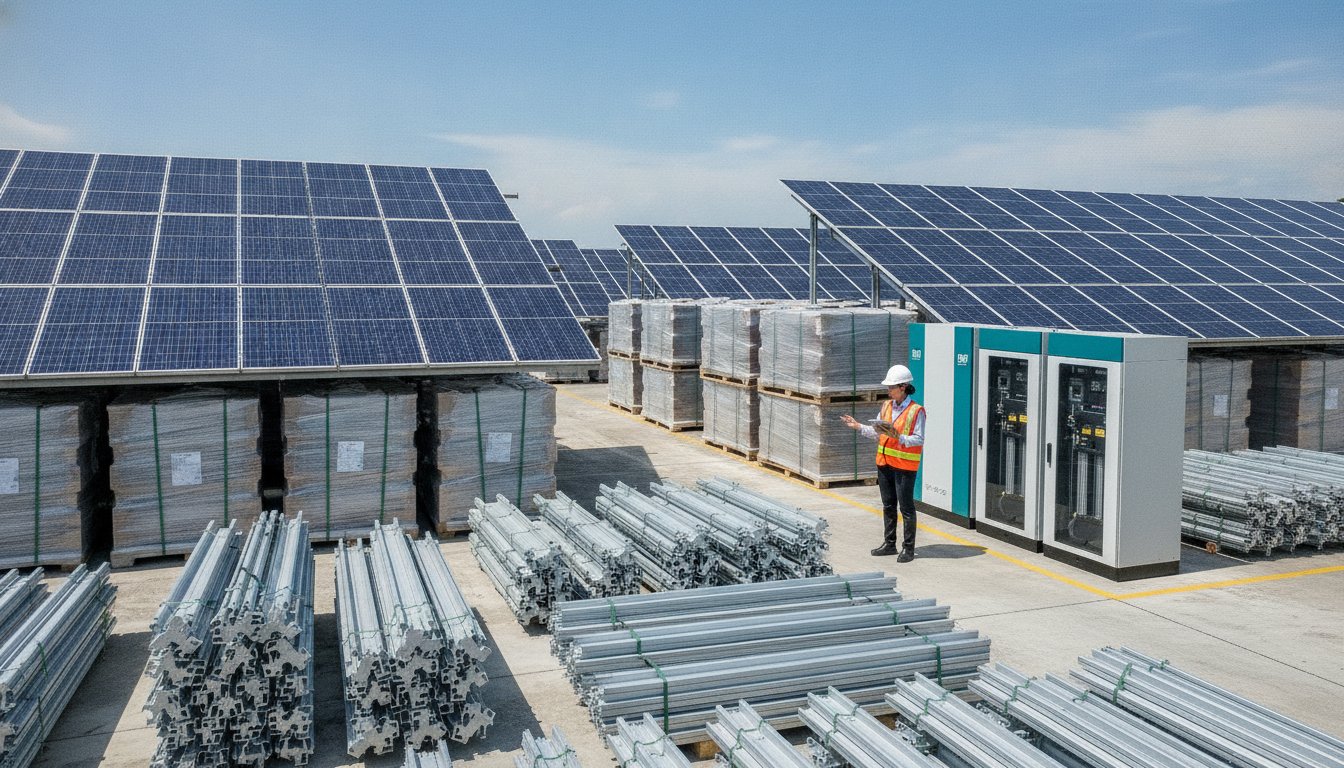
A standard P-type PERC module loses up to 5% more annual yield than N-type TOPCon alternatives when operating in 75°C roof environments. For EPC contractors, procurement of wholesale solar panels Malaysia requires more than just identifying Tier-1 brands. It demands hardware with a temperature coefficient of -0.29%/°C or lower and IEC 62804 PID resistance to withstand 85% relative humidity. You’re already aware that hardware degradation in equatorial climates and supply chain volatility remain the primary risks to project IRR. This guide delivers a technical framework for sourcing high-efficiency hardware and managing complex cross-border logistics within the Singapore-Malaysia corridor.
We provide a clinical analysis of the 2026 procurement landscape, focusing on N-type TOPCon performance metrics and SIRIM QAS International certification standards. The following sections detail localized inventory strategies for monocrystalline modules, LiFePO4 battery storage, and specialized mounting hardware like standing seamlock roof clamps. You’ll gain a structured approach to minimizing procurement risk through established logistical channels and technical specification auditing. This ensures your hardware meets the rigorous durability standards required for industrial deployments in high-humidity tropical environments. We focus on the transition from legacy systems to the Solar ATAP framework to maintain project viability.
Key Takeaways
- Analyze the impact of the Solar Accelerated Transition Action Programme (Solar ATAP) and CRESS framework on commercial procurement and 10-year contract durations.
- Identify critical performance benchmarks for wholesale solar panels Malaysia, specifically N-type TOPCon modules rated for high-humidity tropical environments.
- Navigate cross-border logistics requirements, including SIRIM consignment certificates and MIDA tax exemptions for efficient SG-to-Malaysia hardware transit.
- Secure specialized industrial components like standing seamlock roof clamps and LiFePO4 storage to meet specific mounting and energy density requirements.
- Establish a procurement framework based on inventory depth and technical documentation availability to support multi-megawatt EPC project timelines.
The Wholesale Solar Landscape in Malaysia and Singapore
Industrial solar deployment in 2026 operates under the Solar Accelerated Transition Action Programme (Solar ATAP) and the Corporate Renewable Energy Supply Scheme (CRESS). These frameworks mandate high-efficiency hardware to optimize the “use-it-or-lose-it” credit mechanisms defined in Energy Commission Guideline GP/ST/No. 60/2025. Procurement of wholesale solar panels Malaysia has transitioned from legacy P-type PERC modules to N-type TOPCon monocrystalline technology, driven by the need for superior temperature coefficients in equatorial environments. EPC contractors manage multi-megawatt projects where hardware reliability and immediate availability are non-negotiable. The market now prioritizes modules with linear performance warranties of 30 years and degradation rates below 0.4% annually.
Market Drivers for Industrial Solar in 2026
The CRESS framework allows corporate consumers to execute direct physical Power Purchase Agreements (PPAs) with Independent Power Producers. This shift has increased demand for utility-scale components capable of handling fixed System Access Charges (SAC) of 25 sen/kWh for firm output. While the photovoltaics manufacturing in Malaysia sector supports global supply, specialized Tier-1 modules often require regional distribution hubs to bypass domestic lead time volatility. Remote infrastructure projects in East Malaysia and rural Peninsular regions increasingly utilize off-grid hybrid systems. These installations combine high-wattage monocrystalline PV with LiFePO4 storage to ensure grid stability in areas with 4.2 to 5.6 kWh/m²/day irradiance levels. EPC procurement cycles now integrate Battery Energy Storage Systems (BESS) as standard components for firm capacity delivery.
Singapore vs. Malaysia: The Logistics Corridor
Singapore functions as a critical master distribution node for the Malaysian market. Localized inventory buffers in Singapore mitigate risks associated with port congestion at Port Klang or Tanjung Pelepas. For Malaysian installers, sourcing wholesale solar panels Malaysia through Singapore-based partners provides access to diverse SKU availability without the 12-week lead times typical of direct factory orders. This proximity allows for just-in-time delivery for large-scale commercial installations. Strategic staging in bonded warehouses simplifies the management of SST exemptions and SIRIM QAS International certification requirements. The August 2026 conditional approval of 900 MW in solar imports from Johor to Singapore has further solidified this corridor as a strategic renewable energy hub. Reliability is maintained through high-volume logistical coordination across the Causeway and Second Link, ensuring that hardware arrives at project sites in sync with construction phases.
Technical Specifications for Tropical Performance
Tropical environments require hardware with specific thermal and electrochemical stability. Standard PV modules often suffer from accelerated power loss due to relative humidity exceeding 80% and roof temperatures hitting 75°C. A Malaysian Investment Development Authority analysis confirms that the region’s solar transition depends on high-performance hardware that meets SIRIM QAS International standards. Procurement for wholesale solar panels Malaysia must prioritize N-type TOPCon cells over legacy P-type PERC to ensure project longevity. They don’t suffer the same heat-induced derating as older technologies, making them the standard for 2026 industrial deployments.
Monocrystalline PV Module Evaluation
N-type TOPCon modules provide a temperature coefficient of -0.29%/°C. This outperforms P-type PERC’s -0.35%/°C, resulting in 3% to 5% higher annual yields in Kuala Lumpur or Singapore. PID resistance is critical for equatorial zones. Modules must comply with IEC 62804 testing protocols at 85°C and 85% relative humidity for a minimum of 96 hours. For industrial sites, bifacial glass-glass modules offer superior durability compared to backsheet options. They resist moisture ingress and electrochemical delamination more effectively. This construction prevents the “snail trail” defects common in high-humidity environments.
Mounting Hardware and Circuit Protection
Corrosion resistance is mandatory for coastal and industrial zones like Pasir Gudang or Jurong. It’s mandatory for mounting hardware to meet IEC 61701 Severity 6 standards. Anodized aluminum frames require a minimum 15 to 20 μm coating thickness to prevent pitting. Specialized standing seamlock roof clamps are essential for maintaining metal roof integrity without penetration. For ground-mounted or infrastructure projects, engineer-rated solar panel pole mounts must withstand local wind load requirements. Solar circuit protection must include DC breakers and surge protection devices (SPD) rated for high-frequency tropical lightning strikes. These components ensure the system survives voltage spikes during monsoon seasons.
Lithium LiFePO4 batteries are the preferred chemistry for tropical energy storage due to their high thermal runaway threshold. They maintain stability at higher ambient temperatures compared to standard lithium-ion variants. Hybrid inverters require robust thermal management, including high-grade heat sinks and active cooling, to prevent efficiency drops. Ratings should remain stable even when ambient temperatures exceed 40°C. You can view our current inventory of monocrystalline solar panels and LiFePO4 batteries to match these specific technical requirements.
Procurement Framework: Evaluating Wholesale Suppliers
Procurement for industrial solar projects requires a shift from transactional purchasing to strategic supply chain management. EPC contractors must audit suppliers based on inventory depth and technical proficiency. The IEA report on solar PV global supply chains highlights that manufacturing concentration increases the necessity for localized inventory buffers. For wholesale solar panels Malaysia, the evaluation framework should prioritize distributors capable of supporting multi-megawatt deployments without relying on volatile factory lead times. Reliability is defined by the supplier’s ability to maintain immediate stock of Tier-1 hardware during peak demand cycles. It’s not just about the lowest price; it’s about the security of the supply chain.
Verification of certification standards remains a mandatory step. This includes TUV and IEC certifications for safety and performance, alongside local SIRIM QAS International compliance for the Malaysian market. Documented proof of these standards ensures project bankability and facilitates smooth grid-connection approvals. EPCs shouldn’t overlook the importance of having these documents readily available for regulatory submissions.
Inventory and Availability Metrics
Industrial installers require substantial buffer stock to prevent project downtime. A reliable partner maintains deep inventory across all Balance of System (BOS) components. This includes specialized hardware like solar panel pole mounts and standing seamlock roof clamps, which are often overlooked in generic procurement. Assessing a supplier’s historical performance in the B2B sector reveals their capacity to handle high-volume logistical demands. Immediate availability of solar circuit protection and DC cables allows EPCs to remain on schedule despite regional port congestion. You don’t want your installation crew waiting on a single shipment of clamps to finish a megawatt-scale roof.
Technical Compatibility and System Design
System efficiency depends on the seamless integration of monocrystalline solar panels with hybrid inverters and lithium LiFePO4 batteries. MPPT charge controllers must be specifically matched to the high-current output of modern N-type modules to avoid clipping or thermal overload. Sourcing from a single-point distributor ensures that all components, from the solar battery to the mounting racks, are pre-validated for electrical and mechanical compatibility. This reduces engineering overhead and minimizes the risk of DC arc faults caused by mismatched connectors or incompatible protection gear. Technical support documentation, including detailed SLDs and warranty terms, is essential for professional EPC planning and client handovers. Using a unified hardware ecosystem simplifies long-term maintenance and troubleshooting for the end-user.

Cross-Border Logistics and Inventory Management
Movement of solar hardware across the Singapore-Malaysia border requires precise adherence to customs protocols and technical verification. For wholesale solar panels Malaysia, the process begins with staging at Singaporean master distribution hubs. This localized staging bypasses the volatility of direct factory shipping and provides a buffer against regional port congestion. Effective logistics management ensures that high-value components arrive at project sites in sync with installation phases, preventing costly crew downtime.
Documentation requirements remain the primary bottleneck in cross-border transit. Assembled PV modules fall under HS Code 8541.43, which currently enjoys a 0% baseline customs import duty rate in Malaysia. However, clearing the Royal Malaysian Customs Department requires an electronic K1 form and valid SIRIM QAS International consignment certificates. Procurement of large-scale lithium LiFePO4 batteries necessitates compliance with Class 9 dangerous goods regulations. Managing these requirements through a Singapore-based partner simplifies the transition between Singapore’s GST framework and Malaysia’s SST exemptions via MIDA Schedule C certificates.
Logistics Optimization for Malaysian Installers
Coordinating hardware arrival with site mobilization is critical for project IRR. Bulk handling of monocrystalline panels involves double-stacked palletization and reinforced corner protection to prevent micro-cracks during transit across the Causeway or Second Link. Professional industrial packing is mandatory for hybrid inverters and sensitive solar circuit protection gear. Customs clearance strategies involve pre-filing for tax exemptions to avoid the standard 10% Sales Tax. This proactive approach ensures that hardware moves from Singaporean warehouses to Malaysian project sites within predictable windows, regardless of seasonal shipping spikes.
Wholesale Inventory Strategies
The transition from Just-in-Time (JIT) to safety stock procurement models provides stability against 12-week factory lead times. Singaporean warehouses function as critical inventory nodes, maintaining immediate availability for EPCs. Tracking systems for industrial hardware provide real-time visibility from order placement to final site delivery. This visibility allows project managers to coordinate crane schedules and labor deployment with precision. By maintaining localized safety stock of specialized components like standing seamlock roof clamps and solar panel pole mounts, installers can respond to project variations without delaying the commissioning date. You can secure your project timeline by accessing our ready-stock inventory for cross-border distribution.
Strategic Sourcing with SM Solar: B2B Hardware Solutions
SM Solar functions as a master distributor for the Singapore-Malaysia corridor. We specialize in the high-volume supply of monocrystalline solar panels and lithium LiFePO4 batteries. Our inventory supports industrial-scale deployments where hardware reliability is a functional requirement. We maintain immediate stock levels to bypass the 12-week lead times associated with direct factory procurement. This localized availability ensures that EPC contractors can secure wholesale solar panels Malaysia without compromising project timelines. We operate as a technical partner, providing the essential components for large-scale solar infrastructure. Our role is to act as the silent link in the supply chain, prioritizing technical specifications and availability over marketing narrative.
Industrial Grade Components and Protection
Our inventory includes specialized solar circuit protection and high-spec DC hardware. We provide mounting profiles designed for specific Malaysian roofing systems, including standing seamlock roof clamps for non-penetrative industrial installations. For ground-mounted systems, we supply engineer-rated solar panel pole mounts. Our selection of hybrid inverters and MPPT solar charge controllers is pre-validated for compatibility with high-current N-type modules. This technical alignment reduces the risk of field failures and simplifies the commissioning process for off-grid and grid-tied systems. We also stock high-density lithium LiFePO4 battery banks designed for thermal stability in equatorial climates, ensuring energy storage systems maintain performance at 40°C ambient temperatures.
The SM Solar Advantage for Installers
Founded in 2008, SM Solar possesses technical expertise in tropical solar applications. We understand the specific degradation risks associated with high humidity and elevated ambient temperatures. Our cross-border distribution network facilitates the movement of hardware between Singapore and Malaysia with logistical precision. We handle the complexities of inventory staging and technical documentation, allowing installers to focus on site execution. This established supply chain provides a robust link for professional EPCs operating in the region. We ensure that every component, from the solar battery to the circuit protection, meets the rigorous standards required for industrial infrastructure. Our organization is built on the depth of its inventory and the reliability of its logistical partners.
Contact SM Solar for wholesale procurement and technical specifications
Optimizing Renewable Infrastructure Procurement for 2026
Industrial solar success in the Singapore-Malaysia corridor requires a transition to high-efficiency N-type TOPCon modules and integrated LiFePO4 storage. Technical precision in selecting hardware with low temperature coefficients and IEC 62804 PID resistance ensures long-term IRR in equatorial climates. Managing the procurement of wholesale solar panels Malaysia involves more than just selecting Tier-1 brands. It’s about a localized logistics strategy that utilizes regional warehouses to mitigate port congestion and volatile factory lead times. Implementing a unified hardware ecosystem, from specialized standing seamlock roof clamps to DC circuit protection, reduces engineering risks and installation downtime.
SM Solar has functioned as a specialized B2B hardware supplier since 2008. We provide direct distribution of LiFePO4 batteries and monocrystalline PV modules, maintaining expertise in tropical-grade solar mounting and protection systems. Our established distribution network simplifies the cross-border movement of industrial components, ensuring your project remains on schedule. Request a Wholesale Quote for Industrial Solar Hardware to secure your 2026 project pipeline. We look forward to supporting your next large-scale deployment with technical reliability and logistical efficiency.
Frequently Asked Questions
What are the lead times for wholesale solar panel orders from Singapore to Malaysia?
Lead times for wholesale solar panels Malaysia typically range from 3 to 7 working days for ex-stock items staged in our Singapore warehouses. This localized inventory strategy bypasses the 12-week manufacturing lead times associated with direct factory orders. Bulk shipments clearing the Causeway or Second Link require electronic K1 forms and SIRIM consignment certificates. We coordinate with logistical partners to ensure hardware arrival aligns with specific project installation phases.
How do I ensure solar mounting hardware is resistant to corrosion in high-humidity areas?
Ensuring resistance requires hardware compliant with IEC 61701 Severity 6 for salt mist corrosion. Anodized aluminum frames must have a minimum coating thickness of 15 to 20 μm to prevent pitting in industrial or coastal zones. We supply fasteners made from 304 or 316-grade stainless steel to prevent galvanic corrosion. These specifications are mandatory for hardware used in high-humidity tropical environments where relative humidity frequently exceeds 80%. It’s a critical durability benchmark for tropical performance.
Are LiFePO4 batteries better than AGM for industrial solar storage in Malaysia?
Lithium LiFePO4 batteries are superior to AGM for industrial applications due to their high thermal runaway threshold and energy density. They maintain operational stability at ambient temperatures exceeding 40°C, which is critical for Malaysian climates. LiFePO4 chemistries offer over 3,000 cycles at 80% depth of discharge, compared to 500 cycles for standard AGM variants. This longevity reduces the total cost of ownership for large-scale energy storage projects. It’s the standard for 2026 industrial storage.
What technical certifications are required for solar panels used in commercial projects?
All PV modules must hold SIRIM QAS International certification under MS IEC 61215 for design qualification and MS IEC 61730 for safety. Grid-connected solar inverters require a Certificate of Approval (COA) from Suruhanjaya Tenaga. They must comply with MS IEC 62109-1 and -2 standards. Verification of these documents is a prerequisite for grid-connection approval and project bankability in the commercial and utility sectors. It’s necessary to ensure compliance with Energy Commission Guideline GP/ST/No. 60/2025.
Can SM Solar provide specialized mounting hardware for standing seam metal roofs?
SM Solar maintains a specialized inventory of standing seamlock roof clamps designed for non-penetrative industrial installations. These clamps provide mechanical stability without compromising the integrity of metal roofing systems. We also supply solar panel pole mounts and L-feet mounting profiles to accommodate diverse structural requirements. Our hardware is engineered to withstand local wind loads while adhering to the technical standards required for industrial-grade solar infrastructure. It doesn’t require roof penetration, maintaining warranty integrity.
What is the benefit of sourcing solar hardware from a Singapore-based distributor?
Sourcing from a Singapore-based distributor provides access to immediate safety stock and reduces supply chain volatility. Singaporean warehouses act as critical nodes that mitigate port congestion at Port Klang or Tanjung Pelepas. This proximity allows EPCs to manage wholesale solar panels Malaysia procurement with just-in-time delivery models. It simplifies the management of SST exemptions and ensures all hardware meets regional technical standards before arriving at the project site. It’s a strategic advantage for project IRRs.
How do I calculate the correct circuit protection for a large industrial PV array?
Calculating circuit protection requires adherence to MS IEC 60364-7-712 electrical codes. Large industrial arrays must include DC circuit breakers and surge protection devices (SPD) rated for tropical lightning strike frequencies. Protection gear must match the maximum string voltage and short-circuit current of the specific N-type TOPCon modules used. Mismatched components or cross-mating incompatible connectors are leading causes of DC arc faults. It’s essential to verify compatibility before site mobilization.
Does SM Solar offer technical support for inverter and battery integration?
We function as a direct technical partner for large-scale solar procurement, providing documentation for inverter and battery integration. Our support includes verifying the compatibility of hybrid inverters with lithium LiFePO4 battery banks to ensure seamless energy management. We provide detailed technical specifications and SLDs for professional EPC planning. This technical alignment ensures all balance-of-system components operate within their rated thermal and electrical parameters. It’s a standard part of our B2B service.