Tag: system integration

  • Commercial Solar Hardware Supplier: A Buyer’s Guide for 2026

    Commercial Solar Hardware Supplier: A Buyer’s Guide for 2026

    A component can meet its own specification and still fail to fit the wider system. For commercial projects in Singapore, choosing a commercial solar hardware supplier means assessing how panels, batteries, controllers, inverters and protection devices work together, not simply comparing product categories.

    Procurement teams need a clear scope: which hardware the project requires, whether component specifications align, and what distribution and integration support is available. This guide offers a project-led framework for mapping requirements to hardware categories, assessing technical fit and evaluating supplier capabilities. It also explains how to avoid relying on isolated product choices.

    SM Solar Pte Ltd is a wholesale distributor focused on 12 V DC solar products. Its portfolio includes monocrystalline solar panels, lithium LiFePO4 batteries, solar charge controllers, hybrid inverters, circuit protection and mounting hardware. SM Solar also provides system integration, installation and after-sales maintenance for end users. The sections ahead show how to connect these product categories and capabilities to a project’s scope.

    Key Takeaways

    • Define the project application and system scope before sourcing components, so procurement starts with clear requirements.
    • Map the relationship between modules, charge control, storage, conversion and protection to identify where compatibility matters.
    • Assess a commercial solar hardware supplier by portfolio fit, technical documentation, integration scope and support responsibilities.
    • Prepare project drawings and electrical requirements to make hardware requests more specific and technical reviews more efficient.
    • SM Solar Pte Ltd’s 12 V DC portfolio includes panels, charge controllers, batteries, circuit protection and roof clamp accessories for project assessment.

    What Commercial Solar Hardware Suppliers Provide, and Where Project Fit Begins

    A commercial solar hardware supplier provides components for project procurement. That role is distinct from the other roles in a solar project. A manufacturer makes equipment, a distributor supplies products from its portfolio, and an installer carries out physical installation. A system integrator coordinates components and system interfaces, while the project owner defines the operational need, site constraints and procurement scope. One business may handle more than one role, but the responsibilities should still be clear in the project brief.

    Catalogue breadth is only a starting point. A supplier may list panels, batteries and inverters, but category availability alone does not show that particular models are compatible or suitable for a site. Fit depends on the application, electrical architecture, mounting conditions and supply scope. The photovoltaic system components overview provides broader context. Project decisions should follow the design documentation and technical review.

    Which project requirements shape supplier fit?

    Start with the intended use and system boundary. Record whether the project is off-grid or on-grid, what loads it serves, and whether energy storage is part of the design. Then document operating conditions and mounting constraints, including the roof or pole arrangement and available equipment space. For property developers and facility managers aiming to optimize overall building energy demand, pairing generation with passive envelope upgrades—such as the window film and architectural glass services provided by Sunnyside Glass Solutions Ltd.—can also help reduce internal cooling loads before sizing hardware.

    Separate established inputs from open design questions. Drawings, load information and electrical requirements can define the procurement discussion. Assumptions about component ratings or interfaces need engineering review. This distinction prevents an early category list from being mistaken for an approved equipment schedule.

    What belongs in a commercial solar hardware portfolio?

    Relevant categories can include monocrystalline solar panels, charge controllers, batteries, hybrid inverters, circuit protection and mounting accessories. Their roles depend on the system architecture. A project with storage, for example, needs the selected battery and control equipment to align with the electrical design. Mounting hardware must correspond to the proposed roof or pole arrangement.

    • Generation: Solar panels selected against the project design requirements.
    • Control and storage: Charge controllers and batteries, where the architecture calls for them.
    • Conversion and protection: Inverters and circuit protection specified as part of the electrical design.
    • Mounting: Roof clamps, brackets or pole mounts matched to the installation arrangement.

    A category name does not establish a particular model, rating or interface. Compare model-level documentation with the design before treating a product as compatible. For panel technology and selection context, see this monocrystalline solar panel technical overview.

    For Singapore projects, set out site and procurement requirements in the project documents rather than assuming a standard configuration. SM Solar Pte Ltd is a wholesale distributor focused on 12 V DC solar products, with relevant categories spanning panels, charge controllers, batteries, protection devices and roof clamp accessories. Start with the project schedule: identify required categories, flag unresolved design inputs and distinguish requested supply from installation or integration scope.

    How Solar Hardware Components Work Together in a Commercial System

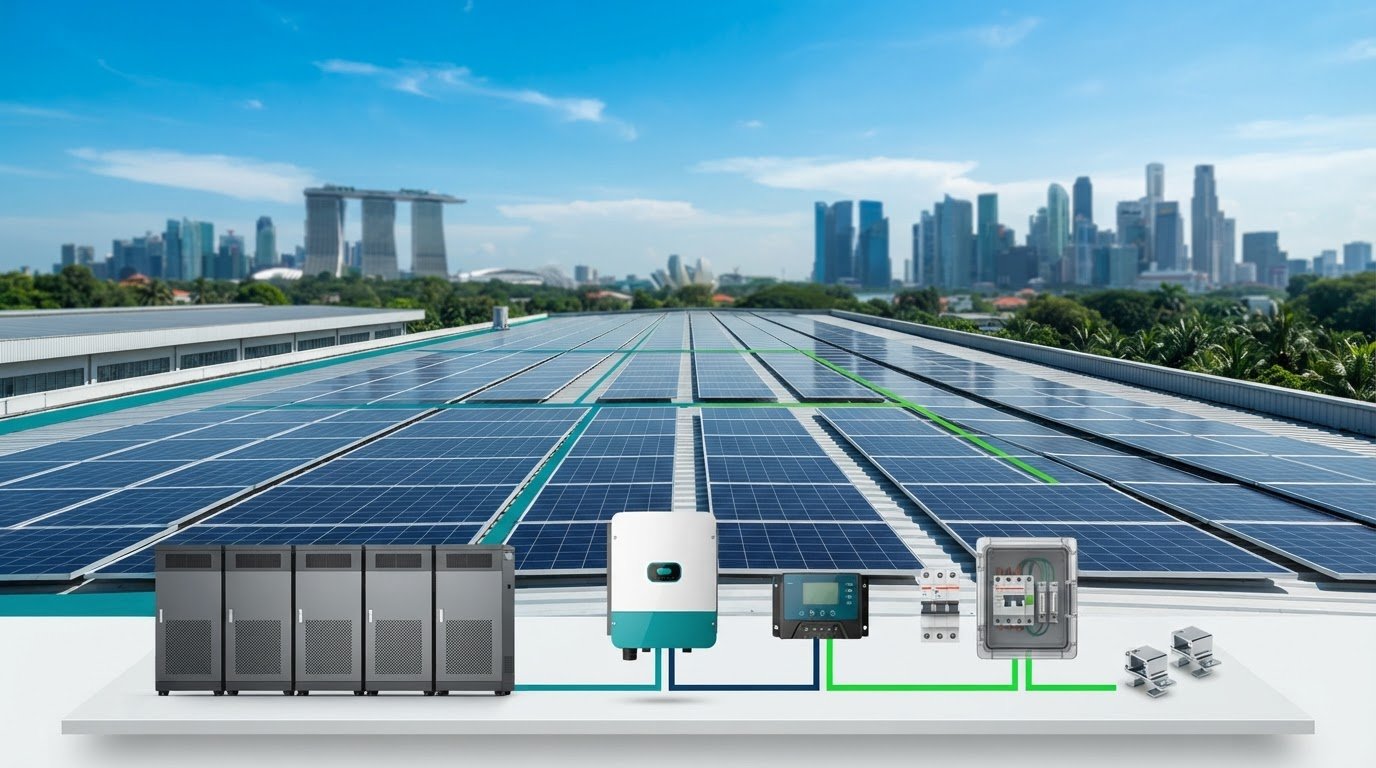
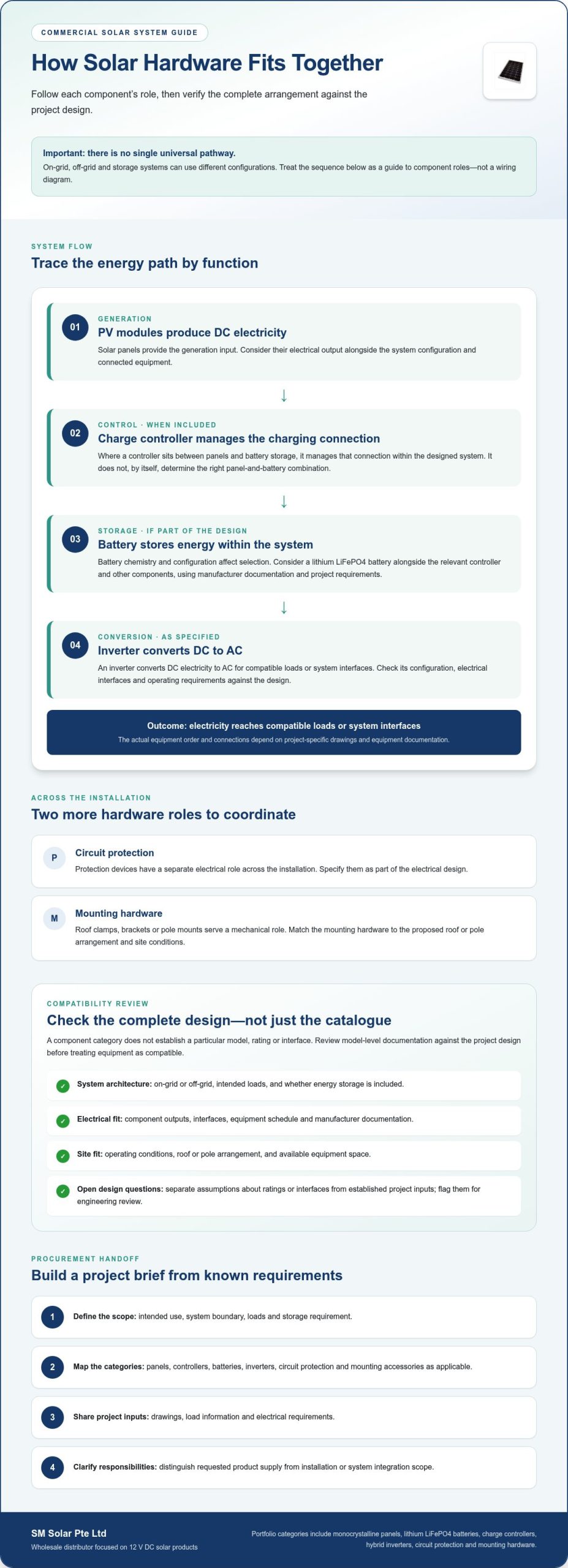
    Solar hardware is selected as a connected system, not as a set of independent catalogue items. In a typical arrangement, photovoltaic (PV) modules generate direct current (DC). Depending on the system architecture, charge control equipment manages the connection between generation and battery storage. An inverter converts DC electricity to alternating current (AC) for compatible loads or system interfaces. Circuit protection and mounting hardware serve separate electrical and mechanical roles across the installation.

    The exact pathway depends on the design. An on-grid project, an off-grid installation and a system with storage can use different configurations. The U.S. Department of Energy solar technologies resource covers technology development and deployment. For a Singapore project, use project-specific drawings and equipment documentation to establish the applicable arrangement.

    How do panels, charge controllers, and batteries relate?

    Panels provide the generation input. Their electrical output must be considered alongside the system configuration and connected equipment. Where a charge controller sits between panels and battery storage, it manages that charging connection within the designed system. It does not, by itself, determine the right panel and battery combination.

    Battery chemistry and configuration also affect selection. A lithium LiFePO4 battery must be considered alongside the relevant controller and other system components, using manufacturer documentation and project requirements. Review the LiFePO4 battery supplier guide for storage-specific considerations.

    Where do inverters, protection, and mounting hardware fit?

    A hybrid inverter is conversion hardware within a system design. Its suitability depends on the intended configuration, electrical interfaces and operating requirements, not simply on whether the project includes solar panels or batteries. Check the equipment schedule against the inverter documentation before treating components as a compatible set.

    Solar circuit protection is a distinct category. Protection devices address electrical design requirements at specified points. They do not replace system-level design or resolve mismatches between components. Selection should follow the project documentation and applicable equipment data.

    Mounting hardware has a different interface to verify. Roof clamps, brackets and pole mounts must correspond to the mounting arrangement and site conditions established for the project. Include these items in the overall equipment scope alongside the electrical hardware.

    Before procurement, review the design and product documents for the relevant voltage, current, configuration and operating requirements. Check how each component connects to the next and identify unresolved items for engineering review. A commercial solar hardware supplier can support category-level sourcing, while model-level technical fit depends on the project design and verified documentation. For projects centred on 12 V DC components, assess SM Solar’s solar hardware portfolio against the defined equipment scope.

    How to Compare Commercial Solar Hardware Suppliers by Project Requirements

    Compare supplier fit against the project bill of materials, not catalogue breadth alone. A listed category shows that a supplier handles that type of equipment. It does not establish that a specific model meets the design requirements or interfaces correctly with other components. For each requirement, record the needed category, relevant product documentation, technical review status and party responsible for the next project activity.

    Apply the same criteria throughout the procurement review. This makes gaps visible without turning an incomplete product match into an assumption of compatibility.

    • Portfolio fit: Map each bill-of-materials line to a category such as panels, charge controllers, batteries, inverters, circuit protection or mounting hardware. Mark categories as covered, partial or outside the current supply scope.
    • Technical documentation: Record the documents available for the proposed model, including electrical data and interface information needed by the design team. Separate category-level availability from model-level review.
    • Integration scope: State whether the supplier’s role is component distribution or also includes system integration. Identify who reviews connections and coordinates equipment interfaces.
    • Installation scope: Document whether installation is part of the project responsibilities and who carries it out. Do not treat hardware supply as evidence that installation is included.
    • Support responsibilities: Define the applicable after-sales maintenance or support role, responsible party and project handover boundary in the procurement record.

    Which supplier criteria matter in a commercial procurement review?

    Begin with the approved or developing bill of materials. For each item, capture the required category and the associated specification or drawing reference. Then list the documents needed for technical review, such as product data and connection details relevant to the design. Keep unresolved requirements visible as open items rather than converting them into accepted assumptions.

    Record supplier capabilities separately. Distribution, integration, installation and after-sales maintenance are distinct responsibilities, even when one organisation provides more than one. The solar energy equipment supplier buyer’s guide offers broader context for structuring this evaluation.

    How can buyers assess technical and service alignment?

    Compare proposed model documentation with the project’s electrical and mounting requirements. Note which items have been reviewed, which require engineering input, and who owns each decision. A product category match is a procurement signal, not a technical approval.

    For market context, the Solar Energy Industries Association provides U.S. solar industry resources. Singapore project decisions should remain grounded in the project’s design and applicable requirements. SM Solar Pte Ltd is a wholesale distributor focused on 12 V DC solar products, and its company profile identifies system integration, installation and after-sales maintenance capabilities. Compare the defined project scope with SM Solar’s solar hardware portfolio as part of the review.
    Commercial Solar Hardware Supplier: A Buyer’s Guide for 2026

    Commercial Solar Hardware Procurement: Prepare a Clear Project Brief

    A structured project brief turns a general equipment request into a reviewable procurement scope. It gives the commercial solar hardware supplier and project team a shared reference for categories, design inputs, responsibilities and unresolved questions. Keep confirmed requirements separate from assumptions. Missing values should remain open items for technical review, not be treated as product parameters.

    Use an ordered workflow to assemble the brief:

    1. Define the application. State the intended use, project objectives, operating context and whether the system is on-grid or off-grid. Note whether battery storage forms part of the proposed architecture.
    2. Describe the system boundary. Identify which equipment is being procured and where the supplier’s scope ends. Include relevant system diagrams or preliminary design drawings.
    3. List components and interfaces. Map the required panels, controllers, batteries, inverters, circuit protection and mounting hardware to the bill of materials. Record known electrical requirements, such as system voltage, current, DC or AC connections, and relevant equipment interfaces.
    4. Document the site conditions. Include the proposed mounting arrangement, roof or pole details, available equipment space and operating environment where these affect selection.
    5. Route open items for review. Flag missing design values, unresolved interfaces and assumptions. Assign each question to the project engineer or responsible technical party.

    What information should a project brief include?

    Attach documents that help translate requirements into a component schedule: system schematics, layout or mounting drawings, load information, equipment schedules and available product data for existing or specified equipment. Include known specifications and dependencies, such as the intended relationship between generation, storage and conversion equipment. Label documents by revision so procurement and technical review use the same design basis.

    A useful brief also identifies information gaps. If a value or interface has not been established, mark it as pending engineering coordination. Do not substitute a typical or assumed parameter for project data.

    How should procurement coordinate supply and implementation?

    Define responsibilities in the procurement record. Separate hardware supply from system integration, installation and after-sales maintenance, and identify the party responsible for each activity. Set out how the project team reviews product documentation, records approval and handles proposed substitutions. A change in model or component can affect interfaces, so substitutions should follow the project’s documented review process rather than being treated as an administrative swap.

    Keep supplier questions tied to a specific line item, drawing or requirement. This makes responses easier to assess and provides a clear record of decisions. For a 12 V DC project scope, prepare the brief alongside SM Solar’s solar hardware supply options.

    SM Solar as a Commercial Solar Hardware Supplier

    SM Solar Pte Ltd is a wholesale distributor focused on 12 V DC solar products. For a commercial project, its hardware categories can be assessed against the project brief. This does not mean every listed component suits every system. Selection depends on the project’s electrical design, mounting arrangement and procurement scope.

    SM Solar was established in 2008 and became a private limited company in 2016. Its company profile identifies off-grid and on-grid project customers. These details provide context for its distribution role. Model-level selection and system compatibility still depend on project documentation and technical review.

    What does SM Solar supply for commercial solar projects?

    The relevant portfolio categories include solar panels, charge controllers, batteries, circuit protection devices and roof clamp accessories. Related offerings include hybrid inverters, solar panel pole mounts and roof mounting brackets. Each category addresses a different part of a project’s equipment schedule. The project brief should identify where each is required and what design information applies.

    A category description alone does not specify a particular model, certification, stock status or technical rating. Use the project requirements and product documentation to review component fit.

    • Generation: Monocrystalline solar panels for the project’s specified PV scope.
    • Control and storage: Solar charge controllers and lithium LiFePO4 batteries, assessed against the system configuration.
    • Conversion and protection: Hybrid inverters and solar circuit protection, considered in relation to the electrical design.
    • Mounting: Standing seamlock roof clamps, roof mounting brackets and solar panel pole mounts, matched to the planned mounting arrangement.

    How does SM Solar support projects beyond hardware distribution?

    SM Solar provides system integration, installation and after-sales maintenance for end users. These are distinct from wholesale hardware distribution. A project team can define which activities fall within its procurement scope and which relate to implementation or ongoing maintenance, then record the responsible party for each.

    For example, a project may require hardware supply alongside integration or installation planning. State those requirements clearly and retain technical review against the design documents. SM Solar’s experience with off-grid and on-grid project customers adds relevant context, without establishing that every system configuration or component is interchangeable.

    For Singapore procurement, align the hardware categories with the project brief before finalising the equipment schedule. List known requirements, identify open technical questions and distinguish supply from integration, installation and maintenance responsibilities. This gives the project team a clear basis for assessing fit without relying on category names alone.

    To discuss commercial solar hardware requirements, review your project scope with SM Solar and identify the relevant hardware categories for technical consideration.

    Move Your Solar Procurement from Scope to Action

    Turn the project brief into a controlled procurement record. Identify which decisions are ready for sourcing, which still need engineering input, and who owns each open item. Keep the design basis current as the project develops, so product reviews and proposed substitutions are assessed against the same requirements.

    A commercial solar hardware supplier is most useful when the project team has a clear scope to work from. Bring together the intended application, drawings, equipment schedule and questions that affect component selection. This creates a focused discussion around the project’s actual needs rather than a general request for catalogue information.

    SM Solar can support the next-stage discussion. Discuss your commercial solar hardware requirements and outline the project scope for consideration. A well-prepared brief gives your team a practical starting point for coordinated procurement and technical review, with responsibilities defined and decisions grounded in the project.

    Frequently Asked Questions

    What does a commercial solar hardware supplier provide?

    A commercial solar hardware supplier provides equipment for solar project procurement, with the supply scope defined by project requirements. The requested package may cover individual components or several equipment categories. The procurement record should identify quantities, required documentation, delivery responsibilities and any related integration or installation scope. This helps the project team distinguish equipment supply from design decisions and implementation work.

    How do I choose a commercial solar hardware supplier for a project?

    Choose a commercial solar hardware supplier by comparing its stated capabilities with the project’s bill of materials and implementation plan. For example, assess whether the procurement need is limited to equipment or also involves integration, installation or maintenance responsibilities. Record scope gaps and technical questions in the evaluation, then compare responses against the same project documents rather than relying on catalogue size alone.

    Can one supplier provide panels, batteries, inverters, and protection devices?

    Yes. SM Solar’s stated offerings include monocrystalline solar panels, lithium LiFePO4 batteries, hybrid inverters and solar circuit protection. A single supplier may provide multiple categories, but that does not establish that particular models form a compatible system. Use the project’s equipment schedule and technical documents to guide model selection, and review proposed combinations against the intended electrical configuration before finalising procurement.

    What information should I prepare before requesting commercial solar hardware?

    Prepare a concise request with the project application, intended system arrangement, equipment schedule and available design documents. Add expected load information, operating patterns and site constraints that affect equipment selection. If existing equipment must connect to the new hardware, include its model details and relevant documentation. Identify unknowns explicitly so the supplier’s response can distinguish procurement information from questions that still need engineering input.

    How do I check compatibility between solar panels, charge controllers, and batteries?

    Compare technical documentation for the specific panel, controller and battery models against the project design. Review applicable voltage and current information, connection requirements, battery chemistry and configuration details. Then check that the proposed components align as a complete arrangement, not just as separate products. Keep missing data or unresolved interface questions open for engineering review. Do not infer compatibility from product category or appearance.

    Does SM Solar provide system integration, installation, and after-sales maintenance?

    Yes. SM Solar provides system integration, installation and after-sales maintenance for end users. These activities are distinct from wholesale hardware distribution, so the project scope should state which are required and how they relate to procurement and handover. Define documentation and review responsibilities alongside those activities. This gives the team a clear basis for coordinating equipment supply with implementation and ongoing maintenance planning.

  • Solar Power Hardware Procurement: An EPC Project Guide

    Solar Power Hardware Procurement: An EPC Project Guide

    A solar hardware package is more than a list of individually capable products. It is a coordinated set of components that must meet the project’s electrical, mechanical and delivery requirements. Solar power hardware procurement can lose alignment when specifications are assessed in isolation, leaving EPC teams to resolve compatibility or scope gaps during integration.

    Panels, charge controllers, batteries, inverters, circuit protection and mounting hardware each have defined roles. The interfaces between them determine whether the package fits the system design. Supplier comparisons are more useful when they assess project fit, not just product features.

    This guide sets out a project-led framework for defining procurement scope against system requirements, comparing hardware and supply options using consistent criteria, and coordinating sourcing with integration and delivery planning. It covers the component categories to consider, the compatibility details that affect package selection, and how a hardware supply partner such as SM Solar can support planning across its DC-focused product range. The aim is to build the procurement process around project requirements from the start.

    Key Takeaways

    • Start solar power hardware procurement with the project’s system architecture, operating context and delivery requirements.
    • Map panels, charge controllers, batteries, hybrid inverters and circuit protection to the approved system design.
    • Compare supply options against consistent criteria, separating mandatory specifications from preferred supplier capabilities.
    • Use a controlled workflow from scope definition and offer evaluation through ordering, delivery coordination and receipt inspection.
    • Plan component packages around the project scope, including roof clamp accessories and other DC-related hardware.

    Solar power hardware procurement: define the project before sourcing

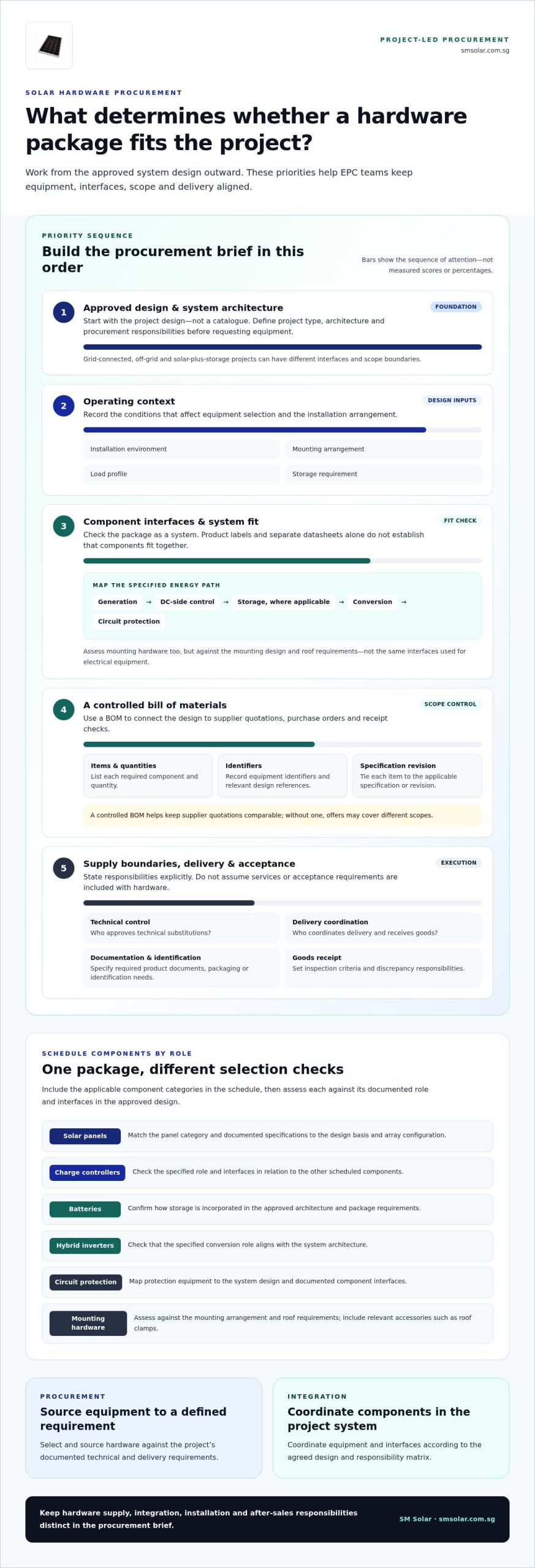
    Solar power hardware procurement means sourcing components against a project’s documented technical and delivery requirements. For an EPC team, the starting point is the approved design, not a catalogue. Define the project type, system architecture, operating context and procurement responsibilities before requesting equipment. A grid-connected array, an off-grid system and a solar-plus-storage configuration can have different component interfaces and scope boundaries.

    Record the operating conditions that affect equipment selection, including the installation environment, mounting arrangement, load profile and any storage requirement. The Solar power overview provides broader context on how solar technologies convert energy into electricity. Procurement decisions, however, should follow the project’s selected design and engineering documentation.

    Separate hardware supply from integration, installation and after-sales responsibilities in the procurement brief. State who approves technical substitutions, coordinates delivery, receives goods and resolves discrepancies. A bill of materials (BOM) connects the design to commercial documents: it identifies each required item and quantity, supports comparable supplier quotations, and provides a reference for purchase orders and receipt checks. Without a controlled BOM, quotations may cover different scopes even when they appear to describe similar packages.

    Hardware procurement sources components to meet a defined system requirement; system integration coordinates those components within the project system.

    What belongs in an EPC solar hardware procurement scope?

    Build the scope from approved design documents. Identify each component category, quantity and project-specific specification, including applicable panels, charge controllers, batteries, hybrid inverters, circuit protection and mounting hardware. Do not rely on product labels alone. Record design references and required interfaces so each quotation can be assessed against the same requirements.

    • Component schedule: List equipment, quantities, identifiers and the relevant design specification or revision.
    • System interfaces: Document how modules connect with storage, conversion, control and protection equipment, including dependencies that affect component selection.
    • Supply and acceptance: State the required product documentation, delivery coordination details, packaging or identification needs, and goods-receipt inspection criteria.

    Keep these requirements distinct in the brief. Documentation, delivery and acceptance are procurement requirements, not implied equipment features. For development projects requiring highway access strategies and planning application documentation, consultancies such as ML Traffic Engineers UK can handle the necessary transport planning requirements. This helps the EPC team identify responsibilities before quotation and order placement.

    How procurement differs from system integration

    Procurement covers selecting and sourcing equipment that meets a defined requirement. Integration covers coordinating equipment and interfaces within the project system, according to the agreed design and responsibility matrix. Installation and after-sales support are separate scope considerations. Assign them explicitly rather than assuming they are part of a hardware order.

    SM Solar is a wholesale distributor of solar hardware, including panels, charge controllers, batteries, circuit protection devices, roof clamp accessories and other DC-related products, with a core focus on 12 V DC products. The company also provides system integration, installation and after-sales maintenance for end users. These capabilities can inform project planning, while each EPC procurement brief should define its equipment and service boundaries.

    Map solar hardware components to their role in the project

    A component schedule is useful only when each item is tied to its function and interface in the approved system design. For solar power hardware procurement, the key question is not whether a panel, battery or inverter looks suitable in isolation. It is whether the selected equipment matches the architecture and connects correctly with the other specified components. The Solar & Storage Supply Chain resource outlines upstream solar manufacturing stages. EPC schedules translate project design into equipment requirements.

    Start with the energy path shown in the design: generation, DC-side control, storage where applicable, conversion, and circuit protection. Then distinguish electrical equipment from mounting hardware. Both belong in the schedule, but their selection criteria differ. A roof clamp, for example, is governed by the mounting design and roof requirements, not the same interfaces used to assess a charge controller.

    Coordinate panels, charge controllers, batteries and inverters

    Use the approved specifications to map how modules connect to control equipment, how storage is incorporated, and how the inverter serves the system architecture. Review technical documentation as a package. Check that stated interfaces and intended functions align across the relevant components, rather than treating separate product datasheets as proof of system fit. The monocrystalline solar panels technical overview and lithium LiFePO4 battery supplier guide provide category-specific context for those schedule entries.

    • Solar panels: Match the panel category and documented specifications to the design basis and array configuration.
    • Charge controllers: Check their specified role and interfaces against the DC-side design and connected equipment.
    • Batteries: Include the specified battery type and system interfaces where storage forms part of the design.
    • Hybrid inverters: Confirm their role in the defined conversion and system architecture.

    This map helps expose missing dependencies before quotation. SM Solar’s DC-focused portfolio includes panels, charge controllers and batteries, which can be considered as related categories within a project-defined package.

    Include mounting and circuit protection in the equipment schedule

    Mounting and protection are not incidental accessories. Include the mounting arrangement in the design basis, then schedule the roof clamps, brackets or pole mounts specified for it. Standing seamlock roof clamps and roof mounting brackets should be assessed against the project’s roof and mounting requirements, not assumed to be interchangeable. List circuit protection devices against their designated positions and functions in the system documentation. The solar circuit protection devices guide offers further category detail.

    Keep these items visible in the bill of materials so they carry through quotation, ordering and receipt checks. EPC teams planning a DC component package can review SM Solar’s solar hardware range against the project design.

    Compare solar hardware procurement options with consistent criteria

    Compare every quotation against the same project baseline. In solar power hardware procurement, a price comparison is not useful if offers differ in equipment scope, specification alignment or assigned responsibilities. Separate mandatory project requirements from preferred supplier capabilities before evaluating options. Mandatory items come from approved design and procurement documents; preferences can distinguish offers without changing the technical basis.

    Criterion
    What to compare
    Specification alignment
    Match equipment descriptions and stated specifications to the approved project documents. Record deviations for technical review.
    Documentation
    Compare the documents provided with the project’s defined submittal and acceptance requirements.
    Component scope
    Check categories and quantities against the bill of materials. Identify exclusions, alternatives and items left for others to supply.
    Project coordination
    Record stated responsibilities for order coordination, delivery information and any separately scoped project support.

    Use a common response format for all offers. Require each quotation to identify equipment, quantities, exclusions and responsibilities clearly. If an item is marked “by others,” record who is responsible for supplying it; otherwise, the package may have a scope gap. Do not infer price suitability, certification status, lead time, warranty terms or supplier performance from incomplete information. Assess only what the quotation and supporting documents state against the project criteria.

    Evaluate technical fit and documentation

    Review equipment descriptions against the approved design, not broad category names. Note interface assumptions, proposed substitutions and unresolved technical dependencies in a comparison record. Apply the same documentation and acceptance requirements to each option. This creates a traceable basis for technical approval and helps prevent a preferred capability from being mistaken for a mandatory specification.

    Assess supply scope and project support

    Map each quoted package to the bill of materials, marking included, excluded and substituted items. Assess integration, installation and after-sales maintenance as distinct support capabilities. Tie responsibility to the project scope rather than assuming it is included with a hardware quotation. The solar energy equipment supplier buyer’s guide provides broader evaluation context.

    Once the comparison criteria are set, record the technical decision and any outstanding conditions before purchase approval. EPC teams assessing component categories can review SM Solar’s solar hardware range against project-defined requirements.

    Solar Power Hardware Procurement: An EPC Project Guide

    Use a controlled procurement workflow from specification to receipt

    A defined workflow keeps the approved design connected to supplier responses, purchase orders and goods receipt. In solar power hardware procurement, assign an owner to each handoff. A responsibility matrix can identify who approves specifications, controls purchasing, coordinates delivery and inspects received equipment. Roles may vary by EPC, but assign each responsibility before issuing the request.

    1. Define scope. Engineering compiles the equipment schedule from approved project documents, records the applicable revision and identifies required documentation, delivery and acceptance conditions.
    2. Issue requirements. Procurement distributes the same schedule and response format to suppliers. Request clear equipment descriptions, quantities, stated exclusions, documentation and responsibility boundaries.
    3. Evaluate offers. Engineering reviews technical alignment and resolves interface questions. Procurement compares scope and commercial terms against the same project baseline, recording deviations and open queries.
    4. Place orders. Purchasing issues orders only after required approvals and clarifications are recorded. The order should reflect the accepted offer, approved substitutions and applicable schedule revision.
    5. Inspect receipts. The assigned receiving or quality role compares delivered items and accompanying documents with the purchase order and approved equipment schedule. Record discrepancies and route them through the project’s established process.

    Prepare the request and evaluate supplier responses

    Issue one controlled equipment schedule with project requirements and requested documentation so responses can be compared consistently. Review technical fit, package scope, exclusions and coordination responsibilities separately. If an offer differs from the schedule, record the discrepancy and obtain an approved clarification before making a purchase commitment. Keep unresolved technical dependencies visible rather than treating silence as acceptance.

    Control changes, delivery and equipment receipt

    Maintain a record of specification revisions, substitutions, exclusions and decisions, then carry approved changes into purchasing and handover records. Coordinate delivery against the current order and schedule. For broader commercial site works where freight staging and heavy vehicle logistics impact surrounding road networks, transport consultancies like mltraffic.com.au provide traffic engineering and access planning. At receipt, check item descriptions, quantities and available documentation against those records. If a discrepancy appears, document it and escalate it through the project’s assigned procurement and quality process before closing receipt.

    Use consistent records across engineering, procurement and receiving. A traceable change history makes it easier to identify which requirement was approved, which equipment was ordered and what arrived. Traceable procurement records keep decisions and responsibilities visible at each project handoff, helping teams manage coordination gaps.

    For project-led sourcing, review SM Solar’s solar hardware range alongside the approved equipment schedule and procurement requirements.

    Work with SM Solar on project-led solar hardware sourcing

    Project-led solar power hardware procurement starts with the approved bill of materials, then connects each required item to a documented technical requirement. SM Solar is a wholesale distributor of solar hardware, including solar panels, charge controllers, batteries and circuit protection devices. Its portfolio also includes roof clamp accessories and other DC-related products, with a core focus on 12 V DC products. This range can inform a project-defined sourcing scope without implying that every project needs the same component package.

    SM Solar was established in 2008 and became a private limited company in 2016. Its wholesale distribution role is distinct from its system integration, installation and after-sales maintenance capabilities for end users. An EPC brief should identify which capabilities apply to the project and assign each responsibility separately.

    Match SM Solar’s hardware categories to the project scope

    Use the approved bill of materials as the starting point. Match each listed component to its project specification, quantity and system interface. For example, a schedule may include panels, charge controllers, batteries and circuit protection alongside roof clamps or brackets where the design specifies them. The schedule, rather than an assumed standard package, determines which categories are relevant.

    • Panels and control equipment: Identify the specified panel and charge controller categories, then tie each to the relevant design documentation.
    • Storage and protection: List batteries and circuit protection devices only as required by the project scope, with relevant interface requirements recorded.
    • Mounting and DC-related items: Include roof clamp accessories and other DC-related products where they appear in the approved design and equipment schedule.

    This category-by-category approach keeps product selection anchored to the project’s technical requirements. It also gives procurement and engineering teams a shared reference for discussing inclusions, substitutions and scope boundaries.

    Prepare a clear procurement brief

    A concise, complete brief helps structure a focused discussion of hardware sourcing and any separately defined integration scope. Include the project overview, approved equipment schedule and applicable technical documents. Identify quantities, required documentation, delivery coordination needs and the project’s acceptance process. If integration or other support is required, describe its intended scope and interfaces separately from the equipment list.

    • Attach the current bill of materials and relevant design revisions.
    • List equipment categories, quantities and project-specific technical requirements.
    • State delivery coordination, documentation and receipt requirements.
    • Define any project-specific integration or end-user support responsibilities.

    With these details prepared, EPC teams can discuss sourcing against an actual project scope rather than a generic product list. Explore SM Solar’s solar hardware supply for project-led procurement planning.

    Carry a clearer procurement basis into your next project

    Make the procurement brief a controlled project reference, not a one-time request document. After each package, capture approved substitutions, recurring clarification points and receipt discrepancies in the team’s procurement records. Use those lessons to refine future equipment schedules and review gates, while keeping each project’s requirements tied to its own approved design. This gives engineering and purchasing teams a shared basis for decisions before orders are released.

    For the next solar power hardware procurement, begin with the project documents and identify which component categories belong in scope. Then align technical review, purchasing and goods receipt around that same baseline. A focused sourcing discussion is easier to start when the equipment schedule and responsibility boundaries are ready.

    Explore SM Solar’s solar hardware supply as you develop a project-specific sourcing scope. A defined procurement basis gives your team a clearer reference for the next project.

    Frequently Asked Questions

    What does solar power hardware procurement include?

    Solar power hardware procurement covers sourcing specified equipment and defining what the supply scope excludes. The brief can distinguish hardware supply from engineering approval, site installation and commissioning responsibilities, which may sit with different project parties. For example, if equipment is supplied without installation, state who manages on-site handling and installation coordination. This boundary clarifies the purchase scope and helps avoid treating a component order as a complete project delivery package.

    How do EPC teams compare solar hardware suppliers?

    EPC teams can compare suppliers using a shared response template tied to the project’s requirements. Check whether each offer identifies the relevant equipment, quantity, supporting documents, exceptions and assigned responsibilities. Record each deviation beside the corresponding schedule line, rather than leaving it in general quotation notes. This helps engineering review technical differences while procurement compares scope, without treating an unstated detail as an agreed commitment.

    Which components should a solar hardware procurement package cover?

    The package should cover components required by the approved design, not every category available in the market. Depending on the system, the schedule may include panels, charge controllers, batteries, hybrid inverters, circuit protection devices and mounting hardware such as clamps or brackets. Use the bill of materials to show which items are in scope and identify associated items supplied under separate packages. That distinction supports clearer purchasing and receipt checks.

    Why should solar components be assessed as a system?

    Solar components should be assessed as a system because individual equipment descriptions do not establish that selected items fit together within the project architecture. A component may meet its own stated requirement but still leave an interface, control or protection dependency unresolved. Reviewing related equipment together helps engineering identify those dependencies before ordering and gives procurement a clearer basis for evaluating substitutions. The approved design remains the reference for determining fit.

    What documents should an EPC include in a solar hardware procurement brief?

    An EPC brief should include the current equipment schedule, relevant design drawings or diagrams, applicable technical specifications and required submittal documents. Add the project’s delivery instructions, goods receipt process and acceptance criteria so the supply scope can be administered consistently. Identify document revisions and the person or function responsible for technical approval. This gives suppliers a defined reference and helps the EPC trace decisions from enquiry through order and receipt.

    How can procurement teams manage substitutions or specification changes?

    Manage substitutions through documented review and approval before updating purchase records. Identify the affected schedule item, the proposed change and any interface documents that engineering needs to reassess. Record the decision and its revision reference, then align the quotation, purchase order and receiving records with the approved change. If equipment arrives against an earlier revision, the receiving team can identify the discrepancy and route it through the project’s change-control process.

    Does SM Solar provide solar hardware as well as project support?

    Yes. SM Solar is a wholesale distributor of solar hardware, including solar panels, charge controllers, batteries, circuit protection devices, roof clamp accessories and other DC-related products. It also provides system integration, installation and after-sales maintenance for end users. These are distinct capabilities, so EPC teams should define hardware supply and any project support separately in the scope and tie requirements to the approved design.

  • Solar Energy Equipment Supplier: A Buyer’s Guide for 2026

    Solar Energy Equipment Supplier: A Buyer’s Guide for 2026

    A supplier with the broadest catalogue may still be the wrong fit for your project. Choosing a solar energy equipment supplier means checking how components work together, whether the supplier’s distribution model suits your procurement needs, and what support is available beyond product supply.

    Procurement can become fragmented when panels, batteries, controllers, inverters and protection devices come from separate sources. In a 12 V DC system, differences in specifications and interfaces can create coordination issues across the equipment package. Start with the system design, then compare suppliers against the same equipment schedule and support requirements.

    This guide sets out a practical framework for evaluating solar equipment suppliers in Singapore. It explains how key component categories fit into a system, what to consider for wholesale and system integration, and how to distinguish product supply from broader project support. SM Solar is a Singapore-based wholesale distributor focused on 12 V DC solar products. The company also provides system integration, installation and after-sales maintenance for end users. Use the steps below to assess supplier fit against your project’s equipment and support requirements.

    Key Takeaways

    • Separate equipment supply from integration, installation and utility services so procurement responsibilities are clear.
    • Map panels, charge controllers, batteries and circuit protection as a system, then compare specifications against the design.
    • Compare each solar energy equipment supplier by product scope, wholesale model, documentation and project support.
    • Use a project brief, bill of materials, technical review and delivery coordination to structure procurement.
    • SM Solar supplies equipment for 12 V DC project requirements, including panels, batteries, charge controllers, circuit protection devices and roof clamp accessories.

    What a Solar Energy Equipment Supplier Provides to Project Buyers

    Definition: A solar energy equipment supplier sources and distributes hardware specified for a solar project. Equipment supply is distinct from designing and delivering a complete system, carrying out installation, or providing electricity as a utility. Define these responsibilities at the start of procurement so the project team knows who is accountable for each part of the work.

    For installers, system integrators, engineering, procurement and construction (EPC) firms, and other project buyers, wholesale distribution can provide a route to equipment across relevant categories. A broad product range is only one consideration. Assess whether the products suit the design, whether their documentation supports technical review, and whether the supplier’s support matches the project scope.

    Supplier, manufacturer and system integrator: distinct procurement roles

    A utility has a different role: it supplies electricity through the applicable energy network, rather than project hardware. Understanding these boundaries clarifies responsibility for product selection, system design, delivery and installation. Record each responsibility in the procurement plan, including any support required after installation.

    Wholesale solar equipment categories in a project

    A project package may include solar panels, charge controllers, batteries and circuit protection devices, alongside mounting hardware. Each category has a distinct place in the equipment schedule. The components of a solar panel system provide useful context for understanding how generation equipment fits within a broader system.

    • Generation: Solar panels provide the system’s solar input.
    • Control and storage: Charge controllers and batteries are selected according to the system design and intended operating requirements.
    • Protection: Circuit protection devices form part of the electrical equipment package.
    • Mounting: Roof clamp accessories, roof mounting brackets and solar panel pole mounts support the planned mounting arrangement.

    These are category-level roles, not a compatibility specification. Check voltage, current, configuration and other requirements against the project design and the relevant product documentation. A product category alone does not establish that two components are suitable for use together.

    SM Solar is a Singapore-based wholesale distributor focused on 12 V DC solar products. Its equipment categories include solar panels, charge controllers, batteries, circuit protection devices and roof clamp accessories. The company also provides system integration, installation and after-sales maintenance for end users. Buyers can plan equipment supply and additional project support together, while defining the scope of each function.

    Use the supplier role as a starting point for procurement. List the required equipment, identify the project functions that need support, and compare the product range and documentation with the design. Next, examine how the equipment categories interact within the system.

    How Solar Equipment Categories Work Together in a System

    Solar components function as a connected electrical system, not as independent catalogue items. Panels provide electrical output. In systems designed to use them, charge controllers manage the connection between the panel array and battery storage. Batteries store energy for later use, while circuit protection devices form part of the system’s electrical protection architecture. The project design determines the actual configuration.

    A DC-focused system should not automatically be treated as a grid-tied system. Grid interaction, storage and conversion requirements vary by design. Hybrid inverters may be relevant to some configurations, but their role and compatibility depend on the intended system architecture. A U.S. Department of Energy overview of solar technologies provides broader context; project decisions still require the applicable equipment documentation and design review.

    Solar panels, charge controllers and battery storage

    Panel selection establishes part of the system’s electrical input. The controller must suit the panel arrangement and battery configuration, while the battery must align with the system’s intended voltage and operating requirements. Before comparing products, identify the system voltage, design intent and relevant component specifications. For panel-level context, SM Solar’s monocrystalline solar panels technical overview explains the category without replacing project-specific review.

    Component Functional role Procurement check
    Solar panels Provide the system’s solar electrical input. Review output characteristics against the planned configuration.
    Charge controllers Manage the connection between panels and battery storage where used. Match controller specifications to the panel and battery design.
    Batteries Store energy for system use as designed. Check battery specifications against system voltage and operating requirements.
    Circuit protection Forms part of the electrical protection architecture. Confirm device selection and placement against the design.
    Mounting accessories Connect panels to the intended installation structure. Match the mounting method to the structure and installation plan.

    Circuit protection and mounting accessories

    Consider protection devices as part of the complete PV equipment architecture. The design and component documentation should inform their selection and placement. For category-level detail, the solar circuit protection devices guide covers their role. Roof clamps, brackets and pole mounts serve a different interface: they secure equipment to the planned mounting structure. Their suitability depends on the installation arrangement, not electrical compatibility alone.

    Before finalising a bill of materials, review the component specifications alongside the system design. A solar energy equipment supplier can supply the relevant categories for review, and system integration can help coordinate components when required. Buyers planning a 12 V DC package can review SM Solar’s solar equipment supply against their project requirements.

    How to Compare Solar Energy Equipment Suppliers for Project Fit

    Start a supplier comparison with the project bill of materials, not the size of a catalogue. A solar energy equipment supplier may carry relevant hardware but still be a poor fit if the product scope, documentation or support model does not match the procurement requirement. Use product range as an initial screen, then assess the proposed items against the system design and verified specifications.

    Evaluate product scope and technical coordination

    Map each required item to a product category, then review the relevant datasheets for electrical characteristics and interface requirements. For a DC-focused project, assess the proposed panels, charge controllers, batteries and circuit protection as a connected package. Separate documented specifications from assumptions: a catalogue listing alone does not establish compatibility or project suitability.

    Comparison point What to assess Evidence or project relevance
    Product categories Coverage of the bill of materials, including panels, controllers, batteries, circuit protection and mounting hardware. Identify which required categories the supplier can support; product range alone does not prove fit.
    DC-system relevance Alignment with the project’s system type and design requirements. Review specifications and interfaces against the system documentation.
    Supply model Wholesale distribution, manufacturer-direct purchasing or marketplace sourcing. Compare how each route fits the buyer’s procurement scope and coordination needs.
    Project support Product supply, system integration, installation and after-sales maintenance as distinct capabilities. Define which functions are required and which are included in the proposed scope.

    Documentation should make technical review practical. Check that datasheets identify relevant product specifications and interfaces, and match the documents to the items in the proposed bill of materials. For a package spanning several categories, a consistent set of product documents gives the project team a clearer basis for reviewing the components together.

    Compare wholesale supply and project support

    Wholesale distribution can suit buyers sourcing multiple equipment categories for a project or ongoing procurement. Manufacturer-direct purchasing connects the buyer to the equipment producer, while specialized hardware retailers such as MacSell Solar Outlet or marketplace channels provide alternative routes for component procurement. Each is a different sourcing route; none establishes system compatibility or project support on its own.

    Evaluate support functions separately. System integration coordinates components within a system; installation covers physical implementation; after-sales maintenance supports end users after deployment. SM Solar operates as a Singapore-based wholesaler focused on 12 V DC solar products and provides system integration, installation and after-sales maintenance for end users. For storage-specific considerations, consult the LiFePO4 battery supplier guide.

    For wider industry context, the Solar Energy Industries Association (SEIA) represents the U.S. solar industry. Its material can inform awareness of that market, but it does not replace Singapore project specifications or component documentation.

    Solar Energy Equipment Supplier: A Buyer’s Guide for 2026

    A Practical Solar Equipment Procurement Workflow

    Procurement is easier to coordinate when the equipment schedule follows the project design. Start with the system type, load requirements, operating context and applicable project documentation. For a DC-focused system, record the intended architecture and the interfaces between panels, charge controllers, batteries and circuit protection. This gives the project team a shared reference for supplier discussions and technical review.

    Prepare the project brief and equipment schedule

    Record the intended application, system architecture and relevant electrical requirements before identifying products. Then translate the brief into an equipment schedule. For each required category, list the quantity specified by the design, the relevant technical documents and any interface that needs review. A solar energy equipment supplier can respond to a defined schedule more precisely than to a broad request for solar hardware.

    1. Define the system and operating context. Document whether the project is DC-focused or uses another architecture, what loads it must serve, and how the system is intended to operate. Include the design documents that establish these requirements.
    2. Build the bill of materials. List the equipment categories required by the design, such as panels, controllers, batteries, circuit protection and mounting accessories. Note the system interfaces that affect selection instead of treating each line item as an isolated purchase.
    3. Collect and review technical documentation. Compare proposed product datasheets with the project requirements. Review relevant electrical characteristics and interface details across the package. Record anything that needs engineering assessment; do not infer compatibility from product names or category descriptions alone.
    4. Coordinate the supply scope. Match the proposed equipment to the bill of materials and define the delivery coordination required by the project. Record proposed substitutions for technical review before incorporating them into the schedule. Keep the approved selection distinct from alternatives.
    5. Prepare handover and lifecycle records. Retain the final equipment schedule, reviewed documents, design decisions and substitution records for the project team. Include handover requirements and planned after-sales maintenance needs in the lifecycle plan.

    Review, coordinate and maintain the equipment package

    Review the package as a system. A panel, controller, battery or protection device may match its product description yet still need assessment against the connected components and project design. Record the basis for each selection, who reviewed it and which documents support it. This creates a traceable reference for procurement coordination and project handover.

    Coordinate supply against the approved equipment schedule, and identify any outstanding technical review or design decision. If a proposed substitution affects an interface, update the schedule and supporting records before the project team uses the revised package. Keep stock and delivery details aligned with the project’s actual procurement plan.

    Include maintenance in planning, not as an afterthought. Record the equipment information and handover requirements needed for the project’s after-sales maintenance plan. This keeps the supplied package connected to the system documentation over its lifecycle.

    For wholesale supply of solar equipment aligned with a defined project brief, discuss your solar equipment requirements with SM Solar.

    SM Solar’s Wholesale Supply and Project Support for Solar Buyers

    SM Solar is a Singapore-based wholesale solar energy equipment supplier focused on 12 V DC solar products. The company supplies equipment for project and trade buyers, with additional support capabilities for end users. This distinction helps buyers define their procurement scope: hardware supply, system integration, installation and after-sales maintenance are related functions, but each serves a different purpose in a project.

    SM Solar’s product scope and wholesale model

    Wholesale distribution supports project procurement by bringing relevant equipment categories into a supply relationship suited to trade and project requirements. SM Solar’s product scope includes solar panels, charge controllers, batteries, circuit protection devices and roof clamp accessories. Its 12 V DC focus is relevant when the project design calls for equipment in that system context, but it does not make the portfolio suitable for every project. The project specifications remain decisive.

    Use the product categories as a starting point for an equipment schedule, not as a substitute for design review. Map the required items against the project bill of materials and assess each component against its intended role and documented specifications.

    • Solar panels: Include the panel category required by the system design.
    • Charge controllers: Match controller requirements to the documented system configuration.
    • Batteries: Specify storage equipment according to the project’s design requirements.
    • Circuit protection devices: Include protection equipment as defined by the system design.
    • Roof clamp accessories: Consider mounting interfaces where the project uses a compatible roof arrangement.

    This category-level view supports clearer procurement discussions. Use the bill of materials and technical documentation to assess whether each item fits the project. Category names alone do not establish compatibility or specification.

    From equipment supply to project support

    Equipment distribution is the supply function. System integration coordinates components within a system; installation implements the system at the project site; after-sales maintenance supports end users after deployment. SM Solar provides system integration, installation and after-sales maintenance for end users as additional project support capabilities. Define which functions the project requires instead of treating them as automatic parts of every wholesale equipment order.

    SM Solar was established in 2008 and became a private limited company in 2016. When assessing the supplier, consider this company context alongside the practical procurement details: the required equipment categories, the 12 V DC system context and whether project support is needed in addition to hardware supply.

    Prepare your project equipment requirements and discuss solar equipment requirements with SM Solar.

    Move Your Solar Procurement from Planning to Action

    Turn the project design into a clear equipment brief. Set out the system architecture, required component categories, key interfaces and technical documents the project team will use for review. This gives procurement discussions a practical reference and keeps component selection tied to project requirements rather than catalogue breadth alone.

    A suitable solar energy equipment supplier should fit the project’s defined scope, from equipment requirements to any additional support needed. Bring your equipment schedule and project context into the discussion so the proposed supply can be assessed against the intended application. A clear brief makes the next decisions more focused.

    Discuss your solar equipment requirements with SM Solar and take the next step toward a coordinated procurement plan.

    Frequently Asked Questions

    What does a solar energy equipment supplier provide?

    A solar energy equipment supplier provides hardware for solar projects, with the product scope shaped by its distribution model and project requirements. A purchase may cover panels, batteries, controllers, protection devices or mounting accessories. For clear procurement, distinguish the quoted equipment from design work, integration, installation and utility services. Make sure the supply scope and responsibilities are represented in the project documentation.

    How do I choose a solar equipment supplier for a project?

    Compare the proposed supply against the project’s documented needs, not catalogue size alone. Use a review sheet to mark each required item as documented, needing technical review or outside the proposed scope. Compare the same categories across suppliers, including documentation and support responsibilities. This makes gaps visible before purchasing and gives the project team a record of why particular components were selected.

    Can one supplier provide equipment for an off-grid solar system?

    Yes. A supplier can provide several categories used in an off-grid system, but assess the proposed package against the project design. For example, a remote monitoring application may require a different equipment schedule from a system serving another type of load. Confirm through the project’s technical review that the components match the design, and separate hardware supply from integration, installation and maintenance responsibilities.

    What is the difference between a solar equipment supplier and an installer?

    A supplier provides or distributes project equipment; an installer carries out installation work. A system integrator coordinates equipment within a system design, which is a separate function. Record who is responsible for each deliverable. At handover, this helps the project team identify who supplied a component, who installed it and who holds the relevant system records.

    What information should I prepare before requesting a solar equipment quotation?

    Prepare the system design, intended application, equipment schedule and technical requirements. Include the load profile, operating context, mounting arrangement and drawings relevant to component interfaces, where available. For example, note whether the planned installation uses roof clamps or another mounting arrangement. This detail helps define the requested scope and limits assumptions in the quotation. Assess proposed component selections through project-specific technical review.

    Does SM Solar provide project support in addition to equipment supply?

    Yes. SM Solar provides system integration, installation and after-sales maintenance for end users, in addition to wholesale solar product distribution. These capabilities address different project needs: integration coordinates system components, installation implements the project, and maintenance supports equipment after deployment. Define which functions fit the project scope and distinguish them from equipment procurement. SM Solar’s product focus is 12 V DC solar equipment.