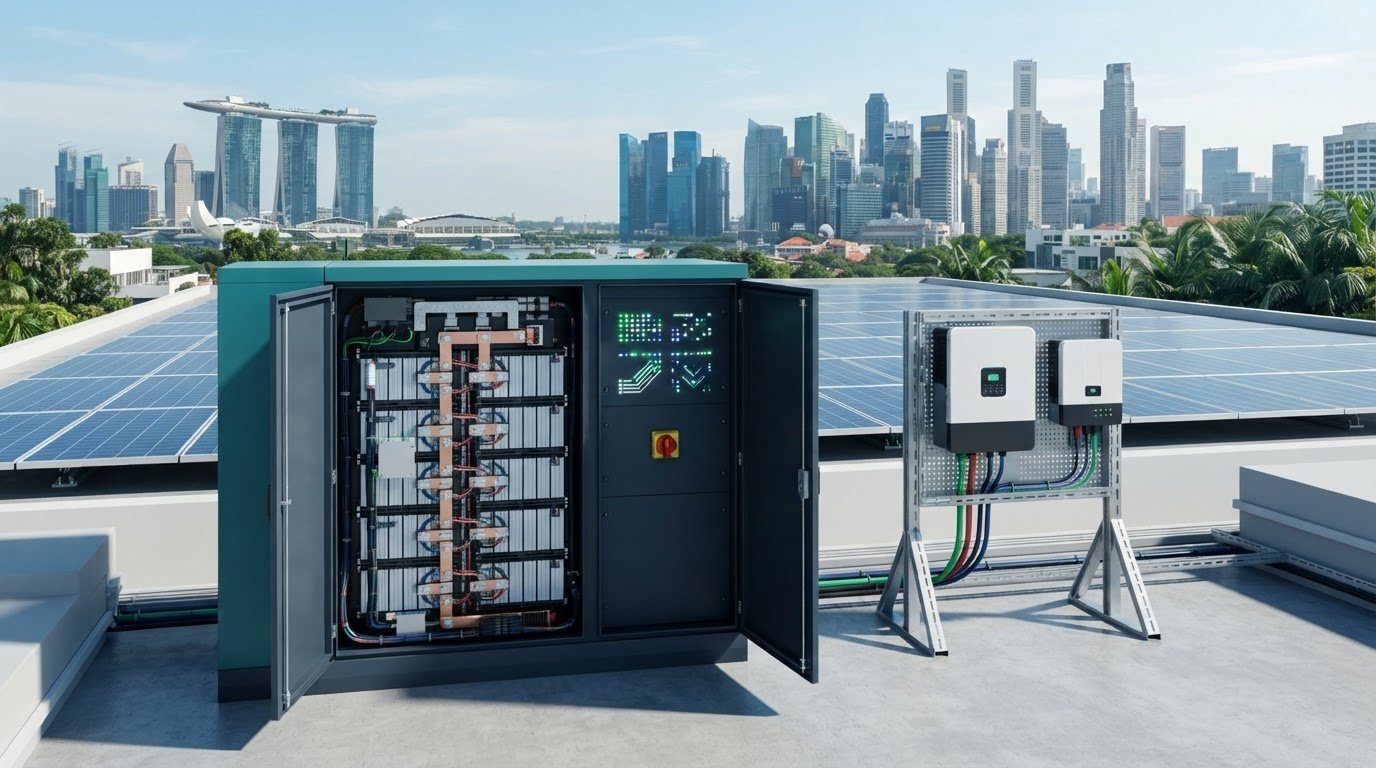
An LFP battery is a sound choice only when the complete solar system can operate within its documented limits. Lithium iron phosphate chemistry is widely used for energy storage, but the label alone doesn’t confirm compatibility with a charge controller or hybrid inverter. Voltage, charging parameters, current limits and battery management interfaces all matter.
When comparing options for a solar project, terminology and interface requirements can be difficult to assess from a product listing alone. The practical questions are clear: what does LFP mean, what should the battery management system protect or communicate, and which documents establish compatibility?
This guide explains how LFP batteries work and how their chemistry differs from other lithium-ion types. It covers the system interfaces and datasheet details to verify, including charger and inverter requirements, protection, operating limits and BMS communication. Check each value against the exact model’s documentation rather than inferring compatibility from chemistry or nominal voltage. Use these checks to prepare a clear technical specification or supplier enquiry, and assess the battery as part of a verified system rather than as an isolated component.
Key Takeaways
- Distinguish LFP cathode chemistry from a complete battery pack and the wider storage system before comparing specifications.
- Trace how an LFP battery stores and delivers energy, separating cell-level electrochemical activity from external power conversion and control.
- Use a structured compatibility check to identify requirements for charge controllers, hybrid inverters, circuit protection and communications.
- Organise project requirements, configuration details and supporting component needs into a clear supplier enquiry. SM Solar is a wholesale distributor of lithium LiFePO4 batteries and related solar products.
What Is an LFP Battery? Chemistry and Core Terminology
An LFP battery is a lithium-ion battery that uses lithium iron phosphate (LiFePO4) as its cathode active material. This definition identifies the chemistry, not the full construction, rating or capabilities of a battery product. For solar project planning, that distinction matters: chemistry is one part of the specification, while cell design, pack configuration and system interfaces determine how the battery fits into the project.
What does LFP mean in a battery?
LFP stands for lithium iron phosphate. The formula LiFePO4 refers to the cathode material, one electrode component inside a cell. It doesn’t describe every material or electronic component in a finished battery. An LFP battery belongs to the broader lithium-ion family, whose members use different electrode chemistries while relying on lithium-ion movement during operation. For an overview of the chemistry and its applications, see Lithium iron phosphate (LFP) battery.
Keep the terms precise in technical documents. Cathode means the positive electrode during discharge; cell means an individual electrochemical unit; pack means an assembly of cells with electrical and mechanical connections. A product described as “LFP” identifies its chemistry category, but the label alone doesn’t establish its voltage, capacity, construction or suitability for a particular application.
LFP cell, battery pack, and storage system: what is the difference?
A cell is the basic electrochemical unit. Multiple cells can be connected and assembled into a battery pack, which may also include an enclosure, terminals, monitoring or protection electronics, depending on its design. The exact arrangement varies by product. Confirm cell and pack details in the manufacturer’s documentation rather than assuming that all products using the same chemistry share a common configuration.
A storage system is broader than the battery pack. In a solar application, it can include the battery alongside charge-control equipment, an inverter, circuit protection, cabling and system controls. Each component has its own specifications and interfaces. The project needs to account for the complete arrangement, not just the chemistry printed on the battery label.
Terminology check: LiFePO4 identifies the cathode chemistry; “cell” identifies an electrochemical unit; “pack” identifies an assembly of cells; and “storage system” describes the battery together with connected control and power-conversion equipment.
How an LFP Battery Stores and Delivers Electrical Energy
Energy storage involves two linked processes: electrochemical reactions inside the cells and electrical control by the connected equipment. Understanding the distinction helps when assessing an lfp battery for a solar system. Chemistry describes how a cell stores and releases energy; it doesn’t specify the battery’s operating limits or how an inverter communicates with it.
What happens during charging and discharging?
During charging, an external source supplies electrical energy. Lithium ions move through the electrolyte from the lithium iron phosphate cathode towards the anode, while electrons travel through the external charging circuit. During discharge, the process reverses: lithium ions move back towards the cathode, and electrons flow through the external circuit to supply a connected load.
These directions describe the cell-level process, not guaranteed product performance. The charging source and system controls must follow the battery manufacturer’s specified limits. Check the exact model’s documentation for permitted charging and discharge conditions, and don’t infer operating parameters from chemistry alone. The LFP and NMC chemistry overview from Pacific Northwest National Laboratory provides further context on lithium-ion chemistry.
What does the battery management system do?
Cell chemistry governs electrochemical energy storage; the battery management system (BMS) monitors and manages operation within product-defined limits. Depending on the battery design, a BMS may monitor cell voltage, current or temperature and may control charging or trigger protective responses. These functions vary by product, so confirm the included features in the specific datasheet and manual.
The BMS can also provide an interface between the battery and other system components. Where communications are provided, verify the protocol, connection method and required settings against both the battery and inverter documentation. A shared connector or protocol name alone doesn’t establish compatibility. Confirm which data is exchanged, whether the inverter supports the battery’s communication method, and what operating behaviour applies if communication is unavailable.
Cell activity doesn’t convert power for household or system loads. The battery supplies DC power; an inverter performs power conversion where AC output is required. Charge controllers and protection devices have separate roles and must be selected against the battery and project specifications. Use the manufacturer’s documented environmental and operating limits when assessing where and how the battery will be used. Avoid applying generic temperature assumptions to a specific model.
For project enquiries, SM Solar’s wholesale solar product range includes lithium LiFePO4 batteries and related solar hardware. Include the battery model and relevant component datasheets so the required interfaces can be checked.
LFP Battery Compatibility: Check System Interfaces Before Specification
Compatibility rule: verify the complete system interface before selecting a battery. An LFP battery’s chemistry doesn’t establish whether it will work with an existing charge controller or hybrid inverter. The components must align on electrical operating limits, protection requirements and, where used, communications. Compare the project environment with the battery’s documented operating limits, too. Don’t substitute general assumptions for the exact model’s datasheet.
Which solar hardware interfaces should be checked?
Start with the battery and charge-controller documentation. Confirm that the controller’s battery profile and charging settings fall within the battery manufacturer’s specified limits. Then compare the battery’s electrical requirements with the hybrid inverter’s supported battery input and operating conditions. A similar nominal voltage or an LFP setting in a menu isn’t enough to confirm full compatibility.
Review the battery and system documentation for DC circuit protection requirements, including the specified protective-device type and placement. For communications, confirm the supported protocol, wiring or connection method, settings and control functions on both sides. Don’t assume two components interoperate because they use the same connector or list the same protocol name. The LFP battery supplier guide provides further supplier and standards context.
How can a compatibility table prevent specification errors?
Record each requirement alongside its source document and verification status. Leave values blank until they’re confirmed against the relevant manufacturer documentation. Mark unresolved items for supplier or manufacturer confirmation rather than treating them as compatible by default.
| Component | Required parameter or check | Source document | Verification status |
|---|---|---|---|
| Battery | Voltage, current, charging limits and environmental operating limits | Exact battery datasheet and manual | Confirm for selected model |
| Charge controller | Battery profile, adjustable charging settings and supported limits | Controller datasheet and manual | Compare with battery requirements |
| Hybrid inverter | Battery input range, charging capability and operating conditions | Inverter datasheet and manual | Confirm against both devices |
| DC protection | Protective-device requirements and installation arrangement | Battery and system documentation | Confirm for system design |
| Communications | Protocol, connection, settings and supported control functions | Battery and inverter documentation | Confirm end-to-end support |
Keep confirmed specifications separate from open questions. This creates a traceable basis for reviewing the system and clarifying unresolved interfaces before equipment selection.
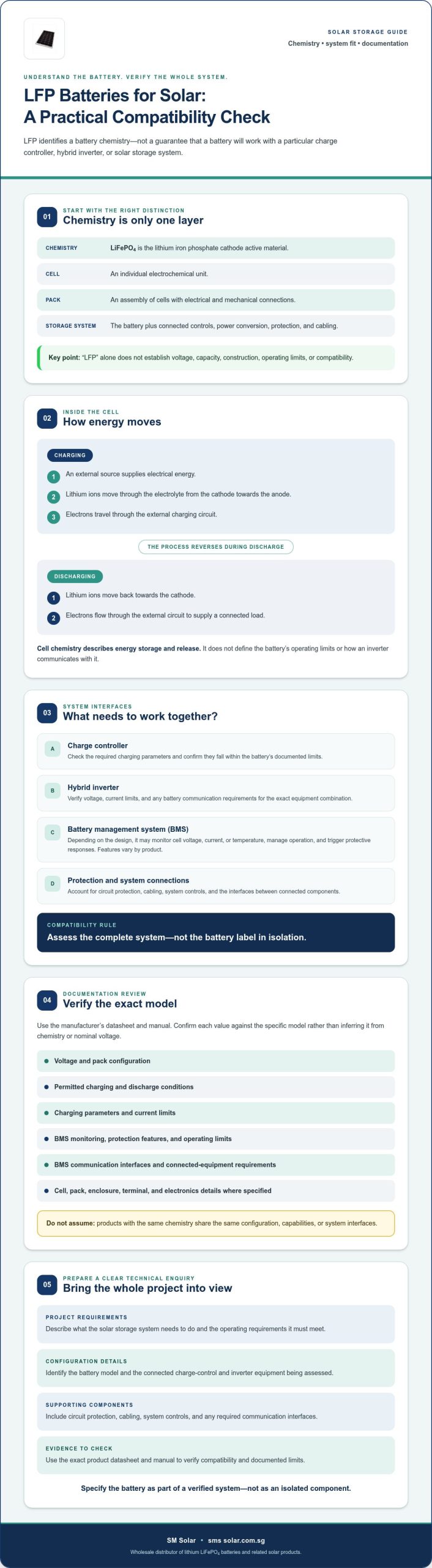
How to Review an LFP Battery Specification for a Solar System
Review the battery against the project, not as a standalone product. A consistent process helps identify missing information before selection. Use manufacturer documentation for every limit and value. Don’t fill gaps with industry averages or assumptions based on chemistry.
Which battery datasheet fields should a technical reviewer record?
Use the exact model’s datasheet and manual. Record specifications as published, including units, conditions and qualifications. Capture the battery’s electrical ratings and limits, stated environmental operating conditions, protection features and communication interfaces. Also note the document title and revision so reviewers can trace each value to its source.
If a field is absent, unclear or inconsistent with another document, mark it as unresolved. Request written confirmation from the manufacturer or supplier before treating it as a design input. A blank field is safer than an assumed value.
How should the battery be integrated into a solar design?
Map the battery alongside the charge controller, hybrid inverter and DC circuit protection devices. Check wiring, control functions and operating requirements against the approved project documents and the documentation for each selected component. Installation and commissioning decisions should be handled by qualified project personnel using applicable documentation.
Use this review sequence:
- 1. Define the project. Record the required system function, load profile, solar-system configuration and integration constraints from the project documents.
- 2. Review the battery. Capture the exact model’s electrical, environmental, protection and communications specifications, preserving stated units and conditions.
- 3. Cross-check connected equipment. Compare the battery requirements with the charge-controller and inverter documentation, then check DC protection requirements against the battery and system design.
- 4. Map interfaces. Document wiring and control connections, including any communication method or supported control function that the design depends on.
- 5. Resolve open items. Flag missing, conflicting or unclear values for written confirmation. Keep confirmed specifications separate from pending checks.
Include the project’s expected environmental conditions in the review, then compare them with the exact battery documentation. Don’t infer temperature limits or operating suitability from the LFP label. The same rule applies to voltage, current, charging and protection values.
Use this record as the basis for a complete technical enquiry. Send SM Solar your battery and related component requirements for a wholesale product enquiry.
Sourcing LFP Batteries and Coordinating Solar System Components
A useful supplier enquiry connects the battery request to the project’s full equipment configuration. Include the intended system function, documented electrical requirements and relevant project constraints. This gives the supplier context to respond to the specification rather than to the chemistry label alone.
What information should an LFP battery supplier enquiry include?
Prepare a concise enquiry package with the information needed to assess product fit and system interfaces:
- Project requirements: intended system function, load profile, configuration and relevant environmental or installation constraints documented for the project.
- Electrical requirements: required values and operating conditions drawn from the project design, with units and source documents retained.
- Connected equipment: the selected charge controller, hybrid inverter and DC circuit protection hardware, including model details where available.
- Interface details: wiring, communications and control requirements that need confirmation across the battery and other components.
- Open questions: any missing, unclear or conflicting specifications, with a request for current product documentation and written confirmation.
Attach relevant datasheets or identify their document revisions. Separate confirmed design inputs from items awaiting confirmation. Don’t use assumed values to complete the request; that can conceal a compatibility issue until later in procurement or system review.
How does SM Solar fit into a solar hardware supply workflow?
SM Solar is a wholesale distributor of solar products, including lithium LiFePO4 batteries. Its related solar hardware categories include charge controllers, hybrid inverters and circuit protection, alongside solar panels and other DC-related products. Coordinating the enquiry around the battery and its supporting components can help clarify which specifications and interfaces need to be reviewed together. Confirm product models and specifications directly for each enquiry.
The company profile also states system integration, installation and after-sales maintenance capabilities for end users. Refer to the profile for the scope of those capabilities, and don’t assume they apply to every project or enquiry. For additional supplier and standards context, consult the LFP battery supplier guide.
For a technical product enquiry, provide your project requirements, selected component details and unresolved specification questions to SM Solar. This gives the wholesale distributor a clear basis for discussing lithium LiFePO4 batteries and related solar hardware without presuming a particular model or availability.
Specify the Battery as Part of the Complete Solar System
An lfp battery specification is only a starting point. The chemistry identifies the battery category, while product documentation defines its operating limits, protection functions and communication interfaces. Review those details alongside the charge controller, hybrid inverter and circuit protection requirements before confirming system compatibility.
Keep project requirements, component details and open questions together in a clear technical record. Use exact-model datasheets, preserve units and conditions, and request confirmation for missing or conflicting values rather than relying on assumptions. This makes supplier discussions more focused and supports a better-informed selection.
SM Solar distributes lithium LiFePO4 batteries and other solar products on a wholesale basis. Its company profile also states system integration and after-sales maintenance capabilities. To share your project requirements and related hardware details, submit your LFP battery and solar hardware requirements.
A documented, system-level review gives your project a clearer basis for the next specification decision.
Frequently Asked Questions
What is an LFP battery?
An LFP battery is a lithium-ion battery that uses lithium iron phosphate, with the chemical formula LiFePO4, as its cathode material. LFP names the cell chemistry, not every component in the finished battery or storage system. The complete product may include assembled cells, terminals, an enclosure and battery-management electronics. Check the exact model’s documentation for its construction, ratings and operating limits.
Is an LFP battery the same as a LiFePO4 battery?
Yes. LFP is the common abbreviation for lithium iron phosphate, and LiFePO4 is its chemical formula. The names refer to the same cathode chemistry. They don’t mean that every battery using this chemistry has an identical cell arrangement, capacity, control features or electrical specifications. For procurement, confirm the exact model and review its datasheet rather than relying on either label alone.
How does an LFP battery work?
An LFP battery stores and releases energy through controlled electrochemical reactions. During charging, lithium ions move through the cell from cathode towards anode, while electrons flow through the external charging circuit. During discharge, the movement reverses and electrons travel through the connected circuit to supply a load. The battery’s operating conditions depend on the manufacturer’s documentation, not on a generic description of the chemistry.
Can an LFP battery work with any solar inverter?
No. Compatibility depends on the battery’s documented electrical limits and the inverter’s supported battery input, charging settings and operating requirements. If the battery relies on communications with the inverter, confirm that both devices support the relevant protocol, connections and control functions. Check the battery and inverter datasheets together. Similar nominal voltage or a selectable LFP setting alone doesn’t prove that the equipment is compatible.
What does a battery management system do in an LFP battery?
A battery management system (BMS) monitors and manages battery operation within limits defined for the product. Depending on the design, it may monitor cell voltage, current or temperature and provide protective responses or communications. Features vary, so confirm them in the exact battery’s datasheet and manual. If the inverter uses BMS data, verify communication requirements and supported controls in both manufacturers’ documents.
What should I check on an LFP battery datasheet?
Check the exact model’s voltage, capacity, current ratings, charging and discharge limits, environmental operating conditions, protection features and communication interfaces. Preserve the units, conditions and qualifications stated by the manufacturer. Compare relevant values with the charge controller, inverter and circuit protection documentation. Flag missing, unclear or conflicting information for written confirmation. Don’t fill gaps with typical values from another model or general industry guidance.
Can an LFP battery be used in an off-grid solar system?
Yes, an LFP battery can be considered for an off-grid solar system if its documented specifications suit the project and the connected equipment is compatible. Define the system function and load profile, then review the battery alongside the charge controller, inverter and circuit protection. Confirm wiring, control interfaces and environmental limits against product and project documentation. A chemistry label alone can’t confirm suitability for a specific design.