
Wind exposure, pole dimensions and foundation conditions can affect whether a mounting arrangement suits a project. Choosing solar panel pole mounts means more than matching a bracket to a panel. Buyers also need to consider the site, structural loads and the connections between the pole, mounting hardware and PV module.
Choosing between top-of-pole and side-of-pole designs is only one part of the specification. The pole, attachment details and foundation must also suit the project. Verify site-specific engineering requirements before selecting hardware, so you can assess whether the components are designed to work together.
This guide explains common pole-mount configurations, project and structural checks, and compatibility details to confirm. It also outlines what to prepare before sourcing hardware, including module dimensions, pole details and site conditions. SM Solar distributes solar panel pole mounts as part of its wholesale solar hardware range. Confirm the available configuration and compatibility against your project requirements.
Key Takeaways
- Understand how solar panel pole mounts support PV modules and transfer forces into the pole and foundation.
- Compare configuration and orientation options against the site layout, shading, access and adjustment needs.
- Check site conditions, module details, pole and foundation requirements, environmental exposure and maintenance access before selecting hardware.
- Prepare site information, drawings, module data and pole details so supplier discussions can focus on fit and documented specifications.
- Check every interface between the module, mount and supporting structure. Do not assume components are universally compatible.
What Solar Panel Pole Mounts Do in a PV System
Solar panel pole mounts secure photovoltaic (PV) modules to a pole and hold them in a defined position. They also provide a structural path for forces acting on the array to reach the pole and foundation. Suitability depends on the project design, site conditions and manufacturer specifications, not on the mount alone.
Pole mounts are one type of ground-supported PV structure. The overview of Photovoltaic mounting systems describes a range of mounting approaches, including pole mounts. For project checks involving solar mounting hardware reliability standards, identify the requirements that apply to the specific system and site. Do not assume that one standard or configuration suits every installation.
How a pole-mounted PV array is assembled
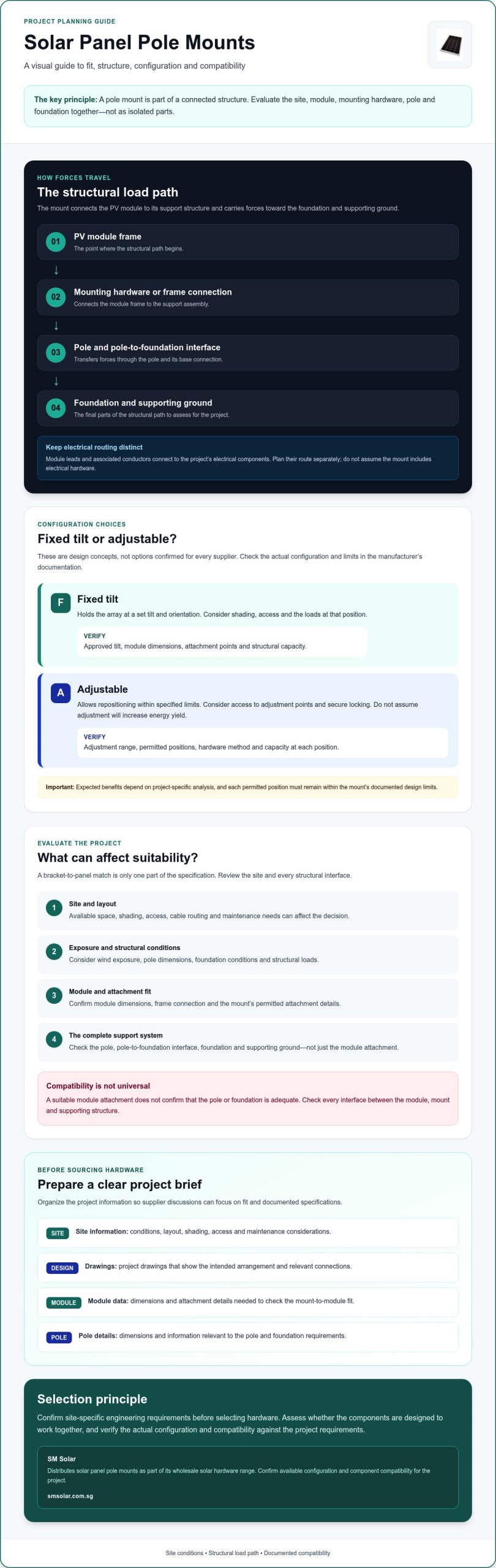
The structural load path starts at the module frame. Mounting hardware connects the frame to a support assembly, which transfers forces into the pole. The pole transfers those forces through its base connection into the foundation and supporting ground. Each interface needs review: a suitable module attachment does not confirm that the pole or foundation is adequate.
Structural assembly and load path:
- PV module frame
- Mounting hardware or frame connection
- Pole and pole-to-foundation interface
- Foundation and supporting ground
Electrical routing: Module leads and associated conductors connect to the project’s electrical components. Plan their route separately from the structural load path. Do not assume that the mount includes electrical hardware.
This is a component-interface diagram, not a supplied-kit layout. Confirm the actual attachment method and component specifications with the relevant manufacturers and project design team.
Where pole mounts may fit a project
A ground-supported pole arrangement may suit a site where the array needs to sit independently of a roof, provided the layout and supporting ground can accommodate a pole and foundation. Available space, shading, access, cable routing and maintenance needs all affect the decision.
Roof-mounted approaches depend on a suitable roof structure and compatible attachment points. Neither method is a universal substitute for the other. Compare site constraints, structural requirements and array layout before choosing a mounting approach. SM Solar distributes pole mounts as part of its wholesale solar hardware range. Confirm the available configuration and component compatibility for your project.
Pole-Mount Configurations, Orientation, and Adjustment
Configuration affects how a module is held, how its position is set and which interfaces need checking. Fixed tilt and adjustable are design concepts, not options confirmed for every supplier. Before specifying solar panel pole mounts, check the actual configuration, permitted module dimensions and adjustment limits in the manufacturer’s documentation.
Fixed and adjustable pole-mount designs
A fixed design holds the array at a set tilt and orientation. An adjustable design allows repositioning within specified limits, using its designated adjustment points and locking method. Do not assume adjustment will increase energy yield. Any expected benefit depends on project-specific analysis, and each permitted position must remain within the mount’s documented design limits.
These are comparison categories, not a claim that either configuration is currently available from a particular supplier. The Ground-mounting installation guide provides further context on planning ground-mounted arrays. Project-specific design and manufacturer information should guide the selection.
Module layout, tilt, and shading
Orientation and tilt are project inputs, not universal preset values. Nearby structures, vegetation and other obstructions can shade a module or restrict access for inspection and adjustment. Array geometry affects spacing and clearance, while the selected position affects the forces the mount and pole must resist. Review these factors together on the site layout.
Module dimensions, frame details and attachment zones must suit the mounting interface. For monocrystalline solar panels Singapore projects, check the exact module data sheet and mount specifications rather than relying on panel type alone. SM Solar distributes solar panels and pole mounts, but compatibility and available configurations need confirmation. Buyers can review solar hardware options and prepare module dimensions and preferred orientation for a supplier discussion.
How to Evaluate Solar Panel Pole Mounts for a Project
Evaluate the mount as part of a structural system, not as an isolated bracket. Suitability depends on the site, module, pole, foundation, environmental exposure and maintenance plan. A mount that fits the module may still be unsuitable if the pole or foundation cannot support the project loads, or if the array blocks access.
Separate documented product limits from project-level design decisions. Manufacturer specifications should state supported interfaces, materials and permitted installation conditions. Wind exposure, pole capacity, foundation design and ground conditions need assessment for the actual project. A catalogue description or physical fit is not engineering approval.
Structural and environmental checks
Wind acting on the module and mounting assembly can impose forces on the pole and foundation. A qualified project review should consider site exposure, array geometry, pole dimensions and capacity, foundation arrangement and relevant soil conditions. Do not infer a suitable pole or foundation design from the mount’s appearance or from another installation.
Assess exposure to moisture and other corrosive conditions, then check the specified materials and protective finishes for the mount, pole and fasteners. Grounding and bonding requirements also need qualified review as part of the complete PV design. Do not rely on generic load ratings or compliance claims unless documentation applies to the complete assembly and project.
Compatibility across modules and hardware
Compare the module’s frame dimensions, approved clamping zones and permitted mounting method with the mount documentation. Confirm the fastener type and interface details rather than assuming similar-looking parts are interchangeable. For the pole, verify its diameter, material and connection to the mounting bracket. Check that dissimilar materials and protective finishes suit the intended environment.
Product-level compatibility is not the same as approval for an engineered installation. A module may attach to a bracket as specified, while the combined assembly still needs structural review of the loads, pole and foundation. For solar panel pole mounts, record unanswered questions and confirm them with the manufacturer, supplier or qualified project professional.
- Site: Exposure, obstructions, ground conditions and maintenance access.
- Module: Dimensions, frame details and permitted attachment zones.
- Support: Pole material, diameter, bracket interface and foundation design.
- System: Documented limits, material compatibility, electrical routing and grounding requirements.
This assessment helps clarify trade-offs. A pole arrangement may allow flexibility in array placement where ground space and foundation conditions permit, but it adds pole and foundation interfaces that need site-specific design. Roof mounting depends on the roof structure and its attachment conditions instead. Neither approach suits every project.
Solar Panel Pole Mount Planning: A Pre-Specification Checklist
A clear specification separates hardware selection from structural and installation decisions. Use this workflow to prepare for a supplier discussion about solar panel pole mounts. Mark missing information as unknown instead of filling gaps with assumptions.
- 1. Document the site. Record the proposed location, known ground conditions, nearby obstructions, environmental exposure, access constraints and maintenance needs. Include a site plan or layout drawing showing the array area and cable route.
- 2. Define the array requirements. State the project purpose, module quantity, intended orientation and tilt, and proposed arrangement. Gather module data sheets with dimensions, frame details and permitted mounting zones.
- 3. Check the interfaces. Provide the pole material and diameter, proposed bracket connection, and available pole or foundation drawings. Compare these with the documented module-to-bracket and bracket-to-pole requirements. List electrical routing and grounding assumptions separately.
- 4. Verify the design. Ask the responsible project professional to assess structural adequacy, foundation and soil conditions, installation method, grounding and applicable requirements. Confirm that the hardware documentation covers the intended configuration and site conditions.
Information to collect before requesting hardware
Prepare drawings that show the array layout, module position, pole location, foundation concept and planned conductor route. Attach the module data sheet and available pole details. Note shading, access for installation and maintenance, and environmental exposure. If pole capacity or soil conditions are unknown, flag them for confirmation by the responsible designer or installer.
Questions to resolve before specification
Ask whether the module frame and clamping zones match the bracket’s documented mounting method, and whether the bracket interface suits the pole diameter and material. Confirm system limitations and the documents supporting each compatibility statement. Product fit alone does not establish structural approval for the complete installation.
Clarify who is responsible for verifying structural adequacy, grounding, installation methods and applicable project requirements. Also confirm that the mounting approach suits the site: pole mounts attach an array to a pole, while standing seamlock roof clamps are for compatible roof applications. These are different, non-interchangeable mounting categories.
SM Solar is a wholesale distributor of solar products and hardware, including pole mounts. For a supplier discussion, provide project drawings, module data and pole details, then review SM Solar’s solar hardware supply. Confirm current configurations and specifications before finalising the selection.
Sourcing Solar Panel Pole Mounts for a Complete Hardware System
Mounting hardware is one part of a PV system. Its interfaces need to be checked against the selected module and supporting structure. Coordinate mount requirements with the module data, pole details and electrical design, while keeping structural approval and electrical system decisions distinct from hardware supply.
SM Solar is a wholesale distributor of solar products and hardware, including solar panel pole mounts. Related product categories include monocrystalline solar panels, solar charge controllers, batteries and solar circuit protection. These categories can help with procurement planning, but their inclusion does not confirm that components form a compatible system. Verify every interface and specification for the project.
Coordinating mounting hardware with PV components
Check mechanical and electrical requirements in parallel. For the mount, compare module dimensions, frame attachment method, bracket interface and pole details with current product documentation. Separately confirm electrical components and protection requirements with the system design. Mount selection does not determine system voltage, component sizing or electrical configuration.
Prepare a coordinated schedule that identifies the intended module, mounting hardware, pole, charge controller, battery and circuit protection where applicable. Record the source of each specification and flag unconfirmed interfaces. Do not assume components are compatible because they appear in the same product category or supplier range.
What to confirm with a wholesale supplier
Before finalising a specification, request current product information for the proposed mount. Confirm supported module and pole interfaces, stated limitations and available documentation. Compare those details with the module data sheet and project drawings. If details are absent or unclear, leave them open for supplier or designer confirmation rather than treating them as approved.
- Product: Current specifications, configuration and documented limits.
- Interfaces: Supported module attachment and pole connection details.
- Project review: Who verifies structural adequacy, grounding and installation requirements.
- Supply: Current availability and supply details, confirmed directly rather than assumed.
Hardware procurement does not replace site-specific engineering or installation responsibilities. Confirm who is responsible for each project decision and retain supporting documentation with the procurement records. This helps reveal compatibility gaps or unclear design responsibilities before treating the specification as complete.
For product information and supply enquiries, contact SM Solar about solar panel pole mounts.
Specify Your Pole-Mount System with Confidence
Choosing solar panel pole mounts starts with the project, not just the bracket. Confirm site and structural requirements, then compare the module, mount, pole and foundation interfaces with current documentation. Treat tilt, orientation, electrical routing and grounding as coordinated design inputs, and refer unverified details to the responsible project professional.
A clear specification makes supplier discussions more useful. Prepare module data, drawings, pole details and site information, and identify who will verify structural adequacy and installation requirements. Check product limits and current supply details directly rather than assuming compatibility or availability.
SM Solar supplies solar panel pole mounts through its wholesale distribution business. Established in 2008, the company became a private limited company in 2016. To discuss hardware supply and the information needed to check specifications, contact SM Solar about solar panel pole mounts.
Documenting project requirements and verifying interfaces gives you a clearer basis for selection and procurement.
Frequently Asked Questions
What are solar panel pole mounts?
Solar panel pole mounts are support structures that attach photovoltaic modules to a pole. They position the modules and transfer forces through the mounting hardware and pole to the foundation. A complete project also involves module attachment details, pole and foundation design, and electrical routing. The configuration, module interface and permitted conditions depend on manufacturer documentation and project design.
How do solar panel pole mounts work?
Solar panel pole mounts secure the module frame to a mounting assembly connected to a pole. Forces acting on the modules pass through the attachment hardware into the pole and foundation. The pole and foundation need assessment for the site and proposed array. Electrical conductors follow a separate route to the system’s electrical components, so structural attachment does not establish electrical design or grounding suitability.
What should I check before choosing a solar panel pole mount?
Check site conditions, module dimensions and frame attachment zones, pole material and diameter, foundation concept, and environmental exposure. Compare the mount’s documented interfaces and limitations with the specific module and pole. Also consider array orientation, shading, cable routing and maintenance access. A qualified project review should verify structural adequacy, grounding and applicable requirements. Product fit alone is not approval for the complete installation.
Can solar panels be mounted on any pole?
No. The pole must suit the mounting bracket interface and be assessed for forces from the proposed array and site conditions. Diameter, material, connection details, capacity, foundation and ground conditions can all affect suitability. Check these against the mount documentation and project design. Do not assume an existing pole is adequate just because a bracket can physically attach to it.
Are adjustable solar panel pole mounts better than fixed mounts?
Not automatically. A fixed mount holds modules in a set position, while an adjustable design allows repositioning within documented limits. The right option depends on the project layout, access needs, module orientation and verified design conditions. Do not assume adjustability increases energy yield without project-specific analysis. Check the adjustment range, locking method and permitted module dimensions in the manufacturer’s specifications.
What information should I provide when sourcing pole-mount hardware?
Provide the project purpose, site layout, module data sheet and intended array orientation. Include module dimensions and frame details, pole material and diameter, available pole or foundation drawings, and information about ground conditions and environmental exposure. Note access, maintenance and electrical routing requirements. Label unknown details so the supplier or responsible project professional can identify what still needs confirmation.
Do solar panel pole mounts require maintenance?
Maintenance requirements depend on the mount, materials, installation conditions and manufacturer guidance. Check the documentation for inspection instructions and recommended intervals, and have a qualified person assess the assembly if damage, looseness, corrosion or movement is observed. Include module attachments, the pole connection and accessible foundation interfaces in the review. Do not assume a universal maintenance schedule or make adjustments beyond the documented procedure.