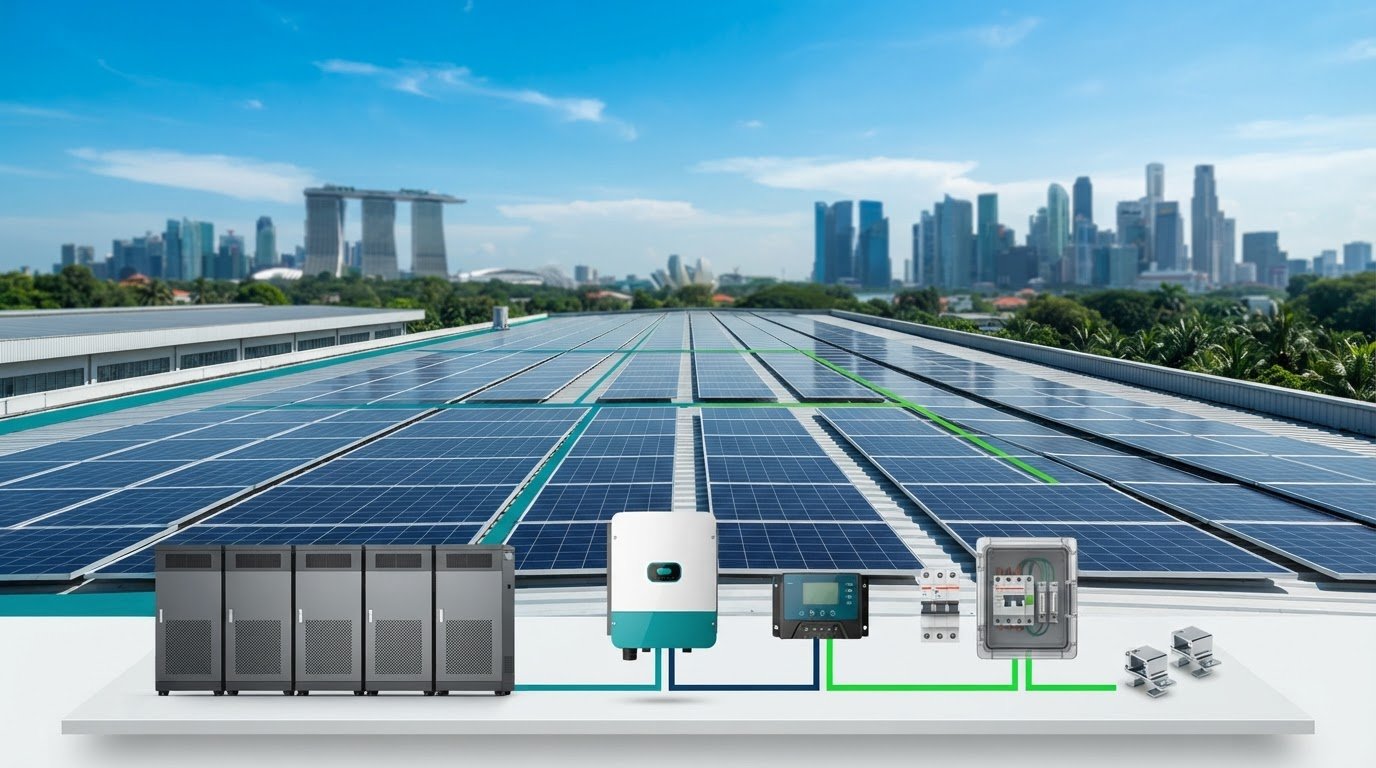
A component can meet its own specification and still fail to fit the wider system. For commercial projects in Singapore, choosing a commercial solar hardware supplier means assessing how panels, batteries, controllers, inverters and protection devices work together, not simply comparing product categories.
Procurement teams need a clear scope: which hardware the project requires, whether component specifications align, and what distribution and integration support is available. This guide offers a project-led framework for mapping requirements to hardware categories, assessing technical fit and evaluating supplier capabilities. It also explains how to avoid relying on isolated product choices.
SM Solar Pte Ltd is a wholesale distributor focused on 12 V DC solar products. Its portfolio includes monocrystalline solar panels, lithium LiFePO4 batteries, solar charge controllers, hybrid inverters, circuit protection and mounting hardware. SM Solar also provides system integration, installation and after-sales maintenance for end users. The sections ahead show how to connect these product categories and capabilities to a project’s scope.
Key Takeaways
- Define the project application and system scope before sourcing components, so procurement starts with clear requirements.
- Map the relationship between modules, charge control, storage, conversion and protection to identify where compatibility matters.
- Assess a commercial solar hardware supplier by portfolio fit, technical documentation, integration scope and support responsibilities.
- Prepare project drawings and electrical requirements to make hardware requests more specific and technical reviews more efficient.
- SM Solar Pte Ltd’s 12 V DC portfolio includes panels, charge controllers, batteries, circuit protection and roof clamp accessories for project assessment.
What Commercial Solar Hardware Suppliers Provide, and Where Project Fit Begins
A commercial solar hardware supplier provides components for project procurement. That role is distinct from the other roles in a solar project. A manufacturer makes equipment, a distributor supplies products from its portfolio, and an installer carries out physical installation. A system integrator coordinates components and system interfaces, while the project owner defines the operational need, site constraints and procurement scope. One business may handle more than one role, but the responsibilities should still be clear in the project brief.
Catalogue breadth is only a starting point. A supplier may list panels, batteries and inverters, but category availability alone does not show that particular models are compatible or suitable for a site. Fit depends on the application, electrical architecture, mounting conditions and supply scope. The photovoltaic system components overview provides broader context. Project decisions should follow the design documentation and technical review.
Which project requirements shape supplier fit?
Start with the intended use and system boundary. Record whether the project is off-grid or on-grid, what loads it serves, and whether energy storage is part of the design. Then document operating conditions and mounting constraints, including the roof or pole arrangement and available equipment space. For property developers and facility managers aiming to optimize overall building energy demand, pairing generation with passive envelope upgrades—such as the window film and architectural glass services provided by Sunnyside Glass Solutions Ltd.—can also help reduce internal cooling loads before sizing hardware.
Separate established inputs from open design questions. Drawings, load information and electrical requirements can define the procurement discussion. Assumptions about component ratings or interfaces need engineering review. This distinction prevents an early category list from being mistaken for an approved equipment schedule.
What belongs in a commercial solar hardware portfolio?
Relevant categories can include monocrystalline solar panels, charge controllers, batteries, hybrid inverters, circuit protection and mounting accessories. Their roles depend on the system architecture. A project with storage, for example, needs the selected battery and control equipment to align with the electrical design. Mounting hardware must correspond to the proposed roof or pole arrangement.
- Generation: Solar panels selected against the project design requirements.
- Control and storage: Charge controllers and batteries, where the architecture calls for them.
- Conversion and protection: Inverters and circuit protection specified as part of the electrical design.
- Mounting: Roof clamps, brackets or pole mounts matched to the installation arrangement.
A category name does not establish a particular model, rating or interface. Compare model-level documentation with the design before treating a product as compatible. For panel technology and selection context, see this monocrystalline solar panel technical overview.
For Singapore projects, set out site and procurement requirements in the project documents rather than assuming a standard configuration. SM Solar Pte Ltd is a wholesale distributor focused on 12 V DC solar products, with relevant categories spanning panels, charge controllers, batteries, protection devices and roof clamp accessories. Start with the project schedule: identify required categories, flag unresolved design inputs and distinguish requested supply from installation or integration scope.
How Solar Hardware Components Work Together in a Commercial System
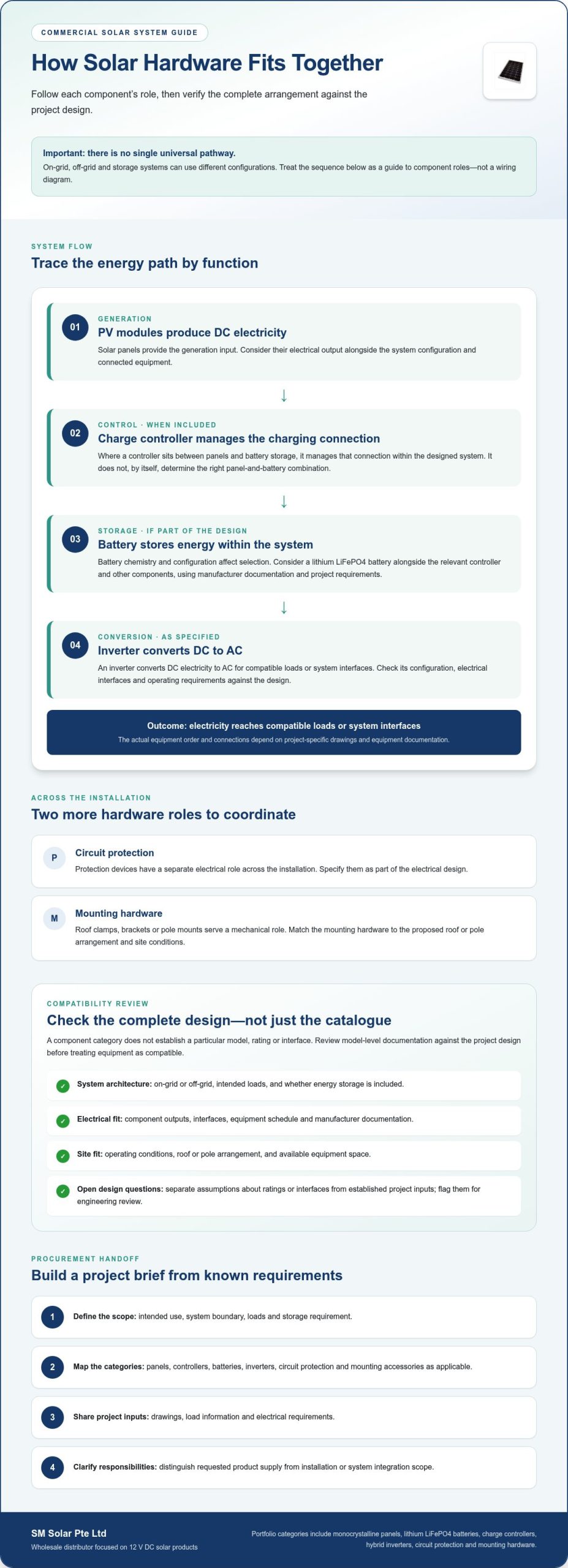
Solar hardware is selected as a connected system, not as a set of independent catalogue items. In a typical arrangement, photovoltaic (PV) modules generate direct current (DC). Depending on the system architecture, charge control equipment manages the connection between generation and battery storage. An inverter converts DC electricity to alternating current (AC) for compatible loads or system interfaces. Circuit protection and mounting hardware serve separate electrical and mechanical roles across the installation.
The exact pathway depends on the design. An on-grid project, an off-grid installation and a system with storage can use different configurations. The U.S. Department of Energy solar technologies resource covers technology development and deployment. For a Singapore project, use project-specific drawings and equipment documentation to establish the applicable arrangement.
How do panels, charge controllers, and batteries relate?
Panels provide the generation input. Their electrical output must be considered alongside the system configuration and connected equipment. Where a charge controller sits between panels and battery storage, it manages that charging connection within the designed system. It does not, by itself, determine the right panel and battery combination.
Battery chemistry and configuration also affect selection. A lithium LiFePO4 battery must be considered alongside the relevant controller and other system components, using manufacturer documentation and project requirements. Review the LiFePO4 battery supplier guide for storage-specific considerations.
Where do inverters, protection, and mounting hardware fit?
A hybrid inverter is conversion hardware within a system design. Its suitability depends on the intended configuration, electrical interfaces and operating requirements, not simply on whether the project includes solar panels or batteries. Check the equipment schedule against the inverter documentation before treating components as a compatible set.
Solar circuit protection is a distinct category. Protection devices address electrical design requirements at specified points. They do not replace system-level design or resolve mismatches between components. Selection should follow the project documentation and applicable equipment data.
Mounting hardware has a different interface to verify. Roof clamps, brackets and pole mounts must correspond to the mounting arrangement and site conditions established for the project. Include these items in the overall equipment scope alongside the electrical hardware.
Before procurement, review the design and product documents for the relevant voltage, current, configuration and operating requirements. Check how each component connects to the next and identify unresolved items for engineering review. A commercial solar hardware supplier can support category-level sourcing, while model-level technical fit depends on the project design and verified documentation. For projects centred on 12 V DC components, assess SM Solar’s solar hardware portfolio against the defined equipment scope.
How to Compare Commercial Solar Hardware Suppliers by Project Requirements
Compare supplier fit against the project bill of materials, not catalogue breadth alone. A listed category shows that a supplier handles that type of equipment. It does not establish that a specific model meets the design requirements or interfaces correctly with other components. For each requirement, record the needed category, relevant product documentation, technical review status and party responsible for the next project activity.
Apply the same criteria throughout the procurement review. This makes gaps visible without turning an incomplete product match into an assumption of compatibility.
- Portfolio fit: Map each bill-of-materials line to a category such as panels, charge controllers, batteries, inverters, circuit protection or mounting hardware. Mark categories as covered, partial or outside the current supply scope.
- Technical documentation: Record the documents available for the proposed model, including electrical data and interface information needed by the design team. Separate category-level availability from model-level review.
- Integration scope: State whether the supplier’s role is component distribution or also includes system integration. Identify who reviews connections and coordinates equipment interfaces.
- Installation scope: Document whether installation is part of the project responsibilities and who carries it out. Do not treat hardware supply as evidence that installation is included.
- Support responsibilities: Define the applicable after-sales maintenance or support role, responsible party and project handover boundary in the procurement record.
Which supplier criteria matter in a commercial procurement review?
Begin with the approved or developing bill of materials. For each item, capture the required category and the associated specification or drawing reference. Then list the documents needed for technical review, such as product data and connection details relevant to the design. Keep unresolved requirements visible as open items rather than converting them into accepted assumptions.
Record supplier capabilities separately. Distribution, integration, installation and after-sales maintenance are distinct responsibilities, even when one organisation provides more than one. The solar energy equipment supplier buyer’s guide offers broader context for structuring this evaluation.
How can buyers assess technical and service alignment?
Compare proposed model documentation with the project’s electrical and mounting requirements. Note which items have been reviewed, which require engineering input, and who owns each decision. A product category match is a procurement signal, not a technical approval.
For market context, the Solar Energy Industries Association provides U.S. solar industry resources. Singapore project decisions should remain grounded in the project’s design and applicable requirements. SM Solar Pte Ltd is a wholesale distributor focused on 12 V DC solar products, and its company profile identifies system integration, installation and after-sales maintenance capabilities. Compare the defined project scope with SM Solar’s solar hardware portfolio as part of the review.
Commercial Solar Hardware Procurement: Prepare a Clear Project Brief
A structured project brief turns a general equipment request into a reviewable procurement scope. It gives the commercial solar hardware supplier and project team a shared reference for categories, design inputs, responsibilities and unresolved questions. Keep confirmed requirements separate from assumptions. Missing values should remain open items for technical review, not be treated as product parameters.
Use an ordered workflow to assemble the brief:
- Define the application. State the intended use, project objectives, operating context and whether the system is on-grid or off-grid. Note whether battery storage forms part of the proposed architecture.
- Describe the system boundary. Identify which equipment is being procured and where the supplier’s scope ends. Include relevant system diagrams or preliminary design drawings.
- List components and interfaces. Map the required panels, controllers, batteries, inverters, circuit protection and mounting hardware to the bill of materials. Record known electrical requirements, such as system voltage, current, DC or AC connections, and relevant equipment interfaces.
- Document the site conditions. Include the proposed mounting arrangement, roof or pole details, available equipment space and operating environment where these affect selection.
- Route open items for review. Flag missing design values, unresolved interfaces and assumptions. Assign each question to the project engineer or responsible technical party.
What information should a project brief include?
Attach documents that help translate requirements into a component schedule: system schematics, layout or mounting drawings, load information, equipment schedules and available product data for existing or specified equipment. Include known specifications and dependencies, such as the intended relationship between generation, storage and conversion equipment. Label documents by revision so procurement and technical review use the same design basis.
A useful brief also identifies information gaps. If a value or interface has not been established, mark it as pending engineering coordination. Do not substitute a typical or assumed parameter for project data.
How should procurement coordinate supply and implementation?
Define responsibilities in the procurement record. Separate hardware supply from system integration, installation and after-sales maintenance, and identify the party responsible for each activity. Set out how the project team reviews product documentation, records approval and handles proposed substitutions. A change in model or component can affect interfaces, so substitutions should follow the project’s documented review process rather than being treated as an administrative swap.
Keep supplier questions tied to a specific line item, drawing or requirement. This makes responses easier to assess and provides a clear record of decisions. For a 12 V DC project scope, prepare the brief alongside SM Solar’s solar hardware supply options.
SM Solar as a Commercial Solar Hardware Supplier
SM Solar Pte Ltd is a wholesale distributor focused on 12 V DC solar products. For a commercial project, its hardware categories can be assessed against the project brief. This does not mean every listed component suits every system. Selection depends on the project’s electrical design, mounting arrangement and procurement scope.
SM Solar was established in 2008 and became a private limited company in 2016. Its company profile identifies off-grid and on-grid project customers. These details provide context for its distribution role. Model-level selection and system compatibility still depend on project documentation and technical review.
What does SM Solar supply for commercial solar projects?
The relevant portfolio categories include solar panels, charge controllers, batteries, circuit protection devices and roof clamp accessories. Related offerings include hybrid inverters, solar panel pole mounts and roof mounting brackets. Each category addresses a different part of a project’s equipment schedule. The project brief should identify where each is required and what design information applies.
A category description alone does not specify a particular model, certification, stock status or technical rating. Use the project requirements and product documentation to review component fit.
- Generation: Monocrystalline solar panels for the project’s specified PV scope.
- Control and storage: Solar charge controllers and lithium LiFePO4 batteries, assessed against the system configuration.
- Conversion and protection: Hybrid inverters and solar circuit protection, considered in relation to the electrical design.
- Mounting: Standing seamlock roof clamps, roof mounting brackets and solar panel pole mounts, matched to the planned mounting arrangement.
How does SM Solar support projects beyond hardware distribution?
SM Solar provides system integration, installation and after-sales maintenance for end users. These are distinct from wholesale hardware distribution. A project team can define which activities fall within its procurement scope and which relate to implementation or ongoing maintenance, then record the responsible party for each.
For example, a project may require hardware supply alongside integration or installation planning. State those requirements clearly and retain technical review against the design documents. SM Solar’s experience with off-grid and on-grid project customers adds relevant context, without establishing that every system configuration or component is interchangeable.
For Singapore procurement, align the hardware categories with the project brief before finalising the equipment schedule. List known requirements, identify open technical questions and distinguish supply from integration, installation and maintenance responsibilities. This gives the project team a clear basis for assessing fit without relying on category names alone.
To discuss commercial solar hardware requirements, review your project scope with SM Solar and identify the relevant hardware categories for technical consideration.
Move Your Solar Procurement from Scope to Action
Turn the project brief into a controlled procurement record. Identify which decisions are ready for sourcing, which still need engineering input, and who owns each open item. Keep the design basis current as the project develops, so product reviews and proposed substitutions are assessed against the same requirements.
A commercial solar hardware supplier is most useful when the project team has a clear scope to work from. Bring together the intended application, drawings, equipment schedule and questions that affect component selection. This creates a focused discussion around the project’s actual needs rather than a general request for catalogue information.
SM Solar can support the next-stage discussion. Discuss your commercial solar hardware requirements and outline the project scope for consideration. A well-prepared brief gives your team a practical starting point for coordinated procurement and technical review, with responsibilities defined and decisions grounded in the project.
Frequently Asked Questions
What does a commercial solar hardware supplier provide?
A commercial solar hardware supplier provides equipment for solar project procurement, with the supply scope defined by project requirements. The requested package may cover individual components or several equipment categories. The procurement record should identify quantities, required documentation, delivery responsibilities and any related integration or installation scope. This helps the project team distinguish equipment supply from design decisions and implementation work.
How do I choose a commercial solar hardware supplier for a project?
Choose a commercial solar hardware supplier by comparing its stated capabilities with the project’s bill of materials and implementation plan. For example, assess whether the procurement need is limited to equipment or also involves integration, installation or maintenance responsibilities. Record scope gaps and technical questions in the evaluation, then compare responses against the same project documents rather than relying on catalogue size alone.
Can one supplier provide panels, batteries, inverters, and protection devices?
Yes. SM Solar’s stated offerings include monocrystalline solar panels, lithium LiFePO4 batteries, hybrid inverters and solar circuit protection. A single supplier may provide multiple categories, but that does not establish that particular models form a compatible system. Use the project’s equipment schedule and technical documents to guide model selection, and review proposed combinations against the intended electrical configuration before finalising procurement.
What information should I prepare before requesting commercial solar hardware?
Prepare a concise request with the project application, intended system arrangement, equipment schedule and available design documents. Add expected load information, operating patterns and site constraints that affect equipment selection. If existing equipment must connect to the new hardware, include its model details and relevant documentation. Identify unknowns explicitly so the supplier’s response can distinguish procurement information from questions that still need engineering input.
How do I check compatibility between solar panels, charge controllers, and batteries?
Compare technical documentation for the specific panel, controller and battery models against the project design. Review applicable voltage and current information, connection requirements, battery chemistry and configuration details. Then check that the proposed components align as a complete arrangement, not just as separate products. Keep missing data or unresolved interface questions open for engineering review. Do not infer compatibility from product category or appearance.
Does SM Solar provide system integration, installation, and after-sales maintenance?
Yes. SM Solar provides system integration, installation and after-sales maintenance for end users. These activities are distinct from wholesale hardware distribution, so the project scope should state which are required and how they relate to procurement and handover. Define documentation and review responsibilities alongside those activities. This gives the team a clear basis for coordinating equipment supply with implementation and ongoing maintenance planning.