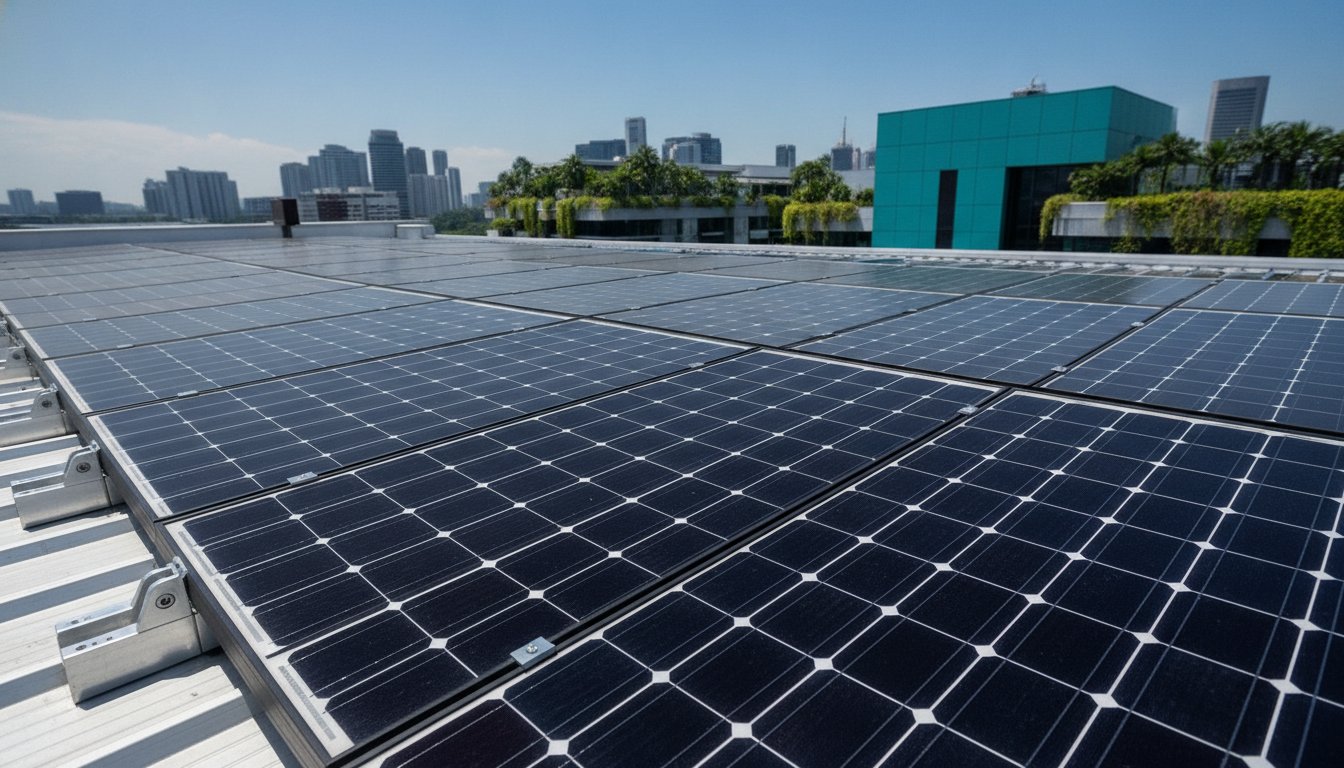
Peak wattage ratings often fail to reflect actual energy yield when operating in the 30°C to 35°C ambient temperatures typical of Southeast Asia. Engineering teams and EPC contractors recognize that high humidity and heat-induced degradation remain the primary threats to long-term PV performance. Selecting monocrystalline solar panels Singapore requires a focus on specific thermal coefficients and PID resistance rather than baseline efficiency metrics alone.
You likely acknowledge that project success depends on component durability and the immediate availability of compatible hardware. This article provides a clinical evaluation of the 2026 technical standards for monocrystalline PV modules, procurement protocols, and hardware integration requirements. We examine the performance parameters of high-efficiency modules alongside specialized mounting solutions, such as standing seamlock clamps and L-feet. The following sections outline a structured framework for technical validation, degradation mitigation, and logistical planning for professional-grade solar hardware in the Singapore market.
Key Takeaways
- Analyze the 2026 performance benchmarks for monocrystalline solar panels Singapore, focusing on the 19-22% efficiency range required for high-density urban deployments.
- Quantify the impact of the Temperature Coefficient of Pmax to accurately project energy yield and Levelized Cost of Energy (LCOE) in tropical climates.
- Verify hardware compatibility with standing seamlock clamps and L-feet to ensure secure, non-penetrative mounting across various Singapore industrial roof profiles.
- Optimize procurement logistics by aligning project schedules with local inventory availability and established wholesale distribution channels.
Fundamental Characteristics of Monocrystalline PV Modules
Monocrystalline photovoltaic (PV) technology represents the current industry standard for high-efficiency energy conversion in land-constrained environments. These modules are manufactured using the Czochralski process, which produces a single, continuous crystal lattice structure. This uniformity in monocrystalline silicon PV cells facilitates significantly higher electron mobility compared to multicrystalline alternatives. Reduced internal resistance within the cell architecture allows for superior photon-to-electron conversion rates, maximizing the output of every square meter of installed hardware.
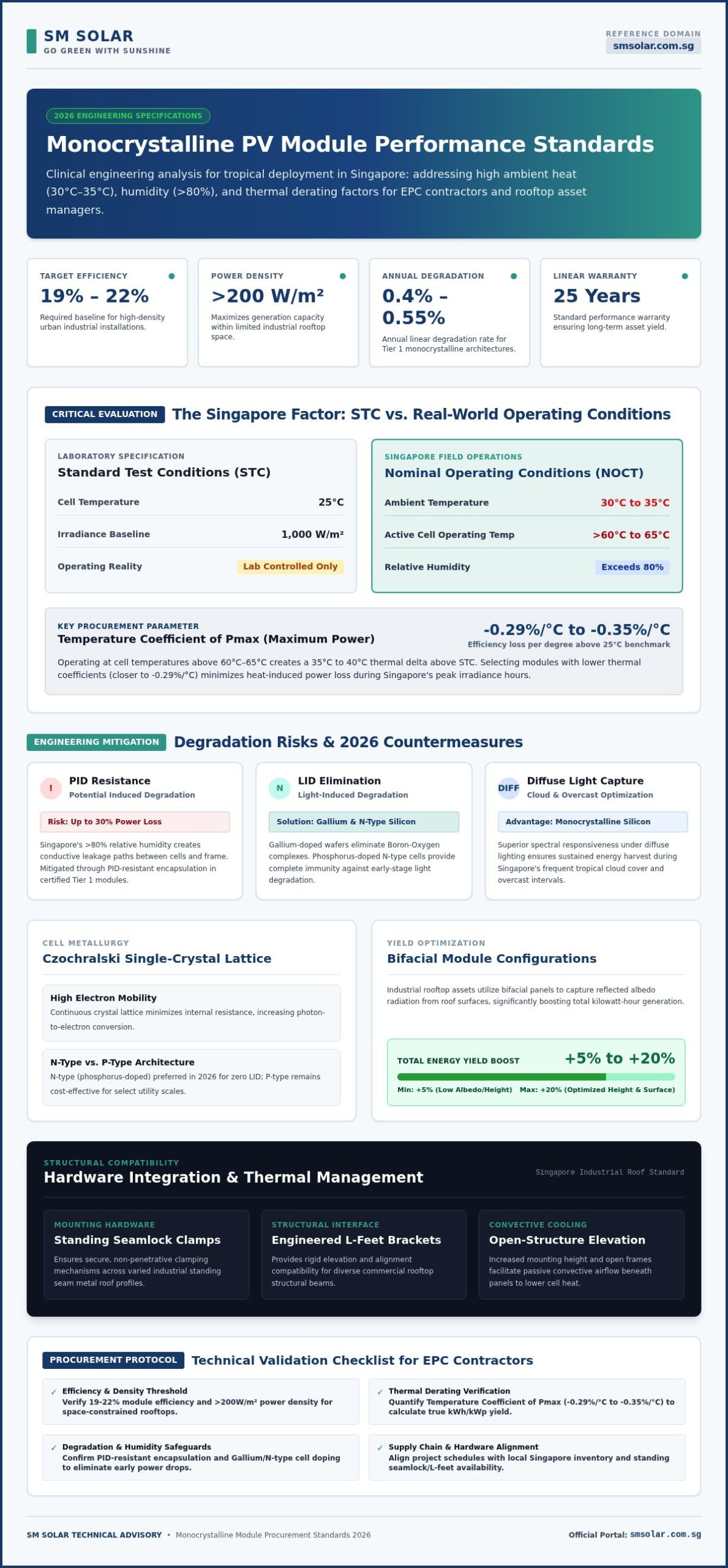
For monocrystalline solar panels Singapore deployments, space efficiency remains the critical procurement metric. High power density, often exceeding 200W/m², enables EPC contractors to maximize system capacity on limited industrial rooftop areas. The uniform dark-blue or black aesthetic profile also provides a professional finish for high-visibility commercial assets. Beyond visual integration, these modules offer high mechanical stability and low annual degradation rates, typically averaging 0.4% to 0.55% per year. Most Tier 1 manufacturers provide a 25-year linear performance warranty, ensuring long-term asset reliability for the institutional and industrial sectors.
Silicon Purity and Cell Architecture
The single-crystal structure directly influences the electrical characteristics of the PV module. N-type monocrystalline cells, which utilize phosphorus-doped silicon, are increasingly preferred in 2026 for their immunity to Light-Induced Degradation (LID). In contrast, P-type cells remain a cost-effective standard for specific large-scale utility projects despite slightly higher degradation profiles. Industrial setups also utilize bifacial module configurations. These capture albedo radiation from the roof surface to increase total energy yield by 5% to 20%, depending on the mounting height and surface reflectivity.
Standard Test Conditions (STC) vs. Real-World Performance
Technical specifications for PV modules are measured at Standard Test Conditions (STC). This is defined as 1000W/m² irradiance at a 25°C cell temperature. However, these figures rarely reflect the operating environment in tropical regions. Nominal Operating Cell Temperature (NOCT) provides a more accurate performance baseline for the local market. While STC assumes 25°C, local ambient temperatures and high solar irradiance frequently drive cell temperatures above 60°C. Engineers must calculate expected output using local irradiance data and the specific temperature coefficient of the monocrystalline solar panels Singapore to determine the actual kilowatt-hour (kWh) yield per installed kilowatt-peak (kWp).
Performance Metrics in Tropical Climates: The Singapore Factor
Operating monocrystalline solar panels Singapore requires accounting for specific thermal derating factors. Standard ratings are based on a 25°C cell temperature, but local conditions frequently drive cell temperatures above 65°C. The Temperature Coefficient of Pmax (Maximum Power) indicates the efficiency loss for every degree above the benchmark. Modern modules typically range from -0.29%/°C to -0.35%/°C. A lower coefficient is essential for maintaining yield during peak irradiance hours in Southeast Asia. Engineering teams must prioritize these values to ensure that the actual energy harvest aligns with projected financial models.
Ongoing crystalline silicon photovoltaic research emphasizes the importance of material purity in preventing Potential Induced Degradation (PID). Singapore’s relative humidity, which often exceeds 80%, creates a conductive path for leakage currents between the cells and the frame. High humidity environments accelerate this effect, potentially causing power losses up to 30% if the module lacks PID-resistant encapsulation. Monocrystalline modules demonstrate superior spectral response under the diffuse light conditions common during Singapore’s overcast periods. Advanced cell designs also mitigate Light Induced Degradation (LID) through Gallium-doped silicon wafers, which eliminate the Boron-Oxygen complexes responsible for early-stage power loss. This technical refinement is standard in 2026 Tier 1 hardware.
Mitigating Heat-Related Efficiency Loss
Thermal management is a function of system design and hardware selection. Increasing the mounting height and using open-structure frames promotes passive convective cooling. Selecting modules with optimized thermal profiles minimizes the impact of high ambient heat on the semiconductor material. Contractors should evaluate the specific NOCT (Nominal Operating Cell Temperature) ratings to ensure compatibility with local rooftop heat signatures. Review the technical specifications of our monocrystalline solar panels Singapore inventory to find modules optimized for high-temperature environments.
Durability Against Tropical Weather Extremes
Environmental stressors in Singapore extend beyond heat. High-intensity rainfall and wind loads during the Northeast Monsoon require robust mechanical load ratings, typically 5400 Pa for static loads and 2400 Pa for wind. Junction boxes must maintain an IP68 rating to prevent moisture ingress during torrential downpours. In coastal areas like Jurong or Tuas, anodized aluminum frames and MC4-EVO2 connectors provide the necessary salt-mist corrosion resistance. These specifications ensure the physical integrity of the array throughout its 25-year operational lifespan.
Comparative Analysis: Monocrystalline vs. Polycrystalline Efficiency
Current 2026 industry standards confirm a significant conversion efficiency gap between cell technologies. Monocrystalline modules achieve 19% to 22% efficiency. Polycrystalline alternatives typically plateau between 15% and 17%. In the Singapore B2B sector, this 4% to 5% delta is decisive. High-efficiency monocrystalline cells utilize superior silicon purity to maintain electron mobility during the diffuse light conditions of the Northeast and Southwest monsoon seasons. This ensures a more consistent energy harvest when solar irradiance falls below peak levels.
The Levelized Cost of Energy (LCOE) for 1MW+ systems favors monocrystalline technology despite higher initial module pricing. Higher power density reduces the total module count required to meet capacity targets. This reduction directly lowers Balance of System (BoS) costs, including fewer monocrystalline solar panels Singapore mounting structures, reduced DC cabling lengths, and decreased installation man-hours. The Energy Market Authority solar energy framework emphasizes maximizing rooftop yield to meet national decarbonization targets, making high-efficiency hardware the primary choice for industrial assets.
Procurement Logic for EPC Contractors
EPC contractors must balance upfront hardware expenditure against long-term operational returns. While monocrystalline modules carry a price premium, the savings in racking and labor often offset the difference in utility-scale deployments. Tier 1 manufacturer reliability is a critical metric for Singapore projects. These manufacturers offer bankability and documented performance histories, reducing the risk of premature failure in high-humidity environments. Long-term ROI projections for commercial rooftops rely on the 25-year linear performance guarantees provided by these high-purity silicon modules.
Application-Specific Recommendations
System designers should prioritize high-wattage monocrystalline modules for land-constrained urban infrastructure where every square meter must be optimized. Bifacial monocrystalline modules provide additional value in setups with high-albedo roof surfaces or elevated mounting structures. Specialized hardware, such as standing seamlock roof clamps and L-feet, must be matched to the specific frame dimensions of these modules. In space-constrained environments, the superior W/m² ratio of monocrystalline technology remains the only viable path to achieving significant energy offset for industrial facilities.
Hardware Integration: Mounting and Circuit Protection Requirements
Technical performance of monocrystalline solar panels Singapore is contingent upon the structural integrity and electrical safety of the supporting hardware. Industrial roof profiles in the local market primarily consist of standing seam and trapezoidal metal sheets. Non-penetrative mounting is required to maintain roof warranties and prevent water ingress. Standing seamlock roof clamps provide secure attachment by gripping the raised seams of the metal profile without piercing the substrate. This method ensures high mechanical resistance against wind uplift while preserving the building envelope.
For trapezoidal roof sections, L-feet and solar rails are the industry standard. These components provide the necessary elevation for underside airflow, which is critical for thermal management as detailed in previous sections. In remote infrastructure applications, such as telecommunications or environmental monitoring, solar panel pole mounts facilitate the deployment of smaller monocrystalline arrays. These systems must be engineered to withstand the high wind loads associated with monsoon seasons and localized squalls.
Mounting Systems for Singapore Roof Types
Aluminum solar mounting profiles must utilize AL6005-T5 or higher grades to ensure structural stability. Galvanic corrosion is a significant risk in Singapore’s humid, salt-laden air. Using stainless steel SUS304 fasteners alongside anodized aluminum components prevents material degradation. Racking systems must carry wind load certifications specific to local building codes.
- Standing Seamlock Clamps: Designed for non-penetrative industrial roof integration.
- L-Feet: Utilized for trapezoidal metal roofs to provide adjustable rail height.
- Solar Rails: High-tensile aluminum extrusions for module alignment and support.
DC Circuit Protection and Safety Gear
High-voltage monocrystalline strings require dedicated circuit protection to mitigate fire risks and equipment failure. DC circuit breakers must be rated for the specific string voltage and current outputs of modern high-wattage modules. Given that Singapore has one of the highest lightning strike frequencies globally, solar surge protection devices (SPDs) are mandatory for protecting inverters and charge controllers from transient overvoltages. DC disconnect switches provide a physical point of isolation for maintenance personnel, ensuring compliance with EMA standards for 2026. Source professional-grade standing seamlock roof clamps and circuit protection hardware directly from our localized inventory.
Procurement Standards for Singapore Solar Installers
Procurement efficiency for large-scale solar assets depends on localized supply chain management. EPC contractors often encounter 8-to-12-week lead times for indent orders from global manufacturers. Maintaining a local buffer of monocrystalline solar panels Singapore inventory allows for immediate project mobilization. This logistical readiness is essential for multi-phase commercial rollouts where component consistency is required to maintain string parity across the entire array. Sourcing from a Singapore-based hardware partner eliminates the uncertainties of international freight and customs delays, providing a stable foundation for project timelines.
All hardware must comply with current Energy Market Authority (EMA) regulations and SS 601 standards for solar photovoltaic systems. These certifications verify that the PV modules, inverters, and circuit protection devices meet rigorous safety and grid-interaction requirements. In 2026, verification of PID resistance and high-temperature performance benchmarks is standard for all government and industrial tenders. Professional installers prioritize hardware that carries documented compliance with these local codes to ensure seamless grid connection and long-term asset bankability.
Supply Chain Reliability and Inventory Management
Centralized inventory management facilitates regional distribution. Singapore-based master distributors act as a logistical bridge for projects spanning both Singapore and Malaysia. Bulk procurement strategies for monocrystalline PV modules and Lithium LiFePO4 batteries reduce the total landed cost per watt. This streamlined approach simplifies the acquisition of specialized mounting hardware, such as standing seamlock clamps, ensuring all components arrive on-site simultaneously. Consistency in component SKUs across different project phases prevents technical mismatches that can occur when buying from fragmented sources.
Technical Support and Documentation
Reliable procurement extends beyond physical delivery to include technical validation. Installers require comprehensive documentation, including manufacturer data sheets, flash test reports, and 25-year performance warranty certificates. Verification of industrial circuit protection specifications ensures that DC breakers and surge protectors meet the specific voltage requirements of high-efficiency monocrystalline strings. Access to localized technical support simplifies the verification of safety standards for project consultants and regulatory bodies. Consult with SM Solar for bulk hardware procurement to verify inventory availability and technical compatibility for your next industrial installation.
Optimizing Industrial PV Deployments for 2026
Technical validation for monocrystalline solar panels Singapore projects requires a focus on thermal coefficients and PID resistance to ensure long-term asset performance. As evaluated, the transition to high-efficiency N-type modules and bifacial configurations provides the necessary power density for land-constrained urban environments. Success in these deployments depends on the integration of compatible mounting systems, such as non-penetrative standing seamlock clamps, and the implementation of robust DC circuit protection compliant with current EMA standards.
SM Solar has served the Singapore solar industry since 2008, operating as a reliable master distributor of specialized PV components. Our centralized inventory includes pole mounts, specialized racking solutions, and a direct supply of LiFePO4 batteries and hybrid inverter systems. Maintaining local stock levels ensures that EPC contractors can avoid supply chain delays and maintain project momentum across Singapore and Malaysia markets. View Technical Specifications for Monocrystalline Modules at SM Solar to secure high-performance hardware for your next industrial installation. Strategic procurement today secures the operational reliability of your renewable energy infrastructure for decades to come.
Frequently Asked Questions
What is the typical efficiency of monocrystalline solar panels in Singapore?
Current 2026 standards for monocrystalline solar panels Singapore range from 19% to 22% conversion efficiency. These figures represent the module’s ability to convert solar irradiance into electrical energy under Standard Test Conditions. High-efficiency modules utilize single-crystal silicon to minimize internal resistance and maximize electron mobility. This efficiency is critical for land-constrained urban environments where maximizing wattage per square meter is the primary project requirement for industrial solar assets.
How does the Singapore heat affect monocrystalline panel performance?
High ambient temperatures in Singapore cause efficiency loss through the Temperature Coefficient of Pmax. Most modules experience a 0.3% to 0.35% drop in power output for every degree Celsius above 25°C. Since local cell temperatures often exceed 60°C during peak hours, actual yield is lower than peak ratings. Passive cooling through elevated mounting and selecting hardware with low thermal coefficients are essential mitigation strategies for tropical deployments in the local market.
Are monocrystalline panels worth the extra cost for industrial projects?
Monocrystalline modules provide a lower Levelized Cost of Energy (LCOE) for industrial systems compared to polycrystalline alternatives. Higher power density reduces the total module count, which decreases Balance of System (BoS) costs. This includes lower expenditures for racking hardware, DC cabling, and installation labor. The 25-year linear performance warranty and superior degradation rates ensure better long-term ROI for large-scale commercial assets in Singapore. Tier 1 hardware remains the industry standard for 2026.
What mounting hardware is best for standing seam metal roofs in SG?
Standing seamlock roof clamps are the optimal solution for non-penetrative mounting on industrial metal roofs in Singapore. These clamps secure the PV array by gripping the raised seams of the roof profile without piercing the substrate. This method preserves the building’s structural integrity and maintains existing roof warranties. Components must be manufactured from high-grade aluminum (AL6005-T5) with stainless steel fasteners to prevent galvanic corrosion in the humid, salt-mist environments common in local coastal areas.
Do monocrystalline panels work effectively during the monsoon season?
Monocrystalline technology remains effective during the diffuse light conditions of the Northeast and Southwest monsoon seasons. These modules demonstrate a superior spectral response compared to older technologies, capturing energy even during overcast periods. While peak irradiance is lower, the single-crystal structure facilitates higher electron mobility at low light levels. This ensures a more consistent daily energy harvest throughout the year in Singapore’s equatorial climate, where cloud cover is a frequent operational factor.
What circuit protection is required for a commercial PV system in Singapore?
Commercial PV systems require comprehensive DC and AC protection to meet 2026 EMA safety standards. Key components include DC circuit breakers rated for the specific string voltage, surge protection devices (SPDs) to mitigate lightning-induced transients, and DC isolators for maintenance safety. Proper grounding and the use of IP68-rated junction boxes prevent moisture ingress during heavy rainfall. These safety measures protect the hybrid inverter and battery storage systems from electrical faults and environmental stressors.
Can SM Solar supply monocrystalline panels to projects in Malaysia?
SM Solar acts as a direct master distributor for both the Singapore and Malaysia markets. We maintain a localized inventory of monocrystalline solar panels Singapore, hybrid inverters, and LiFePO4 batteries to support regional EPC contractors. Our logistical framework facilitates bulk procurement and cross-border distribution, ensuring component consistency for projects in both territories. This centralized supply chain reduces lead times and simplifies procurement for multi-national solar installations, providing a reliable link for professional hardware acquisition.
What is the difference between N-type and P-type monocrystalline cells?
N-type monocrystalline cells utilize phosphorus-doped silicon, making them immune to Light-Induced Degradation (LID). They typically offer higher efficiency and lower temperature coefficients than P-type cells. P-type cells use boron-doped silicon and are more susceptible to early-stage power loss from boron-oxygen complexes. In 2026, N-type technology is the preferred standard for high-performance industrial projects due to its superior long-term stability and higher energy yield in tropical environments. This hardware represents the current pinnacle of PV refinement.