
What if a battery’s rated capacity isn’t the main risk in a tropical solar project? For EPC contractors, choosing a lithium LiFePO4 battery supplier also means checking operation within the site’s temperature range, hybrid-inverter compatibility, and equipment availability. Chemistry alone won’t prevent premature degradation, integration problems, or project delays.
These concerns are familiar to solar installers. Cell performance depends on operating conditions and battery management, while compatibility requires more than matching nominal voltage. Supplier location, available models, and documentation also matter when equipment availability affects project schedules.
This guide sets out a technical framework for evaluating LiFePO4 batteries for industrial storage in Singapore and Malaysia. It covers chemistry and heat-related performance considerations, safety documentation including IEC 62619:2022 and UL 9540A testing, and key checks for BMS communications, inverter pairing, and procurement records. It also explains how a Singapore-based distributor such as SM Solar can fit into a supply-chain assessment. Use these criteria to compare specifications, verify integration requirements, and base procurement decisions on documented performance rather than headline capacity alone.
Key Takeaways
- Compare LiFePO4 and NMC energy density against the space and discharge requirements of your stationary storage design.
- Assess cycle-life and depth-of-discharge figures alongside operating conditions, not as standalone performance guarantees.
- Check BMS cell-balancing functions and request applicable UN 38.3, IEC 62619, and CE documentation during technical evaluation.
- Specify thermal management and enclosure ingress protection for the project’s ambient temperature and humidity conditions.
- Use a lithium LiFePO4 battery supplier evaluation to compare available models, documentation, and compatibility with your solar hardware.
Technical Fundamentals of LiFePO4 for Industrial Energy Storage
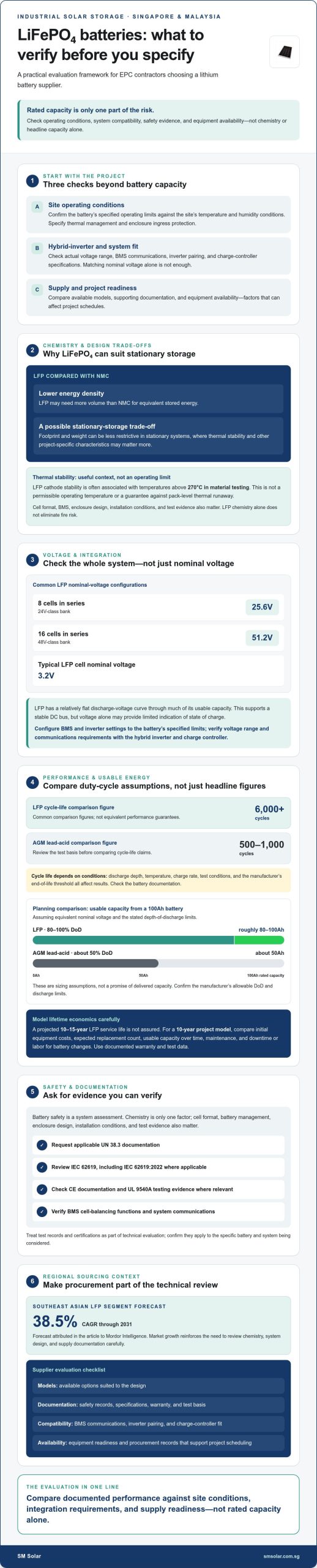
Lithium iron phosphate (LiFePO4, or LFP) uses a phosphate-based cathode with an olivine crystalline structure. This differs from the layered oxide cathodes used in nickel manganese cobalt (NMC) batteries. LFP generally has lower energy density than NMC, so a system may need more volume for equivalent stored energy. For stationary storage, where footprint and weight can be less restrictive than in vehicles, that trade-off may be acceptable in return for thermal stability and other project-specific performance characteristics. The Technical Fundamentals of LiFePO4 provide further background on its chemistry and applications.
LFP is also relevant to industrial decarbonization strategies that pair solar generation with dispatchable storage. Mordor Intelligence forecasts the Southeast Asian LFP segment to grow at a 38.5% CAGR through 2031. For EPCs, that trend reinforces the need to review cell chemistry, system design, and supply documentation carefully.
Chemical Stability and Thermal Runaway Resistance
The phosphate framework contains strong phosphorus-oxygen bonds that help stabilize the cathode as temperature rises. Compared with layered oxide cathodes, LFP is less prone to releasing oxygen during thermal decomposition, which can reduce one factor that intensifies combustion. LFP cathode stability is often associated with temperatures above 270°C in material testing. This is not a permissible operating temperature or a guarantee against pack-level thermal runaway.
Chemistry is only one part of a fire-safety assessment. Cell format, battery management, enclosure design, installation conditions, and test evidence also matter. Commercial building owners and insurers may assess these controls as part of project risk review. LFP chemistry alone doesn’t determine insurance terms or eliminate fire risk.
Voltage Characteristics and Discharge Curves
LFP cells have a relatively flat discharge-voltage curve through much of their usable capacity. This supports a stable DC bus and can simplify inverter control, but it also means voltage alone may provide limited indication of state of charge. Configure the BMS and inverter settings to the battery’s specified operating limits.
A typical LFP cell has a nominal voltage of 3.2V. Common nominal architectures use eight cells in series for a 24V-class bank, or 16 cells for a 48V-class bank, giving nominal pack voltages of 25.6V and 51.2V, respectively. Confirm the battery’s actual voltage range and communications requirements against the hybrid inverter and charge controller specifications. A lithium LiFePO4 battery supplier should provide system-level details for compatibility checks, not just the cell’s nominal voltage.
Performance Metrics: Why LiFePO4 Outlasts Traditional Lead-Acid
Battery selection should be based on usable energy and lifetime duty, not amp-hour rating alone. Common comparison figures put LFP cycle life at 6,000+ cycles and AGM lead-acid at 500–1,000 cycles, but these are not equivalent guarantees. Test conditions, discharge depth, temperature, charge rate, and the manufacturer’s end-of-life threshold all affect the result. Review the test basis in the battery documentation. The LiFePO4 technical performance characteristics provide an engineering reference for evaluating performance claims.
For a 10-year project model, compare initial equipment costs, expected replacement count, usable capacity over time, maintenance requirements, and any downtime or labor associated with battery changes. Don’t treat a projected 10–15-year LFP service life as assured. Actual service life depends on cycling and operating conditions, so use the selected battery’s documented warranty and test data in your model. Ask a lithium LiFePO4 battery supplier for the specifications needed to make that comparison.
Depth of Discharge and Usable Capacity
Depth of discharge (DoD) determines how much of rated capacity is available per cycle. As a planning comparison, 80–100% DoD for LFP versus about 50% for lead-acid means a 100Ah battery could provide roughly 80–100Ah for LFP, compared with about 50Ah for AGM, assuming equivalent nominal voltage and the stated DoD limits. These are sizing assumptions, not a promise of delivered capacity. Confirm the manufacturer’s allowable DoD and discharge limits.
Repeated deep discharge can affect capacity retention, with the impact varying by chemistry and product. Size the bank against the project’s daily load, solar yield, required autonomy, inverter limits, and reserve margin. Greater usable capacity per unit can reduce the number of batteries required, but roof-mounted or elevated enclosures still need structural-load verification. LFP generally offers lower weight for equivalent usable capacity than lead-acid, which may help constrain mounting loads. Compare actual battery mass and energy ratings before finalizing the layout.
Cycle Life and Longevity Standards
End of Life (EoL) is often defined for comparison as the point when capacity falls to 80% of its initial rated value, but check the applicable test protocol and warranty definition. Daily cycling places cumulative demand on cells, and high temperature or deep discharge can change capacity fade. Model expected lifetime using the actual duty profile rather than cycle count alone.
Cycle life is the number of completed charge-discharge cycles a battery delivers before reaching its defined capacity-retention threshold, and it helps estimate replacement frequency for industrial projects. For project-specific comparisons, review LFP battery specifications alongside compatible hybrid inverters and charge controllers. SM Solar’s solar energy components include these equipment categories.
Critical Safety Standards and BMS Requirements for LFP Systems
A safe LFP installation depends on coordinated controls, not chemistry alone. The battery management system (BMS) monitors cell conditions and can restrict charging or discharging when parameters exceed configured limits. It should work with the hybrid inverter and solar charge controller, while correctly rated external protection addresses faults such as overcurrent and short circuit.
Evaluate compliance documents by purpose. UN 38.3 covers testing relevant to lithium battery transport. Request the applicable test summary and confirm it matches the battery model being shipped. IEC 62619:2022 is an international safety standard for industrial lithium batteries. UL 9540A is a test method used to evaluate thermal runaway fire propagation in battery energy storage systems. CE marking indicates a manufacturer’s conformity declaration for applicable European requirements. It is not a substitute for checking which standards and approvals apply to a specific project in Singapore or Malaysia.
The Role of the Battery Management System
An integrated BMS tracks cell-level voltage and temperature, balances cells, and manages protective responses for over-voltage, under-voltage, over-temperature, and overcurrent conditions. Passive balancing dissipates excess energy from higher-voltage cells; active balancing transfers energy between cells. Neither method is universally required for every industrial bank. Assess balancing capability, current limits, monitoring coverage, and service access against the bank’s size and operating profile.
Communication matters as much as protection. RS485 and CANbus are common interfaces, but matching the connector or protocol name alone doesn’t establish compatibility. Confirm that the inverter supports the battery’s specific communication profile, signal mapping, and firmware requirements. If the BMS and inverter don’t exchange valid limits and status data, the system may operate with restricted functionality or rely on fallback settings. Verify charge and discharge limits with the solar charge controller as well.
Regulatory Compliance for Singapore and Malaysia
Project teams should confirm applicable fire-safety, installation, and energy-storage requirements with the relevant authorities and qualified project professionals. In Singapore, check current SCDF requirements for the proposed site and system configuration rather than assuming one rule applies to every battery installation. In Malaysia, verify requirements with the relevant local authorities and project stakeholders. IEC 62619 provides industrial battery safety evidence, but it doesn’t by itself establish site approval.
For regional logistics, request UN 38.3 documentation before shipment planning and ensure the paperwork corresponds to the exact battery configuration. A lithium LiFePO4 battery supplier should also provide the battery datasheet, BMS communication details, and applicable conformity documents. Keep these records with commissioning and system-integration documentation so EPC teams can verify product compliance and inverter compatibility.
Implementation Factors for Singapore and Malaysia Solar Projects
In Singapore and Malaysia, battery performance depends on installation conditions as well as cell specifications. High ambient temperatures can accelerate capacity fade when a battery operates above its recommended temperature range, while humidity and wind-driven rain can challenge exposed enclosures, connectors, and cable entries. Use the manufacturer’s temperature limits and derating data to assess the actual site. Don’t treat LFP chemistry as protection against tropical conditions.
Outdoor and elevated installations need coordinated mechanical and environmental planning. Confirm that the mounting structure can support the battery’s mass and operating loads, and provide clearance for inspection and maintenance. Where practicable, position enclosures away from direct solar gain, with suitable rain shielding, drainage, and cable-entry sealing. An IP rating indicates defined protection against dust and water ingress under test conditions. It doesn’t by itself establish resistance to condensation, salt exposure, or corrosion.
Thermal Management in Tropical Climates
For 30°C+ sites, compare expected enclosure temperatures with the battery’s specified operating and storage ranges. Passive measures include shaded placement, ventilation clearances, and enclosure layouts that avoid trapping heat. Active ventilation may help where passive airflow is insufficient, but it must suit the enclosure’s ingress-protection design and local humidity. Avoid directing hot inverter exhaust toward the battery, and follow the manufacturer’s spacing and airflow requirements.
Hardware Integration and Compatibility
System design should coordinate PV array output, battery charge limits, and inverter operating modes. Monocrystalline solar panels can supply the PV input, while a compatible hybrid inverter manages energy conversion and grid-connected or off-grid operation as supported by the selected equipment. Verify voltage windows, charge profiles, and operating limits across the full hardware set.
An MPPT solar charge controller can track the PV array’s maximum power point, but its battery profile and output limits must match the LFP battery specifications. Select solar circuit protection for the system’s voltage, current, and fault conditions. Don’t assume components are compatible based only on nominal voltage. Check manufacturer documentation and communications requirements before procurement.
For EPC teams, evaluating a lithium LiFePO4 battery supplier alongside compatible hybrid inverters, charge controllers, and solar circuit protection can help identify integration gaps before equipment reaches the site. SM Solar distributes these solar components in Singapore and Malaysia. Review solar battery and inverter options for your project’s hardware assessment.
Sourcing and Procurement: Choosing a lithium LiFePO4 battery supplier in Singapore and Malaysia
Supplier evaluation should cover more than battery specifications. Direct-from-factory procurement may suit projects with established import processes and predictable order volumes, while a regional distributor can provide a closer point of coordination and access to multiple solar component categories. Neither route guarantees shorter lead times. Before committing equipment to a project timeline, confirm current stock, order allocation, shipment schedule, documentation, and responsibility for warranty claims.
For EPC procurement, compare the complete system bill of materials. A supplier offering lithium LiFePO4 batteries, hybrid inverters, solar charge controllers, monocrystalline panels, and solar circuit protection can help teams check component availability and interface requirements across a project. Also confirm warranty terms, claim procedures, and how to obtain technical documents. These checks clarify what support is available without assuming that every distributor provides the same services.
Logistics and Supply Chain Stability
Regional distribution can reduce reliance on a single international shipment, but verify stock location and quantity for each order. Ask for written confirmation of available models, quantities, dispatch arrangements, and project-specific documentation. For bulk procurement, align purchase batches with the construction schedule, confirm that battery and inverter configurations remain consistent, and establish how substitutions will be approved. These controls help limit procurement surprises without relying on unverified delivery promises.
Assess quality and compliance through model-specific records, not general supplier statements. Request relevant test documents, datasheets, BMS communication details, and warranty conditions. Confirm that the documents match the exact battery configuration being procured and that the project team can obtain them for review.
SM Solar: Your Regional Hardware Distribution Partner
SM Solar is a Singapore-based supplier of solar energy components and hardware, serving Singapore and Malaysia. Founded in 2008, the business distributes lithium LiFePO4 batteries, hybrid inverters, solar charge controllers, monocrystalline panels, solar circuit protection, and mounting hardware. This range gives EPC teams a regional supplier to consider when coordinating battery procurement with related solar equipment. Confirm current availability, technical documentation, and warranty processes directly for your project.
For project-specific evaluation, contact SM Solar about product specifications and procurement.
Build Your Next Solar Project on a Verified Supply Plan
Industrial battery procurement is a system decision. Assess chemistry and cycle-life claims against operating conditions, and check safety documentation, BMS communications, and inverter compatibility before specifying equipment. In Singapore and Malaysia, thermal and humidity conditions also make enclosure selection and installation planning central to long-term performance.
A lithium LiFePO4 battery supplier should be evaluated on the documentation, hardware interfaces, warranty process, and regional availability relevant to your project. SM Solar supplies solar energy components and hardware in Singapore and Malaysia, including LiFePO4 batteries and related solar equipment.
Contact SM Solar to discuss LiFePO4 batteries and compatible solar hardware for your project.
Frequently Asked Questions
Is LiFePO4 safer than other lithium battery chemistries for industrial use?
LiFePO4 generally offers greater thermal stability than nickel manganese cobalt (NMC) chemistry, partly because its phosphate cathode is less prone to oxygen release during thermal decomposition. That reduces one factor that can intensify combustion, but it doesn’t make a battery fireproof. For industrial projects in Singapore and Malaysia, assess the complete system, including BMS protections, installation design, and applicable safety test documentation.
How long do LiFePO4 batteries typically last in the Singapore climate?
There’s no single service-life figure that applies to every LiFePO4 battery in Singapore. Lifetime depends on cell quality, operating temperature, depth of discharge, cycling frequency, and charging conditions. Heat can accelerate capacity degradation if the battery operates outside its specified range. Compare the manufacturer’s cycle-life test conditions, end-of-life capacity threshold, temperature limits, and warranty terms with the site’s expected duty profile.
Can I use an existing lead-acid charger for new LiFePO4 batteries?
Don’t assume an existing lead-acid charger is suitable. Confirm that its charging voltage and profile match the LiFePO4 battery’s specifications and that it won’t apply incompatible equalization or desulfation modes. Check the charger’s low-voltage behavior and its coordination with the battery management system (BMS). For a solar installation, verify the settings of both the charger or charge controller and the inverter before commissioning.
What certifications should I look for when sourcing LFP batteries for Malaysia?
Request UN 38.3 transport test documentation for the exact battery model and review IEC 62619 safety documentation for industrial lithium batteries. CE marking is a manufacturer’s conformity declaration for applicable European requirements; it isn’t, by itself, proof of Malaysian project approval. Ask the lithium LiFePO4 battery supplier for matching datasheets and test records, then confirm project-specific requirements with the relevant authorities and stakeholders in Malaysia.
Why is a BMS critical for solar-coupled LiFePO4 storage systems?
A BMS monitors cell voltage and temperature, balances cells, and manages protective responses to operating conditions such as over-voltage and under-voltage. In solar storage, it also helps coordinate safe charge and discharge limits with the inverter or charge controller. Check that communication settings and supported protocols match the system hardware. Without a verified interface, equipment may not exchange battery limits or status data correctly.
What is the typical depth of discharge (DoD) for an industrial LFP battery?
Specified usable DoD commonly falls within an 80–100% range for LFP systems, but the permitted value depends on the battery model and operating requirements. A higher DoD can increase usable energy per rated capacity, but it shouldn’t be treated as a universal design target. Check the manufacturer’s DoD limits, cycle-life test conditions, and warranty definition, then size the bank for the actual load and reserve requirement.
How do LiFePO4 batteries handle high-humidity environments in the tropics?
LiFePO4 cells don’t remove the need to protect battery enclosures and electrical connections from moisture. In Singapore and Malaysia, select an enclosure with an ingress-protection rating suited to the installation’s exposure, and assess cable entries, seals, drainage, and condensation risk. An IP rating doesn’t establish resistance to internal condensation or corrosion. Follow the battery manufacturer’s environmental limits and installation instructions for outdoor or humid sites.
Are LiFePO4 batteries compatible with all hybrid solar inverters?
No. Compatibility depends on the inverter’s voltage and current limits, charging profile, battery settings, and BMS communications. Confirm the specific battery model appears in the inverter’s compatibility documentation, or obtain written technical confirmation from the relevant manufacturers. Check CANbus or RS485 requirements, firmware, and configuration parameters before procurement. SM Solar supplies LiFePO4 batteries and hybrid inverters in Singapore and Malaysia, but system pairing should still be verified for each project.