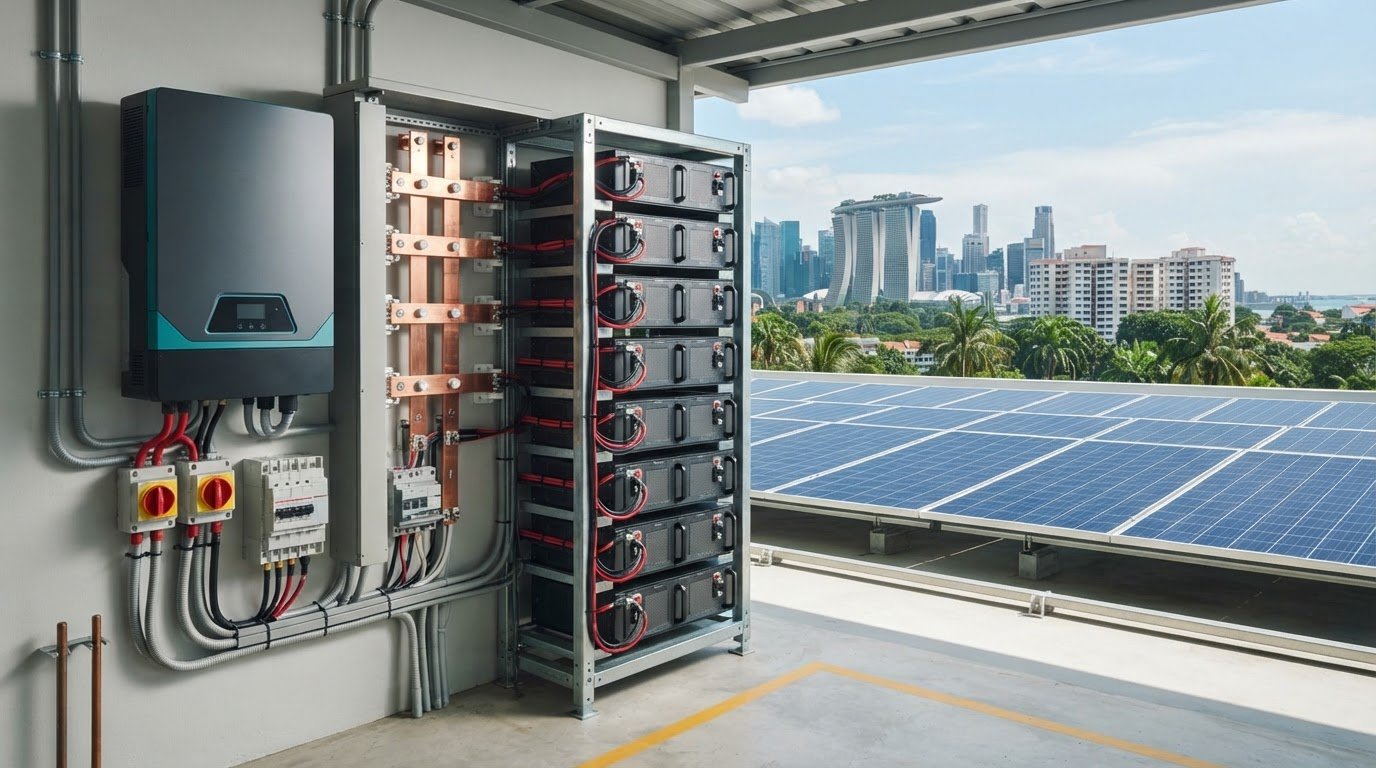
A battery marked 48V can still be the wrong match for a storage system. For 48V LiFePO4 battery storage, nominal voltage alone doesn’t confirm compatibility. Inverter voltage limits, battery management system (BMS) communications, and discharge requirements all affect system operation.
The procurement challenge is to compare usable capacity, continuous and peak discharge limits, protection features, and operating conditions, then verify that the battery and inverter can communicate using a supported protocol. A mismatch may only become apparent during commissioning, not on a specification sheet.
This guide explains how to screen battery options against inverter requirements, system loads, and project conditions in Singapore and Malaysia. It covers the technical documents and integration checks to request before procurement, along with factors to consider for local installations. You’ll also find a practical framework for shortlisting suppliers and confirming current specifications and availability. SM Solar, a Singapore-based solar hardware supplier, supplies LiFePO4 batteries, hybrid inverters, and related components for project teams evaluating system equipment.
Key Takeaways
- Assess 48V LiFePO4 battery storage by its operating-voltage range, not the nominal voltage label alone.
- Check inverter and charge-controller limits alongside BMS communication protocols before selecting equipment.
- Compare rated capacity with usable energy, continuous power, peak current, cycle-life test conditions, and warranty terms.
- Define the project’s load profile, autonomy target, charging source, and expansion needs before finalising capacity.
- Request model-specific datasheets, environmental limits, compatibility confirmation, and relevant documentation before procurement.
What 48V LiFePO4 Battery Storage Means for a Solar System
Definition: A 48V LiFePO4 battery system is an energy-storage assembly that uses lithium iron phosphate cells, belongs to a nominal voltage class commonly labelled 48V, and stores electrical energy for use through a compatible power system.
The label identifies a category, not a complete performance specification. It doesn’t tell you how much energy the system can deliver, what power it can sustain, or whether it will operate correctly with a particular inverter. Those values depend on the battery model, system design, and documented operating limits. Lithium iron phosphate (LFP) batteries use a distinct battery chemistry, but chemistry alone doesn’t confirm system compatibility.
Nominal voltage, operating voltage, and battery configuration
Nominal voltage is a representative class value. Operating voltage varies as the battery charges and discharges, within the limits specified by its manufacturer. The selected inverter must support the battery’s full operating-voltage range, not just match the “48V” label. Compare the battery and inverter datasheets before confirming a match.
Series and parallel arrangements also affect system voltage and capacity. Use only configurations allowed by the battery manufacturer and supported by the system design. Don’t assume batteries can be combined simply because they share a nominal voltage. Model-specific limits, connections, and control requirements matter.
Where 48V LiFePO4 storage fits in project design
Start with the project objective. Size backup storage around the critical loads and required backup duration. Assess self-consumption storage against the timing of solar generation and site demand. Off-grid systems must account for loads and charging sources across the intended operating period. Each objective leads to different capacity and power requirements.
A solar storage system may connect a battery with an inverter, solar charge controller, circuit protection, and monitoring equipment. The exact arrangement depends on the equipment architecture. BMS settings and communications must also align with the inverter and any controller. Usable capacity and output power are model- and configuration-specific, and may be constrained by current limits and operating conditions.
For broader sourcing considerations, see the LiFePO4 battery supplier guide. Treat 48V LiFePO4 battery storage as a system specification to verify, not a plug-and-play category. Compare documented voltage, capacity, power, and integration requirements before shortlisting equipment.
How 48V LiFePO4 Batteries Integrate with Inverters and Solar Equipment
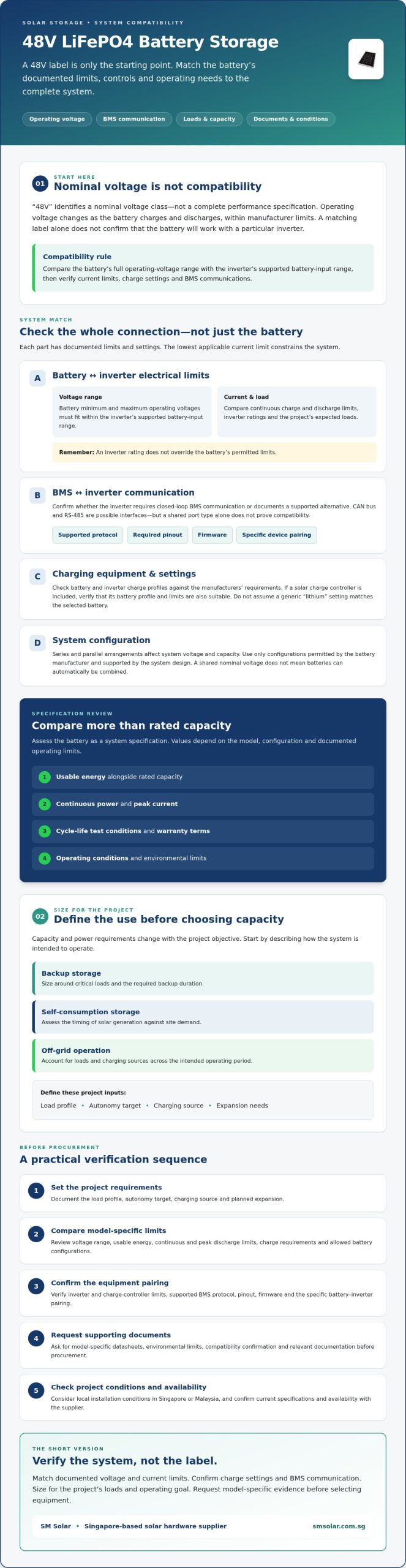
A battery and inverter connect on the system’s DC side, but matching their nominal voltage labels isn’t enough. The battery’s operating-voltage range must fall within the inverter’s documented battery-input range. Current limits matter too: the battery’s permitted charge and discharge currents, inverter ratings, and project load must align. The lowest applicable limit constrains the system.
Compatibility rule: Verify the complete set of interfaces and limits, not voltage alone. For 48V LiFePO4 battery storage, check electrical limits, charge settings, communications, and the other equipment connected to the system.
Inverter voltage range, current limits, and charging settings
Compare the selected battery’s minimum and maximum operating voltages with the inverter’s supported battery-input range. Then review continuous charge and discharge current limits. The inverter’s ratings don’t override the battery’s limits, and the required output must be assessed against the site’s expected loads.
Confirm charge profiles and configuration values in both manufacturers’ documentation. Settings must stay within the battery’s specified operating requirements. If the system includes a charge controller, check that its battery profile and limits are also suitable. Don’t rely on a generic “lithium” setting without confirming that it matches the selected battery.
BMS communications and system components
Determine whether the inverter requires closed-loop communication with the BMS or documents a supported alternative. CAN bus and RS-485 are possible interfaces, but they don’t prove compatibility by themselves. Verify the protocol supported by each device, along with the required pinout, firmware, and specific battery-inverter pairing. A shared port type doesn’t guarantee that devices exchange data correctly.
Include all connected equipment in the review. Check how the battery, inverter, charge controller, monitoring equipment, and solar circuit protection coordinate, and identify which device controls charging and limits. Confirm any required configuration or commissioning steps in the relevant manuals before procurement.
- Voltage: Battery operating range fits the inverter input range.
- Current: Charge and discharge limits support the intended operating conditions.
- Settings: Charge profiles match documented battery requirements.
- Communications: Protocol, pinout, firmware, and device compatibility are confirmed.
For project teams comparing batteries and hybrid inverters, SM Solar’s solar hardware range can help identify equipment options. Confirm current specifications and compatibility documentation for the exact components under consideration.
How to Compare 48V LiFePO4 Battery Storage Specifications
Compare batteries using the same specification fields and test conditions. A headline capacity or cycle-life figure isn’t enough to establish project fit. For each 48V LiFePO4 battery storage option, record what the manufacturer specifies, how it was tested, and whether the information appears in a current, model-specific datasheet. Mark missing or non-equivalent values rather than treating them as equal.
| Specification | What to record | Comparison check |
|---|---|---|
| Nominal voltage | Manufacturer-stated system voltage class | Compare with the intended system design. |
| Rated capacity | Amp-hour (Ah) rating and stated test conditions | Check that the rating basis is consistent. |
| Usable energy | Manufacturer-published usable kilowatt-hours (kWh) | Keep distinct from rated capacity and nominal energy. |
| Continuous output | Continuous current and power limits | Assess against sustained project demand. |
| Peak output | Peak current or power, plus permitted duration | Compare against short-duration load requirements. |
| Life and environment | Cycle-life conditions, temperature and humidity limits | Check test basis and installation conditions. |
| Protection and records | BMS functions, communications, enclosure, certifications and warranty terms | Verify against project requirements and supporting documents. |
Capacity, usable energy, and discharge capability
Amp-hours describe charge capacity; kilowatt-hours describe energy. As a screening calculation, multiply the documented nominal voltage by rated amp-hours and divide by 1,000 to estimate nominal energy in kWh. This isn’t the same as usable energy. Check the manufacturer’s usable-energy figure and permitted depth of discharge rather than assuming all nominal energy can be drawn.
Compare continuous power with expected sustained demand. Assess peak loads separately, including the stated duration of any peak rating. Don’t infer runtime from capacity alone: actual performance depends on load, operating limits, and system configuration.
Life, environmental limits, protection, and documentation
Cycle-life claims are comparable only when depth of discharge, temperature, and other test conditions are disclosed and sufficiently aligned. Record operating temperature and humidity limits, enclosure details, and any derating guidance for the intended installation location. Check BMS protection functions and communication details against system needs.
Before ranking options, request the current datasheet, applicable certification documents, warranty terms, and traceable product identification. If a value is absent, unclear, or based on different test conditions, label it accordingly. A transparent comparison is more useful than a ranking built on unmatched specifications.
What to Check Before Installing 48V LiFePO4 Storage in Singapore or Malaysia
Site conditions and project requirements determine whether a battery specification is suitable in practice. Before procurement or installation, document the intended operating profile and have qualified project professionals verify the electrical design, manufacturer limits, and requirements that apply to the specific site. Projects in Singapore and Malaysia should not rely on generic assumptions about approvals or installation conditions.
Pre-installation project checklist
- 1. Load profile: Identify the loads the system must support, including expected operating patterns and any short-duration demand peaks.
- 2. Autonomy target: Define how long the battery should support the intended loads and the operating conditions that apply to that target.
- 3. Charging source: Confirm whether charging comes from solar, another source, or a combination. Then check that the proposed equipment and settings support it.
- 4. Expansion plans: Record whether future capacity additions are expected. Verify permitted battery configurations and expansion limits with the manufacturer before specifying the system.
- 5. Site environment: Obtain the manufacturer’s temperature, humidity, ventilation, enclosure, and derating limits. Compare these with measured or expected conditions at the proposed location.
- 6. Local requirements: Ask the project’s qualified professionals to identify applicable codes, approvals, and authority requirements for the equipment, site, and system configuration in Singapore or Malaysia.
Site conditions and electrical design checks
Assess the exact installation location, including enclosure rating, airflow, ambient conditions, and access for inspection and maintenance. Heat and humidity can affect equipment operation, so use the battery manufacturer’s documentation to determine whether site conditions require derating or other design measures. Don’t assume an indoor or sheltered location automatically meets equipment limits.
The electrical designer should confirm cable sizing, overcurrent protection, disconnects, grounding, and fault-current requirements for the complete system. These decisions depend on equipment specifications and installation design. A 48V LiFePO4 battery storage project should not proceed on battery voltage alone or on generic wiring assumptions.
Commissioning and handover
Before operation, qualified professionals should verify polarity, system voltage, communications, protection coordination, and configured charge limits against the approved design and manufacturer instructions. Record commissioning settings, equipment identifiers, datasheets, and operating instructions in the project file. Agree with the system owner who handles monitoring, inspections, fault response, and maintenance.
Project teams reviewing batteries and related solar components can contact SM Solar to confirm current product specifications and compatibility documentation.
How to Specify and Source 48V LiFePO4 Battery Storage
A procurement specification turns project requirements into criteria suppliers can answer and project teams can verify. For 48V LiFePO4 battery storage, specify operating requirements rather than relying on a voltage label or general product description. This makes proposals easier to compare and helps identify missing compatibility or environmental information before purchase.
Prepare a project-ready battery specification
Start with the application and site design. State the DC bus requirements, target usable energy, load profile, charging source, and expected expansion path. Record the installation environment and the manufacturer limits the equipment must meet.
Include the connected equipment and acceptance criteria in the specification:
- Battery: Required operating-voltage range, rated capacity, usable energy, continuous and peak current, and permitted configuration.
- Inverter and controls: Inverter model, battery input range, communication interface and protocol, and required charge settings. Include the charge controller where relevant.
- Protection and environment: Required protection equipment, ambient temperature and humidity conditions, enclosure requirements, and manufacturer derating limits.
- Documents and verification: Model-specific datasheet, BMS communication details, applicable certification documents, warranty terms, and written compatibility confirmation.
- Project acceptance: Required documentation and checks before equipment acceptance, plus approvals or local requirements to verify for the specific site.
Evaluate the supplier and confirm the next step
Check that the proposed model, datasheet, product identification, and quoted specifications refer to the same equipment. Request confirmation that the battery’s voltage, current limits, communications, and charge requirements align with the project design and equipment documentation. Record any missing or unclear specifications as unverified.
For projects in Singapore or Malaysia, confirm delivery coverage, lead times, applicable product documentation, and the supplier’s stated support scope directly. These details can vary by product and project, so retain supplier responses with the procurement record.
SM Solar is a Singapore-based supplier of LiFePO4 batteries, hybrid inverters, solar charge controllers, and related components. Project teams can review SM Solar’s solar equipment range and confirm current product options, specifications, compatibility documentation, availability, and project supply fit directly.
Move from Battery Shortlist to Verified System Design
A suitable 48V LiFePO4 battery storage option is defined by the complete system match, not its voltage label alone. Use documented capacity, current limits, operating conditions, and communications to compare candidates. Then confirm that the battery, inverter, charge controller, and protection equipment meet the project’s requirements.
Before procurement, turn those checks into a written specification and request model-specific documentation and compatibility confirmation. For projects in Singapore or Malaysia, have qualified project professionals verify site conditions and applicable requirements, and confirm supply details directly with the supplier.
SM Solar supplies LiFePO4 batteries, hybrid inverters, and solar charge controllers. Review SM Solar’s solar equipment range and confirm current product specifications, documentation, and availability for your project. With a verified equipment match and clear requirements, your team can make a more informed procurement decision.
Frequently Asked Questions
Is a 48V LiFePO4 battery compatible with every 48V inverter?
No. The 48V label alone doesn’t establish compatibility. Compare the battery’s operating-voltage range and charge and discharge current limits with the inverter’s documented input range and ratings. Then verify BMS communication protocol, wiring, firmware, and configuration requirements for the exact equipment models. If manufacturer documentation doesn’t clearly confirm the pairing, request written compatibility confirmation before procurement. Don’t assume two devices will communicate or operate correctly because both are labelled 48V.
Can 48V LiFePO4 batteries be connected in parallel?
Some models permit parallel connection, but the approved unit count and wiring method depend on the battery and system design. Check manufacturer instructions for BMS coordination, current sharing, cable requirements, configuration, and inverter support. Don’t combine different models or batteries in different conditions unless the manufacturer explicitly allows it. Have the system designer verify protection and commissioning requirements for the complete battery bank before connecting equipment or planning an expansion.
How much energy does a 48V LiFePO4 battery store?
Stored energy depends on the battery’s documented voltage and amp-hour capacity, while usable energy depends on permitted depth of discharge and system limits. For 48V LiFePO4 battery storage, use the specific model’s datasheet rather than estimating from its voltage label. Record rated and usable energy separately, then compare continuous power and current limits with the expected loads and inverter specifications. Capacity alone doesn’t establish how long a battery can support a particular system.
What happens if a 48V battery and inverter use incompatible communications?
The battery and inverter may fail to exchange status or control information as intended. Depending on the equipment, this could prevent operation, restrict charging, or require a different configuration documented by the manufacturers. Check protocol support, wiring, pinout, firmware, and settings for both devices before procurement. Don’t bypass BMS protections or apply undocumented settings. If the integration path isn’t clear, ask the relevant equipment suppliers to confirm an approved configuration in writing.
Is 48V LiFePO4 battery storage suitable for Singapore or Malaysia conditions?
Suitability depends on the selected model’s documented temperature, humidity, enclosure, ventilation, and derating limits, compared with the actual site environment. Don’t infer regional suitability from the battery’s voltage or chemistry. For a project in Singapore or Malaysia, have qualified project professionals verify site conditions, electrical design, and applicable local codes, approvals, and authority requirements. Confirm requirements for the specific project location before installation and commissioning.
What specifications should I compare when sourcing a 48V LiFePO4 battery?
Compare operating-voltage range, rated capacity, usable energy, continuous and peak current, BMS functions, communications, and environmental limits. Review cycle-life claims alongside their stated test conditions, and check warranty terms and applicable certification documents. Request a model-specific datasheet and confirm compatibility with the intended inverter and controller. For procurement in Singapore or Malaysia, also verify product identification, documentation, delivery coverage, and current availability directly with the supplier.